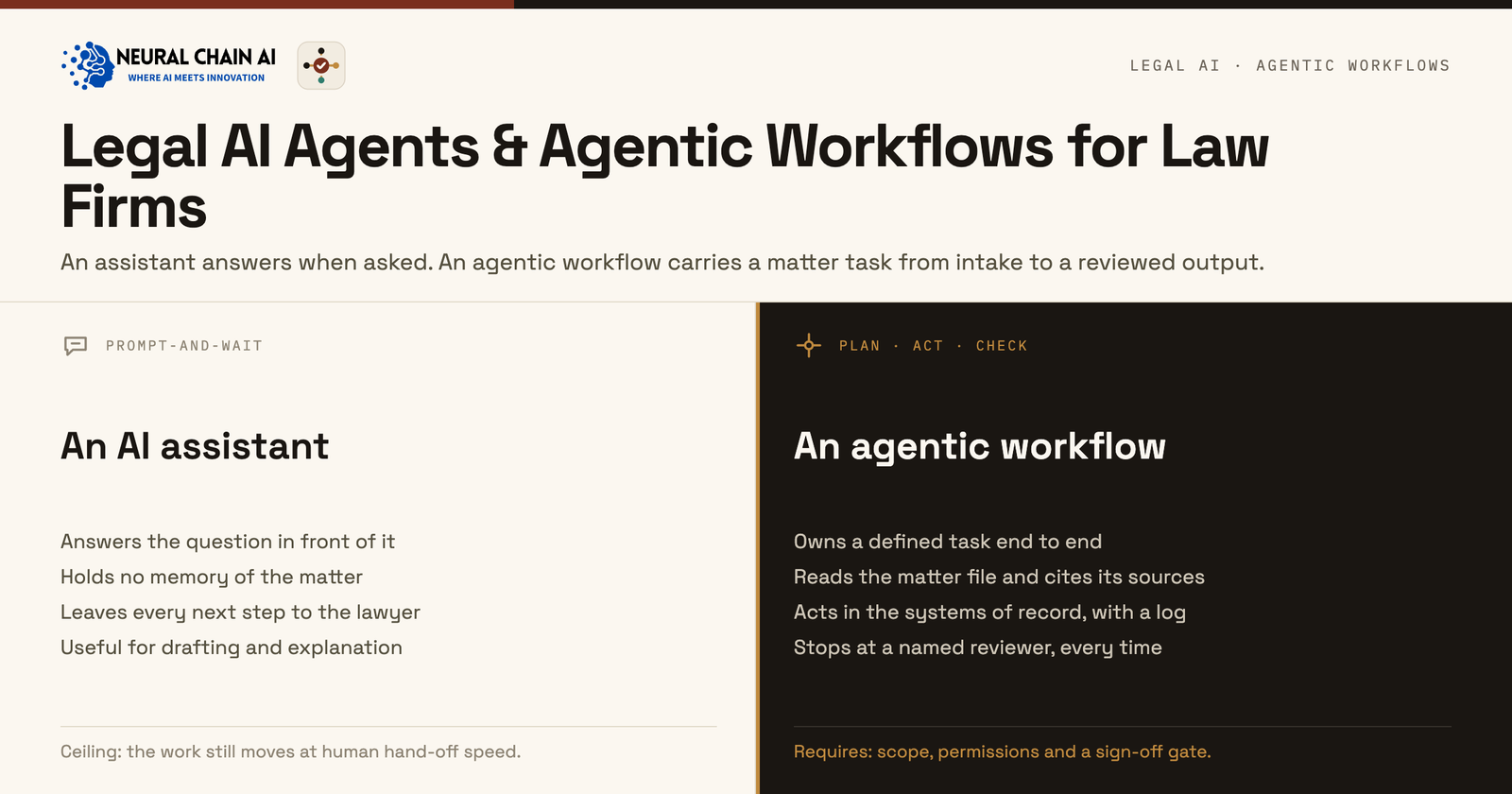
Legal AI agents run multi-step paralegal workflows end to end. An AI model plans the steps, calls the firm’s tools (document management, the review platform, the calendar, case management), keeps notes across the matter and hands each result to a paralegal or lawyer for sign-off. This guide covers the five paralegal workflows legal AI agents run best in 2026, how an agentic workflow is built, where people approve each step, and how law firms deploy legal AI agents privately on their own systems.
Agentic AI is moving into mainstream business software. Gartner predicts that 33% of enterprise software applications will include agentic AI by 2028, up from under 1% in 2024, and that at least 15% of day-to-day work decisions will be made autonomously through AI agents by the same year. In law firms the natural starting point is paralegal work, because it is document-heavy, multi-step and already structured around attorney review. A chat assistant answers one prompt at a time. A legal AI agent works through a sequence (find, read, extract, draft, file) and pauses at the points the firm defines.
How a Legal AI Agent Works
Every legal AI agent combines five parts. The design choices inside each one decide how much work the agent can take on and how easy it is to supervise.
The model. An LLM reads the matter documents, plans the next step and writes drafts. Firms running agents privately use open-weight models served on their own GPUs, often with a smaller, faster model for routine steps such as classification.
Tools. The agent acts through tool calls: search the document management system, open a file, query the review platform, save a draft to a matter folder, propose a calendar entry. Each tool carries its own permission, so an agent can read broadly and write only where the firm allows.
Planning. Given a goal such as preparing a deposition outline for a named witness, the agent breaks it into steps, runs them in order and re-plans when a step returns something unexpected, such as a transcript that cites an exhibit the agent has yet to find in the matter folder.
Memory. The agent keeps a working record of the matter: what it has read, what it extracted and which questions remain open. Retrieval over the firm’s documents supplies the facts, with a citation for each one.
Checkpoints and logs. The firm decides where the agent stops for approval, and every step (the prompt, the tool call, the documents used, the output) is logged so a reviewer can trace how the AI produced a result.
Five Paralegal Workflows Legal AI Agents Run End to End in 2026
The best workflows for AI agents have many repeatable steps, clear source documents and a natural review point at the end.
1. Discovery first-pass review
The agent pulls the collection from the review platform, groups near-duplicates and email threads, runs a classification model for relevance and privilege, writes a one-line reason for each call and assembles a ranked review queue with a summary of the key documents. A lawyer makes the privilege decisions and samples the low-ranked set. On large matters this runs as a self-hosted AI eDiscovery layer on the firm’s existing review platform.
2. Deposition preparation
Given a witness name, the agent searches the matter for every document the witness authored, received or appears in, builds a chronology of those documents, summarizes prior testimony with page-line citations and drafts a topic outline with exhibit references. The attorney refines the outline and chooses the exhibits. Deposition work is a core use of AI for litigation, because the agent’s output is easy to check against the cited pages.
3. Chronology building and cite-checking
The agent extracts dated events from pleadings, correspondence and records, merges duplicates, links each entry to its source page and flags entries where two documents give different dates. On a brief, it checks each record cite against the cited page and lists the cites a person should review.
4. Contract review inside a matter
When a dispute turns on agreements, the agent finds every contract in the file, extracts the clauses the firm’s playbook covers (term, termination, indemnity, assignment, governing law), compares each one to the playbook position and drafts an issues list with clause citations. The lawyer decides which issues matter for the case.
5. Intake and matter setup
The agent reads the intake email and attachments, extracts parties and related entities, runs the conflicts search, opens the matter in case management with the extracted fields, files the documents into the right folders and drafts the engagement letter from the firm’s template. A paralegal clears conflict hits and approves the new matter before anything goes to the client.
Legal AI Agent Workflows at a Glance
The table shows the steps each AI agent runs, the tools it calls and where a person signs off.
| Workflow | Steps the AI agent runs | Tools it calls | Human checkpoint |
|---|---|---|---|
| Discovery first-pass review | Group, classify, explain, rank, summarize | Review platform, classification model | Lawyer makes privilege calls and samples low-ranked documents |
| Deposition preparation | Search, build chronology, summarize testimony, draft outline | Document management, transcript store | Attorney edits the outline and picks exhibits |
| Chronology and cite-checking | Extract dates, merge, link sources, check cites | Document management, brief drafts | Paralegal resolves flagged entries and cites |
| Contract review in a matter | Find contracts, extract clauses, compare to playbook, draft issues list | Document management, firm playbook | Lawyer decides which issues matter |
| Intake and matter setup | Extract parties, run conflicts, open matter, file documents, draft engagement letter | Email, conflicts database, case management | Paralegal clears conflicts and approves the matter |
Autonomy Levels and Human Checkpoints for Legal AI Agents
ABA Formal Opinion 512, issued July 29, 2024, expects managerial lawyers to set clear policies on permissible generative AI use and supervising lawyers to make sure nonlawyer staff are trained in its ethical and practical use. For AI agents, the cleanest way to put that into practice is to set an autonomy level for each action, so supervision is designed into the workflow from the start.
Suggest. The agent proposes a step, and a person runs it. This level suits privilege calls and anything sent outside the firm.
Draft for approval. The agent completes the work product, and a person approves it before it is used. This level suits deposition outlines, issues lists and engagement letters.
Act and report. The agent completes the step and logs it for review. This level suits internal, reversible steps such as filing documents into matter folders or building a draft chronology.
Most firms start every action at draft for approval and move individual steps to act and report once the logs show consistent accuracy. Actions that reach clients, courts or opposing counsel, such as emails, filings and productions, stay at suggest or draft for approval.
State bars are starting to write agent-specific checkpoints into their guidance rather than leaving firms to infer them from general AI rules. The Oregon State Bar’s February 2026 opinion on chatbots and AI agents looks directly at agents handling client intake, and Alabama’s Formal Opinion 2026-01, issued in May 2026, covers agentic AI use and bars firms from billing clients for time an AI agent saved. Both point the same direction as the autonomy levels above: keep a lawyer in the loop on anything client-facing.
How to Evaluate a Legal AI Agent
An AI agent is evaluated at two levels. Step-level checks score each tool call and model output: did the search return the right documents, did the extraction pull the right date, does each citation support its statement. End-to-end checks score the finished work product against what a paralegal produced for the same matter and track how often a reviewer had to correct it.
Build the evaluation set from closed matters the firm has already worked, with the paralegal’s output as the reference. The step logs make every result traceable: when a chronology entry needs correcting, the trace shows whether retrieval missed a document, the model misread it or the plan skipped a step, so the fix goes to the right component. Re-run the evaluation set whenever the model, the prompts or the tools change.
Running Legal AI Agents Privately
Hosted legal AI products such as Harvey, Thomson Reuters CoCounsel and Relativity aiR deliver agent-style workflows as cloud services. NeuralChainAI builds legal AI agents as a private layer on the firm’s existing systems: an orchestrator, open-weight LLMs and smaller machine learning models running on the firm’s own servers or in its private cloud tenant, connected to its document management, review and case management tools.
In a private deployment, the agent’s tool permissions follow the firm’s matter-level access controls through single sign-on, so an agent working on one matter reads only that matter’s files. Every step is logged with the user, matter, documents and output, and client data stays inside the firm’s environment. That gives the firm a clear answer when clients or its own counsel ask how an AI tool uses client data, which Opinion 512 expects lawyers to understand. Our page on private, self-hosted AI for law firms covers the deployment options.
How to Roll Out Your First Legal AI Agent
1. Choose one bounded workflow. Discovery first-pass review and intake make good first agents: high volume, clear inputs and a natural approval point.
2. Map the steps and tools. Write down every step a paralegal takes today, the system each step touches and where a lawyer reviews. That map becomes the agent’s plan and its tool list.
3. Set autonomy for each action. Start every action at draft for approval, and record it in a policy that names the approved AI tools and the review steps.
4. Pilot on live matters with full logging. Run the agent next to the current process, score it against the evaluation set and the paralegal’s output, and widen its autonomy one step at a time as accuracy holds. Target: a measurable cut in paralegal hours on the chosen workflow, at an accuracy level the supervising lawyer signs off on.
Ready to put a legal AI agent to work on your paralegal workflows? Our agentic AI development team builds private legal AI agents on your existing document and case management systems, with the checkpoints your lawyers define. Book an AI strategy session to pick the first workflow.