Human-in-the-loop AI puts a person at a specific point in an automated process, with the information and the authority to change what happens next. Most writing on the subject stops at that definition. This article covers the part that decides whether the arrangement works: where in a process review earns its place, what a reviewer needs in front of them, what an hour of review costs against what it saves, and how to tell whether the review still means anything six months in.
What Is Human in the Loop AI?
Human-in-the-loop AI describes a system where a person reviews, approves, corrects, or overrides the output of a model before that output takes effect. The person sits inside the process rather than beside it. Their decision changes the result.
Two related arrangements get confused with it, and the difference matters commercially. Human-on-the-loop means a person monitors the system while it runs and can intervene, without approving each output individually: air traffic control is the usual analogy. Human-out of-the-loop means the system runs and reports, with people reading dashboards after the fact. The same deployment often uses all three at once, one setting per action type, which is why an argument about whether a company “has a human in the loop” tends to go nowhere. The useful question is which actions, at what point, with what authority.
A word on authority, because this is where most implementations quietly weaken. A reviewer who can see an output but cannot change it is a witness. A reviewer who can change it but faces pressure to keep the queue moving is a bottleneck who will learn to approve. Review works when a person can change the outcome and has time to decide whether they should.
Human-in-the-loop: Where Review Belongs?
Start with reversibility, because it costs nothing to assess and settles most cases. If a person can undo the action in minutes with no lasting effect, the model can act first and be corrected later. Work that sits comfortably on that side of the line:
- Draft replies and draft documents held before sending
- Internal classifications, tags, and priority scores
- Routing and assignment decisions
- Enrichment written to fields a person can edit
Actions that belong behind a gate instead, because undoing them takes an apology rather than a click:
- Money leaving an account, including refunds, credits, and payments
- Contracts and offers going out under signature
- Deletions and irreversible status changes
- Permission and access grants
- Anything a customer, an auditor, or a regulator treats as final
Then consider who carries the consequence. Errors that land on the company get absorbed and fixed. Errors that land on a customer, a patient, an applicant, or an employee create a duty the company cannot delegate to a vendor. That asymmetry, rather than model accuracy, is what usually decides where a gate goes. A model at 97% accuracy still needs review on decisions where the remaining 3% affects someone’s credit application.
Volume works against you here, which is the part buyers underestimate. A gate on 200 items a month is a meeting. The same gate on 200,000 items a month is a department. Review that cannot be staffed at your real volume will be skipped, and skipped review is worse than a documented decision to automate, because it produces an audit trail suggesting oversight that nobody performed. Size the queue before you promise the gate.
One test cuts through arguments about all of this: name the person who will answer for the decision when it goes wrong. If a named person carries it, they need to see it. If nobody can be named, the process needs owners more than it needs a model.
Review Modes: What Each One Costs?
Review is rarely all or nothing. Four arrangements cover most production systems, and the load each one puts on your team differs by an order of magnitude.
| Mode | What reaches the reviewer | Delay added | Review load per 1,000 items | Where it fits |
|---|---|---|---|---|
| Every item | All of it, before anything takes effect | Queue wait plus decision time | 1,000 decisions | Irreversible actions, regulated decisions, the first weeks of any new model |
| Threshold | Items below a confidence score or above a value limit | Only on the held items | 50 to 300, set by where you draw the line | Mixed queues where difficulty varies item to item |
| Sample | A random slice, checked after the action | None | 20 to 100 | Reversible work at volume, once accuracy is established |
| Exception | Only items the system flags as unusual | Only on flagged items | 10 to 50 | Mature systems with anomaly detection worth trusting |
Threshold review deserves more attention than it gets, because the threshold is a business decision wearing technical clothing. Set it by what an error costs rather than by a round number that looks reassuring in a slide. A refund workflow might send everything above a dollar value to a person regardless of model confidence, while sending low-value items through on a confidence score alone. Two different limits, one queue, and the arithmetic works out.
Sampling has a property the other modes lack: it measures the system rather than guarding individual outputs. A random sample tells you the current error rate. A queue of flagged items tells you nothing about the items nobody flagged. Systems that run on exception review alone can drift for months without anyone noticing, so most teams keep a small random sample running underneath the exception queue purely as a measurement instrument.
Human-in-the-loop: What the Reviewer Needs on Screen?
The review interface decides review quality more than the reviewer’s seniority does. Give someone a yes and no button next to a model output and you will get fast approvals. Give them the material to form an independent view and you will get judgment.
| On screen | What it lets the reviewer decide |
|---|---|
| The proposed action, stated plainly | Whether this is the action they would have taken |
| The source material, with the relevant passage marked | Whether the model read the record correctly |
| Confidence, and what the score is calibrated against | How much weight to give the model’s own certainty |
| The next most likely alternative | Whether this was a close call or a clear one |
| What happens on approval, and how to undo it | How much care this decision deserves |
| A reason field on every override | Nothing for them, everything for the next model version |
That last row earns its place on economics rather than governance. Override reasons are labelled training data produced by domain experts during work they were already doing, which is the cheapest source of high-quality labels most companies have and the one most often thrown away. Capture the reason as structured input rather than free text where you can, and the review queue starts paying for part of itself through the retraining pipeline.
Showing the alternative is the other underrated item. A reviewer who sees that the model’s second choice scored almost as well behaves differently from one who sees a single confident answer, and the difference shows up in catch rates.
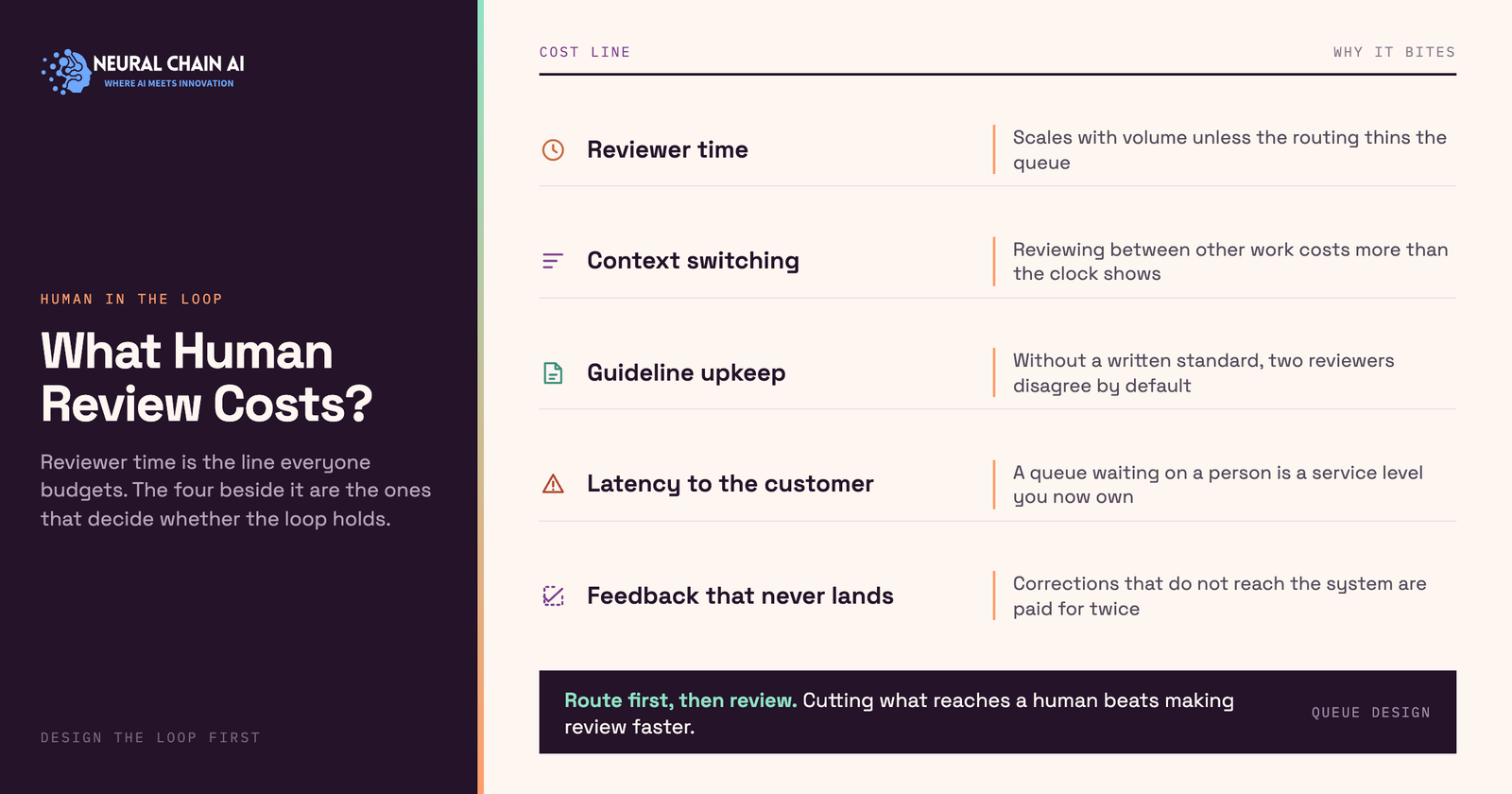
What Human Review Costs?
Review has three costs, and most business cases count only the first.
Reviewer time is the visible one. Take a queue of 2,000 items a month at 90 seconds of review each: 50 hours, or roughly $2,250 at a loaded cost of $45 an hour. That figure belongs on the cost side of any automation business case, and leaving it out is the most common reason a projected saving fails to appear. It also gives you the arithmetic for moving between the modes above. Dropping from every-item review to a 10% sample on the same queue cuts 50 hours to 5.
Delay is the second cost and rarely appears on a spreadsheet at all. An approval queue checked twice a day adds a median of six hours to every held item. In a support workflow that shows up in response time. In an underwriting workflow it shows up in applications abandoned while the applicant waits. Price it by asking what a day of delay costs the business, then multiply by the share of items the gate holds.
Attention is the third, and it sets a ceiling nobody can budget around. Sustained review of near-identical items degrades within a couple of hours, which is why review-heavy operations rotate people rather than assigning review as a full day. Plan the queue around blocks of an hour or two inside other work, and the throughput assumptions in your business case survive contact with the actual team.
Add the three together and review usually lands between 15% and 40% of the labour the automation removed, which still leaves a strong case. The number matters because it is the difference between a project that reports a saving and one that produces it, and it uses the same arithmetic that decides where AI agents pay back first across a business.
Keeping Review Honest
Believe it or not, but a review decays. A reviewer who agrees with a model 200 times in a row starts agreeing on the 201st before reading it. This pattern is well enough established that the EU AI Act names it directly, Article 14 requires that oversight personnel be enabled to stay aware of their tendency to over-rely on system output, which the text calls automation bias.
Override rate is the vital sign. Track it per reviewer and per action type, weekly. A rate that drifts toward zero means either the model improved or the review stopped, and those two look identical on a dashboard while being opposites in every way that matters. Separating them takes a deliberate measurement.
The technique worth stealing from quality assurance: seed the queue with items whose correct answer you already know, mixed in at a low rate and indistinguishable from live work. Reviewers who catch the seeded errors are reading. Reviewers who approve them are not, and the fix is usually workload or interface rather than the person. Agree with the team in advance that seeded items measure the system and never the individual, and the practice holds. Introduce it as a performance monitor and it will not.
Time per review is worth watching alongside the override rate. A median that collapses over a few weeks tells you the queue outgrew the staffing before the error rate does.
What the EU AI Act Requires for Human Oversight?
Companies selling into Europe inherit specific obligations, and the timeline changed recently enough that most published guidance has it wrong. Article 14 requires high-risk systems to be built so that people can effectively oversee them. The people assigned to oversight must be able to:
- Understand what the system can and cannot do, and monitor it for anomalies
- Stay aware of their own tendency to over-rely on its output
- Interpret the output correctly, using whatever interpretation tools exist
- Decide not to use the output, or disregard and override it
- Stop the system
Oversight measures scale with the risk, the autonomy, and the context of use. For certain biometric identification systems, the Act requires that action be verified by at least two separate people before it is taken.
On timing, the AI Act became applicable on 2 August 2026 and the transparency rules took effect then. The high-risk obligations carrying the Article 14 oversight duty were pushed back by the AI Omnibus, which entered into force on 27 July 2026. The European Commission now sets the sequence as follows:
- 2 August 2026. The Act becomes applicable, transparency rules take effect, and the AI Office begins enforcing.
- 2 December 2027. High-risk obligations apply in sensitive areas including biometrics, critical infrastructure, education, employment, and migration.
- 2 August 2028. High-risk obligations apply to AI built into regulated products.
Anything published before mid-2026 that names August 2026 as the high-risk deadline predates that change.
Canadian and US companies rarely fall directly in scope, and the design points still transfer. Interpretable output, a working override, oversight sized to the stakes, and logs that show who decided what are what an insurer, an enterprise customer’s procurement team, or a plaintiff’s lawyer will ask for regardless of jurisdiction. Companies handling regulated records often run the whole review layer on self-hosted infrastructure inside their own network so the audit trail and the data sit under one roof.
When to Reduce Review?
Review should shrink as evidence accumulates, and the evidence has to be specific to the action type rather than to the system as a whole. An agent that has processed 4,000 address changes without a material correction has earned lighter review on address changes. It has earned nothing on refunds.
A reduction is earned when all of these hold:
- A stable error rate measured on a random sample across a full business cycle
- A rollback for that action type that someone has tested rather than assumed
- A named owner who agrees to the change in writing
Review goes back up when any of these happen:
- The model version changes
- An upstream data format or source system changes
- A new request type starts arriving in the queue
- Override rate rises above its established band
Moving back up is a normal operating event rather than a setback, and treating it that way is what lets a team loosen gates confidently in the first place.
Deciding which decisions in your process need a person, and what that review will cost to staff? Our agentic AI consulting and development team builds systems with review layers designed in, deployed inside your own infrastructure. Book an AI strategy session and leave with your gates mapped and costed.