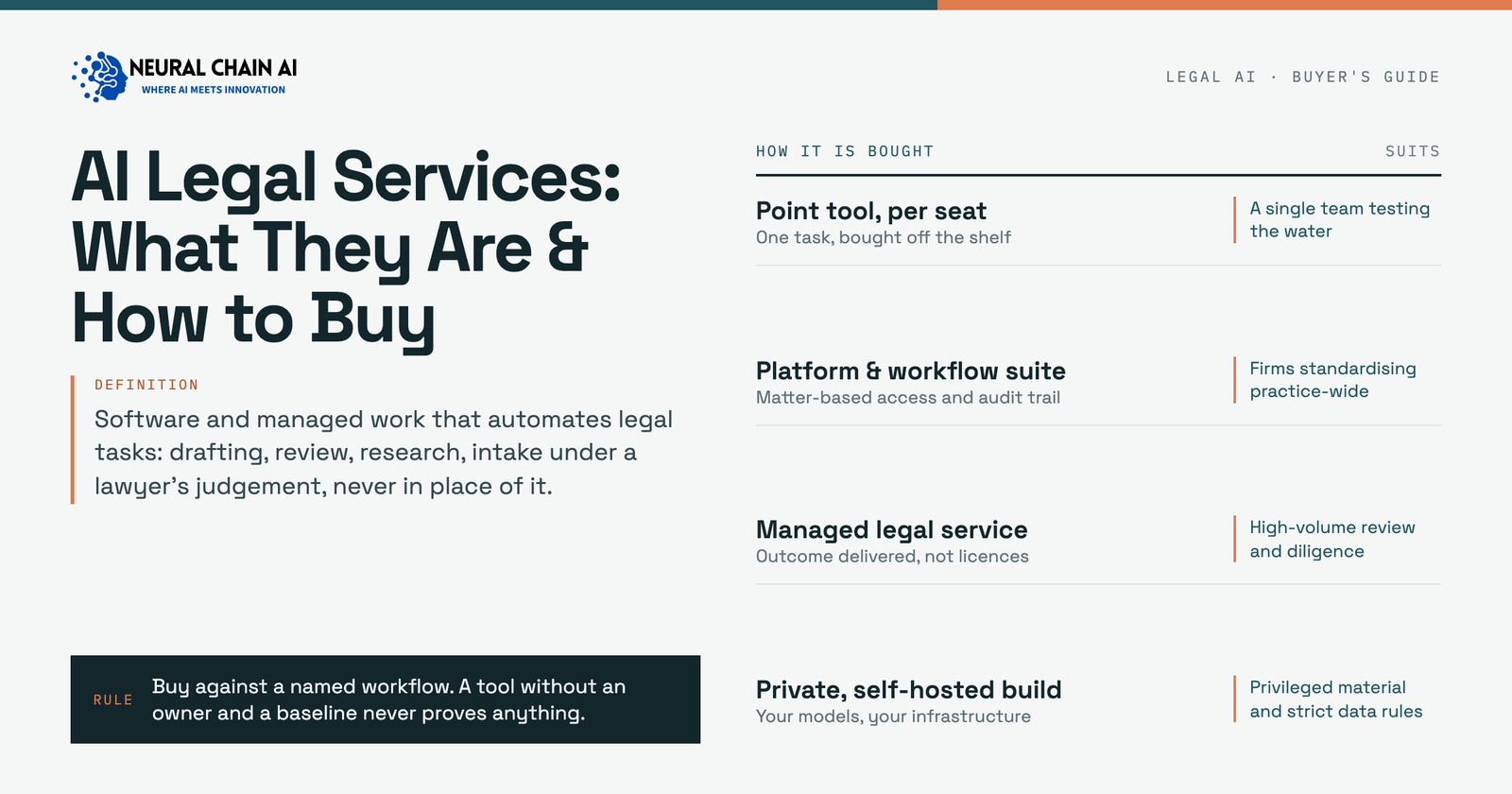
“AI legal services” now spans research bots to managed platforms. Here’s a buyer’s map of what each category does and where the data goes.
AI legal services covers the products and services that bring artificial intelligence (AI) into legal work. The questions that matter are which workflows they automate, which tools sit in each category, and where the firm’s data is processed. This guide covers all three. Firms weighing a private build can start with our overview of private, self-hosted AI for law firms.
What workflows do AI legal services automate?
The market in 2026 organizes around a handful of workflows, each a category you can buy off the shelf or build privately.
Research & drafting. Cited answers, memos, and first-draft documents. This is the most mature category, and the one most lawyers try first.
Contracts. Review, risk flagging, and generation, from standalone tools up to full contract-lifecycle platforms.
eDiscovery. Predictive coding and privilege review that cut the document volume a litigation team reads.
Intake & practice operations. Client intake, billing, and matter management, where AI trims the administrative overhead of running the firm.
Knowledge search. Question-answering across the firm’s own documents, which turns past work product into a searchable asset.
Where today’s tools fit
The best-known services map to those workflows. The column that matters most is the last one, where the firm’s data is processed.
| Workflow | Example tools | Data path |
|---|---|---|
| Research & drafting | CoCounsel, Lexis+ Protégé, Harvey | Vendor cloud |
| Contracts | Spellbook, Luminance | Vendor cloud |
| eDiscovery | Relativity aiR, Reveal | Vendor cloud |
| Intake & practice ops | Clio Duo and similar | Vendor cloud |
Most AI legal services are delivered as cloud software: capable, but they process the firm’s data on the vendor’s infrastructure.
What to weigh before you buy
The buyer’s-map decision comes down to three questions per category.
Where does the data go? A cloud service processes the firm’s data on the vendor’s infrastructure; for confidential matters, that is the deciding factor.
How accurate is it? Every category still needs lawyer verification, so weigh how much review each tool’s output requires.
What does it cost at scale? Per-seat pricing across multiple point tools adds up. A consolidated private build can flatten cost as headcount grows, a real part of the comparison even without naming a figure here.
The private, self-hosted alternative
For confidentiality-bound firms, the same workflows can be built on a private, self-hosted stack, usually with a consultant, which keeps client data in-house and consolidates point tools into one platform. The firm gets the same research, contract, and search capabilities without sending matter data to a patchwork of vendor clouds.
It meets the confidentiality duty ABA Opinion 512 places on the firm. The build-versus-buy decision is unpacked in our companion guide on AI consulting vs building an in-house team.
How to buy or build AI legal services
Map your workflows. List the categories you need (research, contracts, eDiscovery, intake) before shopping, so you buy to a plan.
Check the data path on each. For anything touching client data, prefer a deployment that keeps processing in-house.
Consolidate where you can. One private platform across categories is easier to govern and cost than a stack of separate cloud subscriptions.
Want AI legal services built private, with client data in-house?
Contact us about Private Legal AI →The bottom line
AI legal services automate research, contracts, eDiscovery, and intake, and the buying criterion that matters is where client data is processed. Match the deployment to your confidentiality exposure; for sensitive work, buy or build private. A short scoping conversation will map the right approach.