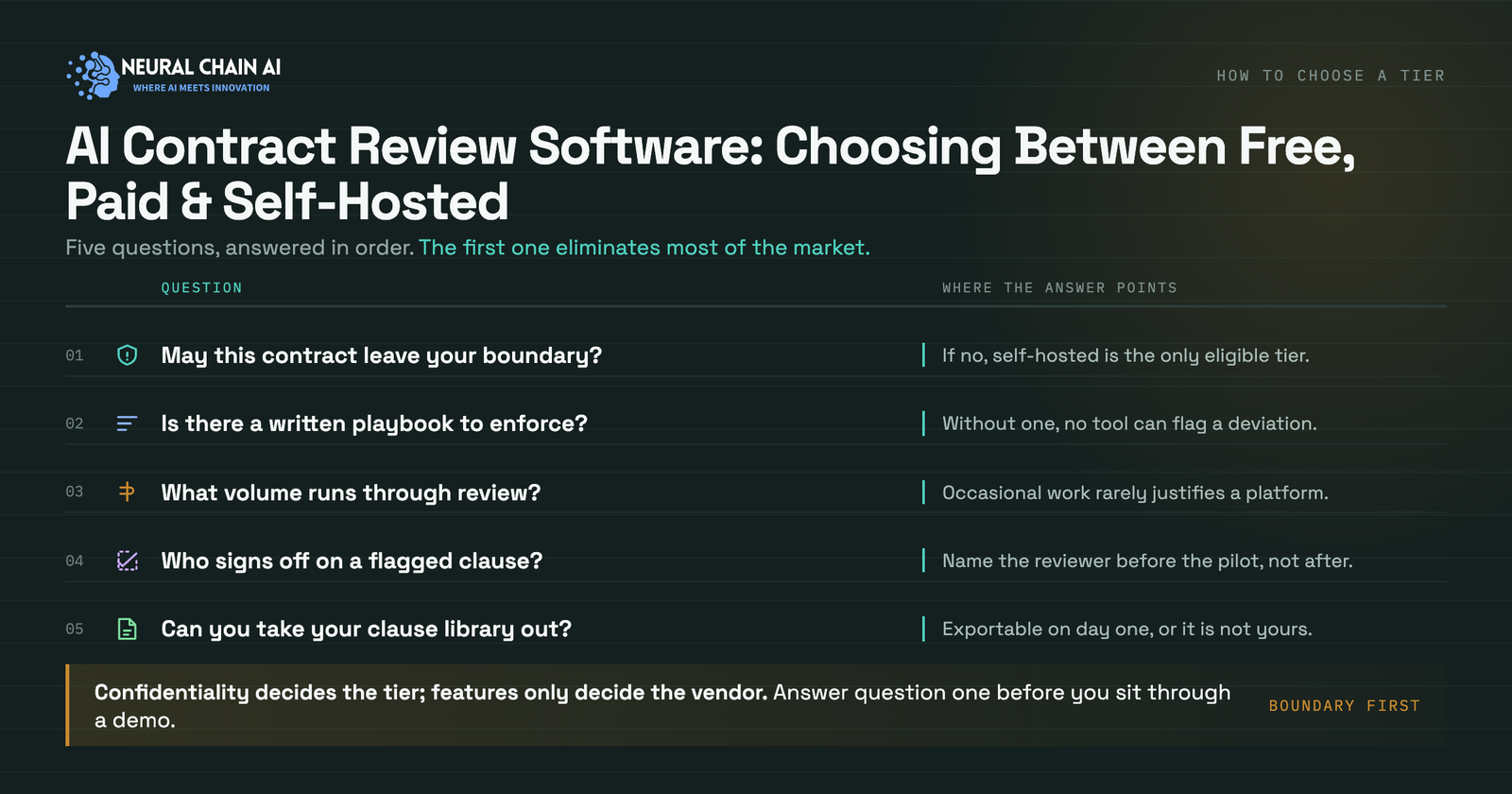
AI contract review software turns an afternoon of redlining into minutes, and the catch is where your contracts get processed. This guide weighs both.
AI contract review software uses artificial intelligence (AI) to automate the slow parts of reviewing a contract, such as reading it, extracting clauses, and flagging risk against a playbook. The questions that matter are which review steps it automates, which tools fit, and where your contracts get processed. This guide covers all three. Firms leaning private can start with our overview of private, self-hosted AI contract review and management.
What does AI contract review automate?
Across a review, AI now handles the repetitive steps, each one saving time as long as a lawyer signs off on the output.
Clause extraction. The software reads a contract and pulls the key terms (parties, dates, payment, termination, liability) into a structured summary in seconds. It turns a 40-page agreement into a checklist a lawyer can scan instead of hunting clause by clause. The reviewer still confirms the extractions against the source.
Risk and issue flagging. Against the firm’s playbook, the tool flags off-market or missing clauses, such as an uncapped indemnity, a missing limitation of liability, or an auto-renewal. It points attention at what matters so review time goes to judgment, not spotting. Calibrate the playbook first, or it flags noise.
Redlining suggestions. It proposes edits and fallback language directly in the document, drafting the first markup for the lawyer to accept, reject, or refine. That compresses the back-and-forth on routine agreements. Bespoke or high-value deals still need a human drafter.
Version and template comparison. The tool compares a draft against a prior version or the firm’s standard template and highlights every deviation. It is the fastest way to catch a quietly changed term buried in a counterparty’s redline.
Plain-language summaries. It produces a short, plain-English summary of what a contract says for a client or business team. Useful for sign-off, provided the lawyer checks that it captures the obligations accurately.
Where today’s tools fit
AI contract review software ranges from free, general-purpose AI you prompt by hand to paid specialist tools built for the job, and the best-known ones map to those steps. The column that matters most is the last one, where your contracts are processed.
| Step | Example tools | Data path |
|---|---|---|
| Clause extraction & risk | Spellbook, Luminance, LinkSquares | Vendor cloud |
| Redlining vs playbook | Spellbook, Robin AI | Vendor cloud |
| Bulk / portfolio review | Luminance, Kira | Vendor cloud |
| Review + drafting | Harvey, CoCounsel | Vendor cloud |
These are all capable, and all process the firm’s contracts on the vendor’s cloud.
Where AI contract review needs a lawyer
The software accelerates review; it does not own it. Three limits define the line.
Judgment on bespoke terms. AI handles standard clauses well but is unreliable on novel, heavily negotiated, or strategically sensitive language, exactly where a deal is won or lost.
Accuracy and verification. Extractions and risk flags can be wrong or incomplete, so a lawyer signs off on every output; the tool speeds the review, it does not replace the reviewer.
Confidentiality. A contract is among a client’s most sensitive material, yet cloud tools process it on the vendor’s servers, the exposure the next section resolves.
The private, self-hosted alternative
The same extraction, risk-flagging, and redlining can run on a private, self-hosted stack, calibrated to the firm’s own clause library and playbook, deployed in the firm’s tenant, so contracts never leave. In practice that is a private model paired with the firm’s templates and clause data, behind the firm’s log-in, with an audit trail of every review.
It preserves the speed of the tools above while meeting the confidentiality duty ABA Opinion 512 places on the firm. For a deeper treatment, see our companion guide to private, self-hosted AI for contract review and generation.
How to deploy private contract review
Start with your playbook. The value comes from calibrating the system to the firm’s standards and fallback positions, so capture those first.
Prove it on one contract type. Run it on a high-volume agreement, such as NDAs or MSAs, before extending across the wider portfolio.
Keep the repository in-house. Point the system at the firm’s own contract store so review and search happen where the data already lives.
Want contract review automated without contracts leaving your firm?
Contact us about Private Contract AI →The bottom line
AI contract review software automates the slow first pass, covering extraction, risk, and redlines, and the choice that remains is where your contracts are processed. For confidentiality-bound firms, a private, self-hosted stack delivers the speed while keeping contracts in-house. A short scoping conversation will map your first workflow.