Robot teleoperation is the practice of a human operating a robot in real time through a control interface, and in robot learning it is the main way training demonstrations get recorded. This guide covers the five rig families and what they cost, what separates usable demonstration data from expensive noise, how much data published programs needed, and how to calculate cost per usable episode rather than cost per hour.
Almost every capable manipulation policy shipped in the last three years was trained on data a person recorded by hand. The Open X-Embodiment dataset pooled more than one million real robot trajectories across 22 embodiments and 527 skills from 60 datasets and 34 labs. DROID contributed 76,000 demonstration trajectories, 350 hours of interaction across 564 scenes and 86 tasks, gathered by 50 human collectors at 13 institutions over 12 months. Behind each of those numbers sits a person holding a controller.
That makes teleoperation a budget line rather than a lab detail. The sections below cover the hardware, the quality question that decides whether the spend converts into policy performance, and the arithmetic that tells you what an hour of collection is worth.
What Is Robot Teleoperation?
Robot teleoperation means a human controls a robot remotely in real time, with the operator’s movements or inputs mapped onto the robot’s joints or end effector. It serves two separate purposes, and conflating them causes most of the confusion in buying conversations.
The first is operation itself: surgery, subsea inspection, mining, nuclear handling, and warehouse exception handling, where a person needs to do a job through a machine. The second is data collection, where the point of the session is not the task but the recording. Every teleoperated episode produces synchronised robot actions and sensor observations that become training data for imitation learning and vision-language-action models.
This guide addresses the second. The distinction matters commercially, because a rig optimised for one is often wrong for the other. Operation rewards latency and situational awareness. Collection rewards throughput, consistency, and clean synchronisation.
Teleoperation Systems: The Five Rig Families
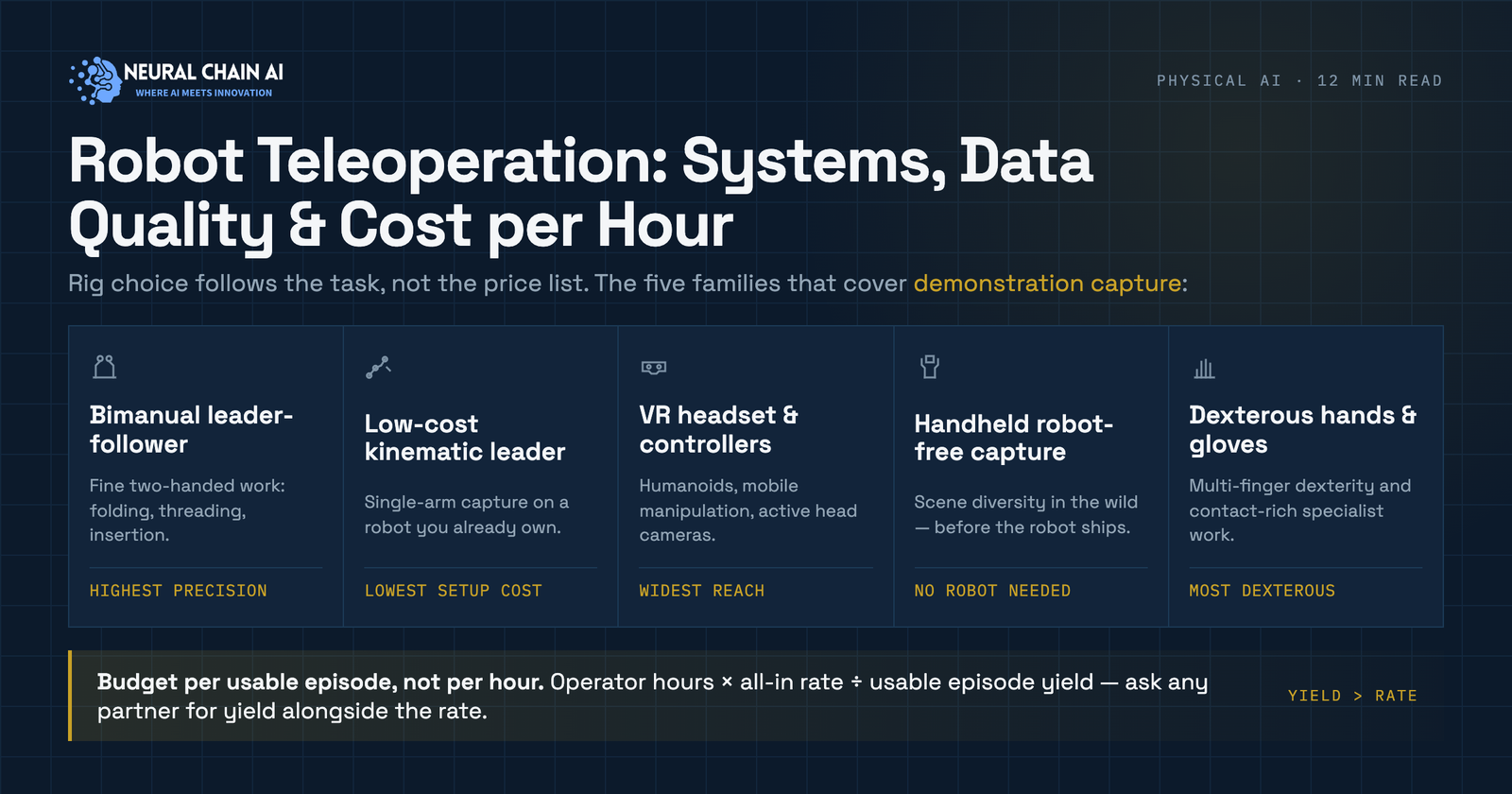
Hardware choice is driven by task family first and budget second. The table below sets out what each approach costs and where it earns its place.
| Rig family | Reference example | Hardware cost | Suits |
|---|---|---|---|
| Bimanual leader-follower | ALOHA, Mobile ALOHA | About USD 18,000, or 20,000 with camera add-ons | Fine two-handed manipulation: folding, threading, insertion |
| Low-cost kinematic leader | GELLO | Under USD 300 per device in parts, follower arm excluded | Single-arm collection where you already own the robot |
| VR headset and controllers | Meta Quest, Open-TeleVision | Roughly USD 500 to 3,500 plus the robot | Humanoids, mobile manipulation, active head cameras |
| Handheld robot-free capture | Universal Manipulation Interface (UMI) | Under USD 1,500 per device | In-the-wild scene diversity, and collection before hardware arrives |
| Dexterous hand and glove systems | DexPilot, Shadow Teleoperation System | From about USD 100,000 to over 400,000 | Multi-finger dexterity and contact-rich specialist work |
Three findings from the literature are worth carrying into a hardware decision. ALOHA reaches 80 to 90 percent task success when paired with action chunking, at hardware under 20,000 US dollars, which is why it appears behind most bimanual VLA papers. GELLO reduces cost to under 300 dollars per device through 3D-printed kinematically equivalent leaders, and a published survey reports it improving reliability by close to 30 percent over VR baselines. UMI removes the robot from the collection loop entirely, so trajectories are recorded in any environment and retargeted to the robot action space during training.
The cost spread across those rows is more than a thousand to one. Two teams collecting the same task can differ by that factor and still both be correct, because the constraint is rarely money. It is whether the interface produces motion the policy can learn from.
What Separates Good Teleoperation Data From Expensive Noise?
This is the part that decides whether a collection budget converts into policy performance, and the part most vendor material skips.
Control Rate and Fidelity
Demonstrations should be recorded at the policy’s control rate, commonly 30 to 60 Hz. Below that you get less signal per minute of operator time. The interface also needs to transmit operator intent accurately, since imprecise control produces trajectories that teach the policy imprecision.
Consistency Across Sessions
The same operator should produce similar demonstrations week to week. High variance between sessions limits what a policy can extract, and teleoperator skill differences introduce noise that is difficult to spot by eye. Research on demonstration curation identifies operator variability alongside human error as a primary source of suboptimal behaviour in teleoperated datasets.
Coverage Rather Than Polish
DROID was designed around scene diversity rather than repetition, moving robots freely between sessions instead of returning to the same tabletop. Policies co-trained with it improved in-distribution success by 22 percentage points and out-of-distribution success by 17 points against an Open X-Embodiment baseline. Breadth of scene, viewpoint, object and lighting is what buys generalisation.
Curation Beats Collection
Here is the result worth planning around: more data is not automatically better data. Published curation work reports that Dexora improved policy performance while discarding 80 percent of its training demonstrations using a kinematic screen. Methods including CUPID and Demo-SCORE use influence functions and policy rollouts to identify which individual demonstrations help closed-loop success and which quietly hurt it. Recent work proposes a power spectral density metric that ranks demonstration quality without running rollouts at all, on the finding that good demonstrations concentrate power in low frequencies while poor ones show broader spectral spread from corrective motion and oscillation.
The practical reading: budget for a QA and curation stage from the start. A dataset that is 40 percent smaller and properly filtered will often outperform the raw capture it came from.
How Much Teleoperation Data Do You Need?
Requirements scale with ambition rather than with task difficulty. These reference points come from published programs.
| Program | Scale | Collection footprint |
|---|---|---|
| Single-task fine-tune | Low hundreds of demonstrations | One rig, days to weeks |
| Fourier ActionNet | 30,000 bimanual trajectories, about 140 hours | VR-based egocentric teleoperation on humanoids |
| DROID | 76,000 trajectories, 350 hours, 564 scenes, 86 tasks | 18 Franka arms, 50 collectors, 13 institutions, 12 months |
| RT-1 | 130,000 episodes across 700+ tasks | 13 robots, 17 months |
| AgiBot World | Over 1 million trajectories, 217 tasks, 106 scenes | 100+ identical humanoid platforms |
| Open X-Embodiment | Over 1 million trajectories, 527 skills | 22 embodiments pooled from 60 datasets, 34 labs |
Read that table as a ladder rather than a target. Most commercial teams are aiming at the top two rows, not the bottom two. A single-task fine-tune on hardware you already own is a weeks-long project. A foundation-model-scale corpus is a multi-institution effort measured in years.
Cost per Hour, and the Number That Matters More
All-in teleoperation collection has been benchmarked at 28 to 60 US dollars per operator hour once wages, supervision, facility overhead and hardware amortisation are counted. That figure is the input, not the answer.
Two multipliers sit on top of it. Teleoperated collection runs close to one hour of skilled operator time for every hour of usable robot data, a constraint AgiBot researchers describe directly in their work on scalable collection. And not every recorded episode survives QA. The number to manage is therefore:
Cost per usable episode = (operator hours × all-in hourly rate) ÷ usable episode yield
Most budgets get all three terms wrong at once. Hardware is the smallest line: a 20,000 dollar bimanual station running two shifts amortises to a rounding error against a year of operator wages. The recurring costs hide elsewhere. Printed leader arms need periodic servo checks and part replacement, adding technician hours per station per week. VR rigs need almost no maintenance but lose scheduled operator time to headset session limits, and inverse kinematics edge cases add QA review that leader-follower rigs do not generate.
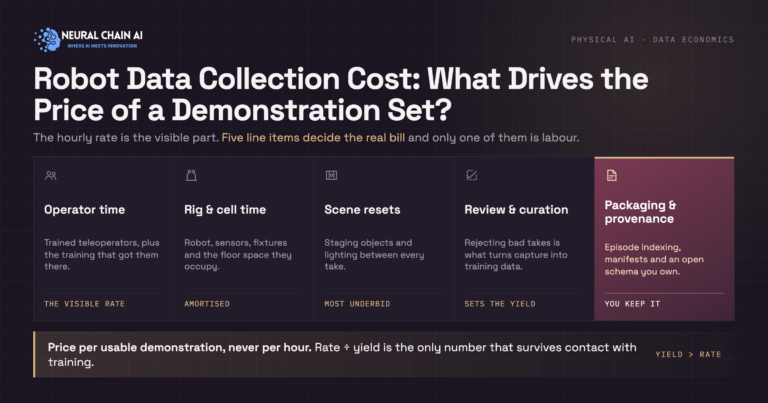
Ask any collection partner for yield and rejection rate alongside the hourly figure. A lower rate with a 55 percent yield loses to a higher rate with a 90 percent yield, and only one of those two numbers usually appears on a quote.
This pattern repeats across robotics budgets. Teams pricing a robot cell run into the same shape, where the arm accounts for roughly a quarter to two-fifths of the total and tooling, guarding and commissioning carry the rest, so a budget built from the catalogue price lands well short. Whether the line item is an arm or an operator hour, the headline number is the one that gets quoted and the multipliers around it are the ones that decide the total.
Our guide to robotics consulting services, engagement models and costs works through the same arithmetic for cell deployments, including the commercial structures firms sell against and the cost benchmarks behind each.
Methods That Lower Cost per Usable Episode
The most useful development in this field is that paying for more operator hours is no longer the only lever.
Synthesis from a single demonstration is the sharpest example. The Real2Render2Real work reported policies trained on data generated from one human demonstration matching policies trained on 150 teleoperated demonstrations, measured across 1,050 physical robot evaluations. Robot-free capture is the second: UMI collects trajectories before your robot ships, which turns hardware lead time into productive weeks and produces data transferable across embodiments. Human video co-training and simulation each shift the ratio further.
On the curation side, filtering is no longer the only option. Ambient Diffusion Policy restricts the contribution of lower-quality data to specific diffusion timesteps rather than discarding it, and reports outperforming co-training baselines by up to 33 percent when scaled to Open X-Embodiment. That matters for budgeting, because it raises the value of data you already hold.
A partner who only quotes operator hours is selling one lever. Ask which mix they would recommend and why.
Robot Teleoperation: Build In-House or Contract the Collection?
Build or Contract – both routes work. The decision turns on how long you will be collecting and how specialised the task is.
| Factor | Build in-house | Contract a collection partner |
|---|---|---|
| Time to first episode | Weeks, including rig build and operator training | Days, on an existing floor |
| Cost shape | Capital plus ongoing wages, technician time and supervision | Variable, priced per episode or per operator hour |
| Task specificity | Suits proprietary tasks on your own hardware | Suits common manipulation skills and scene breadth |
| Scene diversity | Limited to your facility unless you travel | Multiple sites and environments already available |
| Break-even point | Favourable once collection runs continuously for many months | Favourable for bounded programs and for testing whether data helps at all |
A common pattern splits the two. Teams keep depth in-house on the handful of tasks that define their product, where operators build task expertise that no external floor will match, and contract out breadth: the wide range of scenes, objects and viewpoints that buys generalisation but carries no strategic secret. That split also gives you a yield benchmark, because you can compare your own usable episodes per operator hour against a partner running the same task.
The break-even row in that table hides the number that settles it. Building a floor
front-loads hardware, rig build, operator training and pipeline engineering, and those
lines are paid once rather than per episode.
A first in-house run of 1,000 demonstrations carries all of them, while a second run on the same rig with trained operators lands at roughly half the cost per usable episode. Most of the robot data collection cost you pay in year one sits in that gap, which is why a first program judged against a contracted quote on per-episode price will always look expensive. The comparison worth running blends your own cost across the first two or three programs and sets that against the partner’s rate.
How to Set Up a Teleoperation Data Program?
- Pick the rig from the task, not the price list. Fine bimanual work needs leader-follower. Humanoid and mobile manipulation needs VR with active head cameras. Scene breadth points to handheld capture.
- Fix the control rate and camera set before episode one. Changing either mid-program splits your dataset into incompatible halves.
- Write the QA rubric first. Define what a rejected episode looks like, who reviews, and at what sampling rate.
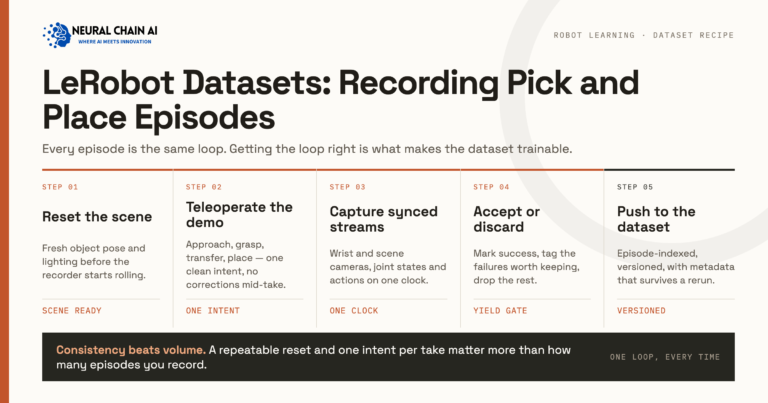
- Standardise the format. LeRobot and HDF5 are the common targets, and the LeRobot dataset format now packs many episodes into shared Parquet and MP4 shards rather than one file per episode. Retrofitting format decisions onto 20,000 recorded episodes is expensive.
- Record provenance and consent. Operator identity, location, date, task label, and rights terms, captured per episode rather than reconstructed later.
- Measure yield weekly. Usable episodes per operator hour is your unit economic. Track it from week one so you can tell whether operator training is working.
- Budget a curation stage. Assume a meaningful share of raw capture will be filtered or down-weighted, and plan the spend accordingly.
Scoping a teleoperation program or comparing build against buy? NeuralChainAI runs robot data collection services and embodied AI training data programs, with the rig selection, QA thresholds and format decisions settled before the first episode is recorded. Bring the task list and the target policy; you get back a costed collection plan with yield assumptions written down.
Teams weighing a data program alongside a wider deployment can also start from physical AI and robotics consulting, where hardware, integration and data strategy are scoped together.