AI training data services help teams fill a dataset gap in three ways: buy a ready-made dataset, license a curated collection, or commission a provider to collect and label new data to your specification. This guide compares those routes on speed, fit, cost drivers, license clarity, and quality control, and gives you a scorecard, a briefing template, and a contract checklist to use on your next project.
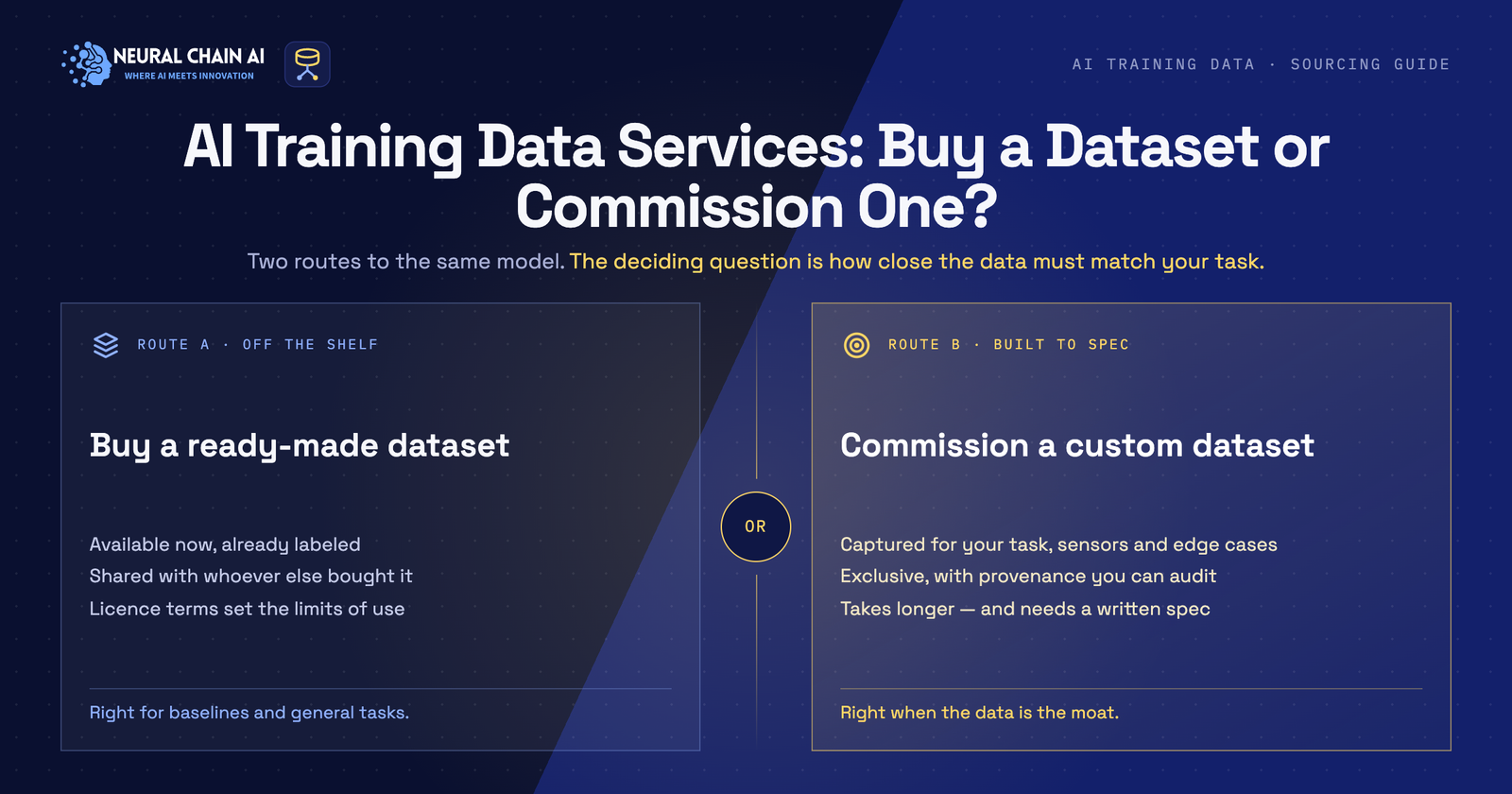
Every model project reaches the same moment. The architecture is chosen, compute is booked, and the team needs examples that match the job. The first decision with AI training data services shapes budget and schedule more than any other. Teams either buy a dataset that already exists or commission one built for their task.
Six factors settle that decision. They are how closely existing data matches your domain, how soon you need a first training run, whether you need exclusive rights, how much provenance documentation your customers expect, how many edge cases define success, and how often the data needs refreshing. The sections below work through each one.
What AI Training Data Services Cover?
Providers sell four routes to training data. The table shows how they compare at a glance.
| Route | What you receive | Best fit | Speed to first batch |
|---|---|---|---|
| Buy an off-the-shelf dataset | A packaged dataset under a standard license | General tasks, prototypes, benchmarking | Shortest |
| License a curated collection | Domain data from a rights holder, often with updates | Specialized domains where rights are clear | Short to medium |
| Commission custom collection | New data captured to your specification, labeled and audited | Proprietary tasks, rare scenarios, exclusive rights | Longest |
| Generate synthetic data | Programmatically produced samples | Rare cases and privacy-sensitive domains | Short once the generator is validated |
Most production projects combine two routes. A common pattern pairs a purchased base dataset with a commissioned batch that covers the cases the base data misses.
When to Buy a Dataset?
Buy a dataset when your task matches data that already exists. Four situations favor buying:
- The task is common, such as sentiment analysis, invoice extraction, or general object detection, and published data covers the variation you expect.
- You need a first model quickly to prove value before you fund collection.
- A benchmark dataset gives you a fair comparison point for your own results.
- The seller publishes a datasheet with the source, collection method, license, and known gaps.
Buyers get speed and a known price. The limit is differentiation, because anyone can license the same data, so it rarely gives your model an edge on its own.
When to Commission a Custom Dataset?
Commission a dataset when the examples you need are missing from the market or when the rights matter as much as the samples. Five situations favor commissioning:
- Your domain has its own vocabulary, formats, or sensor setup, such as clinic notes, factory camera feeds, or warehouse audio.
- Rare events define success, for example defects that appear once in thousands of units.
- You need exclusive or field-of-use rights so competitors cannot train on the same examples.
- Customers or auditors ask for a full chain of custody, including consent records.
- Labels follow your business rules, which public annotation guides do not cover.
Commissioning also lets you design collection around the model. You set lighting, devices, speakers, languages, and labeling rules up front, which shortens iteration later.
Buy a Dataset or Commission One: A Decision Scorecard
Use this table to compare the two routes across the criteria that move most projects.
| Criterion | Buy a dataset | Commission one |
|---|---|---|
| Time to first training run | Shortest | Longer, includes brief and pilot batch |
| Domain fit | Broad and general | Matched to your task |
| Exclusivity | Usually shared with other buyers | Negotiable, often exclusive |
| Provenance record | Varies by seller | Built to your requirements |
| Cost shape | Lower upfront, priced per dataset or seat | Higher upfront, scales with volume and label depth |
| Edge-case coverage | Whatever exists | Targeted by design |
| Refresh schedule | Seller decides | You decide |
To apply it, rate each row from 1 to 5 for importance to your project, then note which route wins the row. If the rows you rated 4 or 5 mostly favor commissioning, commission. If they favour buying, buy and plan a small commissioned top-up for gaps.
What Drives the Cost of AI Training Data Services?
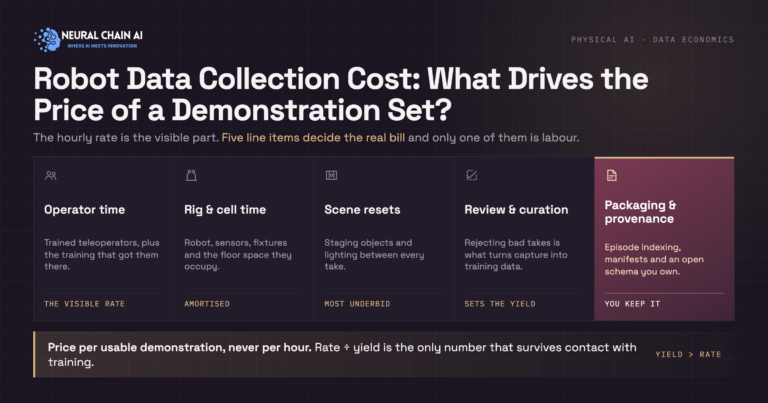
Prices vary by modality, label depth, and rights, so this section lists the drivers that move a quote instead of quoting figures that age quickly.
| Cost driver | How it moves the quote |
|---|---|
| Modality | Text is lighter to collect than video, multi-sensor recordings, or audio with speaker consent. |
| Label depth | A single class tag takes less annotator time than polygons, keypoints, or multi-step reasoning traces. |
| Expertise required | Clinicians, lawyers, and engineers label at higher rates than general annotators. |
| Quality tier | Double annotation and expert review add cost and add confidence. |
| Volume and variety | More scenarios, languages, and environments expand collection effort. |
| Rights | Exclusive or perpetual rights price above non-exclusive, time-limited ones. |
| Documentation | Consent records and audit trails take operational effort to produce. |
Ask every provider to quote the same pilot batch from the same written brief. Identical inputs make quotes comparable, and the pilot shows you label quality before you commit to volume.
License and Provenance Checks Before You Buy a Dataset
A license shown on a dataset page can differ from the license the original creator chose. The Data Provenance Initiative audited more than 1,800 text datasets and found license omission above 70% and error rates above 50% on popular dataset hosting sites (Longpre et al., 2023). In their re-annotation, about two thirds of the Hugging Face licenses they reviewed sat in a different use category than the creator intended, frequently a more permissive one.
Run five checks before you pay:
- Trace the dataset to its original source and read that source’s license, along with the host’s label.
- Confirm the license allows commercial use and training of the models you will sell or deploy.
- Check whether fine-tuned models and model outputs carry conditions.
- Ask how personal data was handled and what the consent covers.
- Save a dated copy of the license text and the datasheet at purchase.
Regulation adds a second reason to keep records. Article 53(1)(d) of the EU AI Act requires providers of general-purpose AI models to publish a summary of training content, and the European Commission released the template for it on 24 July 2025 (William Fry). The template groups sources into categories such as public datasets, licensed private data, scraped content, user data, and synthetic data (CADE). The AI Office can verify compliance from 2 August 2026, and models on the market before 2 August 2025 have until 2 August 2027 (WilmerHale). Check current guidance as timelines can shift.
A narrower model still benefits from the same habit. A one-page provenance record per dataset answers enterprise procurement questionnaires faster. Record the source, the license text and date, the collection method, the consent basis, the processing steps, and the known gaps.
How to Brief a Custom Dataset Commission?
A tight brief cuts revision cycles. Write it before you approach providers, and send the same brief to every one.
| Brief section | What to specify |
|---|---|
| Task and model | What the model predicts and the target metrics. |
| Data specification | Modality, format, resolution, duration, language, and devices. |
| Coverage plan | Scenarios, demographics, and environments with target proportions, including rare cases. |
| Label guide | Class definitions, worked examples, edge-case rulings, and tie-break rules. |
| Consent and rights | Who consents, what they consent to, and the license scope you need. |
| Delivery | File formats, schema, manifest, and batch cadence. |
| Acceptance | Metrics and thresholds that each batch must meet. |
Quality Acceptance Criteria for Training Data
Agree on acceptance metrics before collection starts. Five checks cover most projects:
- Inter-annotator agreement on a sample that two annotators label independently.
- Accuracy against a gold set your team labels and keeps hidden from the provider.
- Coverage against the plan, measured per scenario, language, or environment.
- Duplicate and near-duplicate rate across each delivered batch.
- A label audit by your own reviewer on a random sample from every batch.
Start with a small pilot batch, tune the label guide from the disagreements you find, then scale volume. Keep a test set the provider never sees, so your evaluation reflects real performance.
Where Synthetic Data Fits Beside Bought and Commissioned Data?
Synthetic data fills rare cases and suits privacy-sensitive domains, and it works best as a supplement. A 2024 Nature paper found that indiscriminate training on model-generated content causes irreversible defects, with the tails of the original distribution disappearing, an effect the authors call model collapse (Shumailov et al., 2024). The authors also expect data from genuine human interactions to gain value as generated text spreads across the web. Anchor training in real data, label every synthetic row, filter generated samples before use, and evaluate on a real holdout set.
The Hybrid Route: Buy the Base, Commission the Gap
Hybrid projects start with a purchased dataset that covers general examples, then commission a targeted batch for what the market lacks. Consider a retailer building a shelf-audit vision model. It buys a public retail product dataset for the base, commissions photos from its own stores to cover local lighting and packaging, and evaluates on a holdout set from those stores. The purchase starts training quickly, and the commission aligns the model with the place it will run.
Contract Terms for AI Training Data Providers
Settle these terms in writing before work begins.
| Term | What to settle |
|---|---|
| Ownership and license scope | Who owns the data and labels, and which uses the license covers. |
| Exclusivity and field of use | Whether competitors can license the same data, and in which industries. |
| Derived models | Any conditions on models trained from the data. |
| Rights and consent warranties | Provider confirms it holds the rights and keeps consent records. |
| Acceptance and rework | Metrics, thresholds, and who pays for rework on rejected batches. |
| Delivery | Raw files, labels, manifests, and the label guide version. |
| Retention and deletion | How long the provider keeps copies and how it removes them. |
Have counsel review the final agreement. This article shares general information and is not legal advice.
Commissioning Physical-World AI Training Data
Robotics and embodied AI teams need synchronized multi-sensor recordings, and few catalogs sell the exact combination a given robot requires. NeuralChainAI runs a capture line for this work (disclosure: that is us). The setup records synchronized stereo depth, tactile force arrays, 200Hz IMU, dual wrist cameras, and 21-point hand pose, with consent collected at source and a SHA256 chain of custody for each episode. Output arrives LeRobot-ready. Teams building robot policies or world models can explore our physical AI training data collection solution and our physical AI and robotics consulting service.
Choosing between buying and commissioning? Book an AI strategy session and bring your task, target metrics, and any datasets you are considering. We will help you score the options and scope a pilot batch. For model development around your data, see our machine learning consulting services.