Aerospace AI is the use of machine learning, language models and computer vision on aircraft, component and maintenance data. This guide covers the aerospace AI use cases that pay back first, the data constraints that shape every project (export control, controlled goods, defense cybersecurity and OEM licensing), what regulators say about certification, and where private AI fits when documents cannot leave your network.
AI in aerospace spans everything from airborne autonomy to a technician looking up a torque value. Most of the work that reaches small and mid-sized firms sits on the ground side: maintenance records, engineering documents, inspection images and supplier data. That data carries rules about who may read it and where it may sit. Those rules explain why aerospace artificial intelligence projects look different from retail or marketing projects. Data classification, traceability and deployment location decide whether a pilot ships, and the choice of model comes after.
Two groups read this guide. Maintenance, repair and overhaul (MRO) shops want faster access to records and fewer manual lookups. Tier 2 and Tier 3 suppliers want help with quality, planning and quoting without exposing customer drawings. The sections below cover use cases first, then constraints, then architecture.
Aerospace AI Use Cases at a Glance
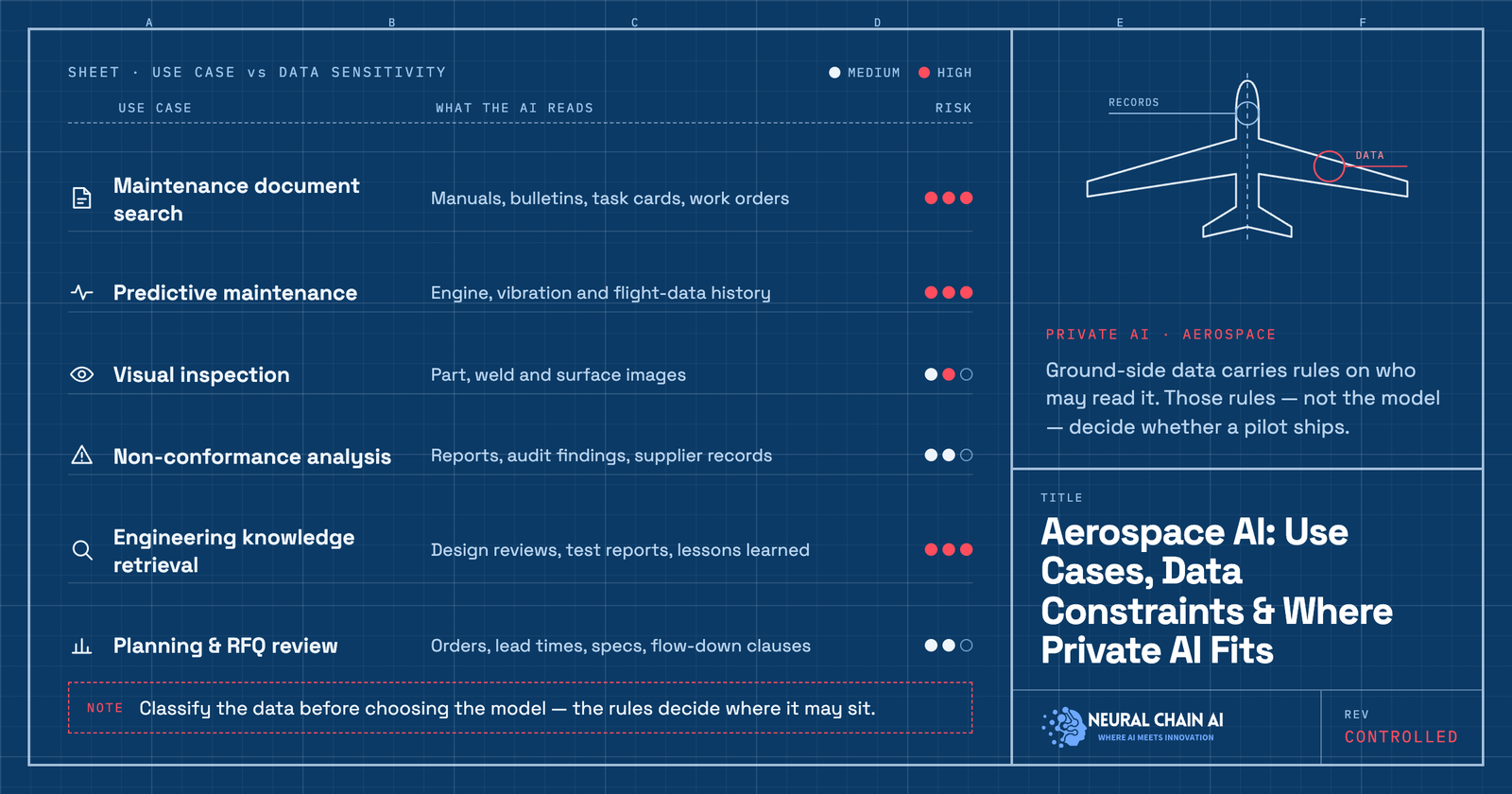
The table maps each use case to the data it reads, who benefits, and the sensitivity that data usually carries. Use it to match a use case to a deployment option later in this guide.
| Use case | What the AI reads | Who benefits | Typical data sensitivity |
|---|---|---|---|
| Maintenance document search | Manuals, service bulletins, task cards, work orders | MRO planners and technicians | High: OEM-licensed, sometimes export-controlled |
| Predictive maintenance | Engine, vibration and flight-data sensor history | Operators and MRO shops | High: operational data under contract limits |
| Visual inspection | Part, weld and surface images | Manufacturers and inspectors | Medium to high: images can show controlled designs |
| Non-conformance analysis | Non-conformance reports, audit findings, supplier records | Quality teams | Medium: commercially confidential |
| Engineering knowledge retrieval | Design reviews, test reports, lessons learned | Engineers and new hires | High: proprietary, sometimes controlled technical data |
| Planning and forecasting | Orders, lead times, capacity, inventory history | Production planners | Medium: commercially confidential |
| RFQ and requirements review | Specifications, certificates, flow-down clauses | Contracts and sales teams | Medium to high |
Aerospace AI Use Cases by Function
Each function below pairs a use case with the data it reads and the person who still signs off.
Maintenance, Repair and Overhaul
Technicians spend time hunting through manuals, service bulletins and prior work orders. A retrieval-augmented generation (RAG) assistant over those documents answers a question with the cited paragraph, so the technician reads the source alongside the summary. The same index lets planners compare a current finding with similar past repairs. Predictive maintenance runs next to it: models trained on sensor history flag components trending toward their limits, and planners schedule the work during a planned check. Both depend on clean records, which is why many projects begin with a data inventory. A private enterprise search layer gives the assistant permission-aware access to each collection.
Manufacturing and Quality
Computer vision reads inspection images for surface defects, missing fasteners and dimensional drift, then flags frames for a human inspector. Language models summarize non-conformance reports and group them by cause, which shows quality teams which supplier or process step repeats a finding. Suppliers that build to customer drawings gain the most, because every deviation record already follows a template. Our manufacturing and industrial AI work covers these workflows.
Engineering and Knowledge Retrieval
Engineering firms keep decades of test reports and design reviews in file shares that nobody searches. A retrieval system with per-folder permissions lets a new engineer ask what an earlier program learned about a material or fastener, and read the original report. Capturing that knowledge while senior engineers are on staff gives new hires a searchable record of why designs look the way they do.
Supply Chain, Planning and Contracts
Forecasting models read order history, lead times and capacity to propose build schedules. Document-review assistants read RFQs and customer flow-down clauses, then list the quality, certification and cybersecurity requirements a quote must answer. Reviewers still sign off. The assistant shortens the first read of a long package.
Aerospace AI Data Constraints: Export Control, Controlled Goods and CUI
Aerospace AI projects start with a data inventory because a handful of rule sets decide where data can live and who can read it. The table summarizes them at a high level. Your export-compliance officer or counsel has the final word on any specific dataset.
| Data type | Governing rule or program | What it means for an AI system |
|---|---|---|
| Export-controlled technical data (US) | ITAR and EAR | Know where the data is stored and who can read it in clear text, including the operator of any hosted model. |
| Controlled goods and technology (Canada) | Controlled Goods Program under the Defence Production Act | Registered businesses and security-assessed individuals handle controlled technology, so AI access lists follow the same people. |
| Controlled unclassified information (CUI) in defense supply chains | NIST SP 800-171 through DFARS 252.204-7012, and CMMC | Systems that store or process CUI meet the NIST requirements named in the contract. |
| OEM-licensed documentation | OEM and customer licence terms | Check whether indexing licensed manuals and drawings in an AI system fits the licence. |
| Airworthiness and quality records | Regulator and quality-system record rules | Answers that inform maintenance work carry a source citation and an audit trail. |
| Personal data | Privacy law such as PIPEDA in Canada and GDPR in the EU | Mask or exclude staff and crew data from the index. |
Export rules show why hosted AI deserves a close look. Since March 2020, 22 CFR 120.54(a)(5) has let companies store and send unclassified ITAR technical data without treating the transfer as an export, provided the data stays end-to-end encrypted so that no third party can read it in clear text. A hosted language model has to read the text you send it to answer. A prompt that contains controlled technical data depends on the model’s operator being an authorized recipient of that data. Running the model inside your own environment keeps the question simple. Counsel can confirm how this applies to each data category.
Canadian shops face a parallel program. The Controlled Goods Program, run by Public Services and Procurement Canada, requires registration before a business examines, possesses or transfers controlled goods or technology in Canada. AI access lists should mirror the security-assessed staff your registration already names.
US defense suppliers also track CMMC. The Department of Defense began including self-assessment requirements in contracts on 10 November 2025. On 13 July 2026 it suspended the third-party assessment phase scheduled for 10 November 2026 and opened a program review, according to Federal News Network. Existing contractor cybersecurity obligations continue during the review. Check the current status before you plan around any CMMC date.
Four design rules follow from these constraints. Classify data before choosing a model. Keep an access list for each document collection. Log every query with the documents it touched. Record which model version produced each answer.
Aerospace AI Certification: What EASA and the FAA Say?
Regulators focus on AI inside aircraft, air traffic systems and safety-critical functions. A document assistant that points a certified technician to the right paragraph, with the technician making and signing the decision, runs under your approved maintenance procedures and quality system. Confirm the boundary with your authority before an AI output feeds a release-to-service decision.
EASA classifies AI by the authority it holds. According to EASA’s paper to ICAO, AI Roadmap 2.0, published in May 2023, defines Level 1 human assistance, Level 2 human-AI cooperation and Level 3 advanced automation. Concept Paper Issue 2 (March 2024) gave guidance for Level 1 and Level 2 machine learning applications. Proposed Issue 03, released on 3 June 2026, extends the framework to Level 3, reinforcement learning and symbolic AI.
The FAA’s Roadmap for Artificial Intelligence Safety Assurance (Version I, 2024) separates learned AI, which is frozen before deployment, from learning AI, which keeps adapting in service, and sets distinct assurance approaches for each. The roadmap treats each new version of a learned AI implementation as a change that goes through safety assurance. A shop that plans to retrain models on new records should version every model and treat each retrain as a controlled change.
Standards work continues in parallel. EUROCAE WG-114 and SAE G-34 are writing ED-324 / ARP6983, a process standard for machine learning in aeronautical safety-related products, with traceability to EASA’s concept papers.
Where Private AI Fits in Aerospace?
Private AI runs the model, the retrieval index and the logs inside infrastructure you control, either on your premises or in a dedicated cloud tenant. For aerospace data that carries access rules, private AI turns the question of who can read a document into an architecture decision you make once. The table lines up the common deployment options against the data in this guide.
| Deployment option | Where data goes | Typical fit for aerospace data | Common use |
|---|---|---|---|
| Public AI chat tools | Vendor cloud, vendor-set retention | Public and non-sensitive material | Drafting, summarizing public documents |
| Vendor API with enterprise terms | Vendor cloud, contractual limits | Commercially confidential data after legal review | General productivity, uncontrolled documents |
| Private cloud tenant | Your cloud account and keys | Much commercial data, and controlled data when region, access and personnel rules match your obligations | Document search, quality analysis |
| On-premises self-hosted | Your servers | Controlled technical data and OEM-licensed documents | Maintenance and engineering knowledge retrieval |
| Air-gapped | Isolated network with no internet path | The most restricted environments | Secure facilities and controlled programs |
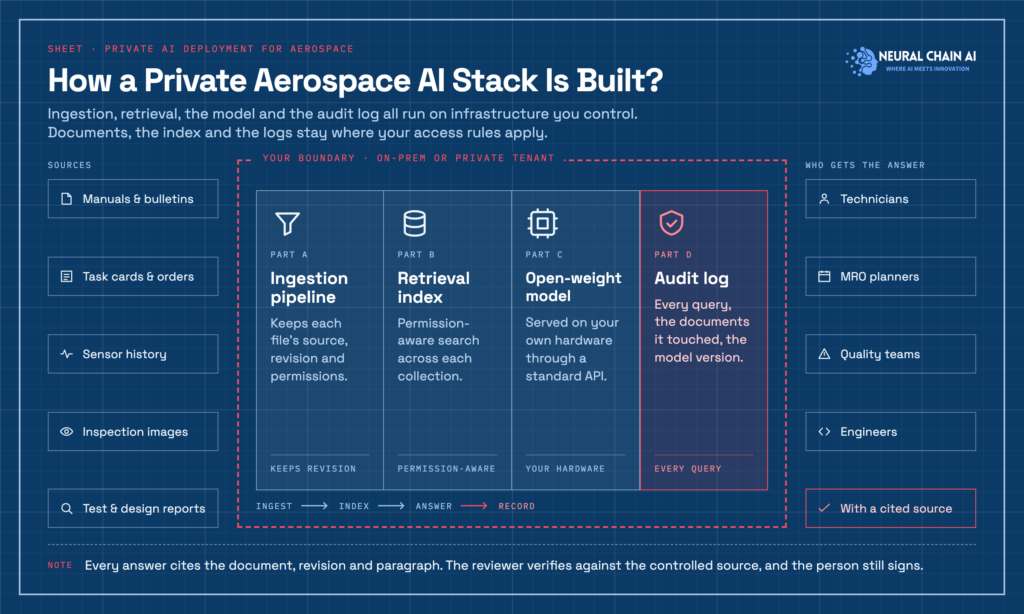
Open-weight language models can run on hardware you own, and inference servers such as vLLM expose them to internal tools through a standard API. A typical private deployment for an MRO shop or supplier has four parts: an ingestion pipeline that keeps each file’s source, revision and permissions, a retrieval index, an open-weight model, and an audit log. Answers cite the source paragraph and revision, so reviewers verify against the controlled document.
At NeuralChainAI, we build this pattern as a custom project for regulated SMB and mid-market firms. The stack runs inside the client’s own infrastructure or cloud tenant, so documents, the retrieval index and the logs stay where the client’s access rules apply. We begin with a data inventory like the one in the 90-day plan below, then build the ingestion pipeline, the retrieval layer and an open-weight model served on the client’s hardware, with a source citation on every answer. The client owns the deployment.
Facilities that keep controlled programs on isolated networks need the model and its updates delivered on approved media. An air-gapped AI deployment follows that pattern. Teams that start in a private tenant can move later when the ingestion pipeline and index are built to be portable.
How to Start an Aerospace AI Project in 90 Days?
A pilot on one document collection gives you evidence before you scale. This plan fits a team of three to five people.
- Days 1–10: Classify the data. List the document sets and data feeds in scope, tag each with its rule set (ITAR or EAR, controlled goods, CUI, OEM licence or commercial), and name who may access each.
- Days 10–20: Choose one workflow. Pick a task with a clear owner and a measurable baseline, such as finding the applicable task card and prior repairs, or triaging incoming non-conformance reports.
- Days 20–40: Build the pilot. Use the deployment option that matches the data tag, and keep source, revision and permissions at ingestion.
- Days 40–55: Write the test set. Collect 50 to 100 real questions with known answers and source paragraphs. Score answer correctness, citation accuracy and how the system behaves when the documents hold no answer.
- Days 55–75: Run with users. Give five to ten users access, log every query, and review misses weekly.
- Days 75–90: Decide. Expand to the next collection, retune, or stop, based on the scores. Set the pass bar before testing, for example 90 percent of answers correct with a correct citation.
Questions to Ask an Aerospace AI Vendor
Use these questions in any vendor or partner review.
- Where are each prompt, document chunk and log entry stored, in which country and in which tenant?
- Who at the vendor can read our data, and do they meet the nationality and registration rules that apply to it?
- Which model version produced each answer, and how do you announce a change?
- Can the system cite the document, revision and paragraph behind every answer?
- Can we export our index, prompts and logs when the contract ends?
Planning an aerospace AI pilot on documents that cannot leave your network? NeuralChainAI designs and deploys private and self-hosted AI for regulated SMB and mid-market firms. Book a 30-minute AI strategy session and leave with a one-page scoping summary.