AI agents for customer service read an incoming request, work out what the customer wants, look up the accounts and policies that apply, take the action the request calls for, and hand the contact to a person when any of those steps comes up short. This article traces the six decisions inside a single ticket, sets out which request types agents resolve today, and breaks down what they cost under the three billing units vendors currently charge on.
Support is the first place most companies point an agent, for a reason: ticket volume and handle time are already measured, so the result shows up in numbers the team already trusts. Gartner projects that by 2029, agentic AI will autonomously resolve 80% of common customer service issues, cutting operational costs by 30%.
The commercial side moved faster than most buyers noticed. Three of the largest vendors now bill on three different units, and the unit changes your invoice more than the rate does.
What AI Agents for Customer Service Do?
An agent answers and acts. It reads the message, retrieves the order record or the policy that governs the request, performs the write the request implies, and replies with what it did. A customer asking to change a delivery address gets instructions from a help article, an answer from a chatbot, and a changed address from an agent.
Acting is what separates the current generation from the deflection bots that came before it. Deflection measured how many people gave up before reaching a person. Resolution measures how many people got what they came for. Those two numbers move in opposite directions on customer satisfaction, which is why the metric a vendor reports deserves a close read before the rate does.
How AI Agents for Customer Service Work? One Ticket, Six Key Decisions
Trace a single contact and the machinery becomes concrete. A customer writes in asking where their order is and whether they can still change the shipping address.
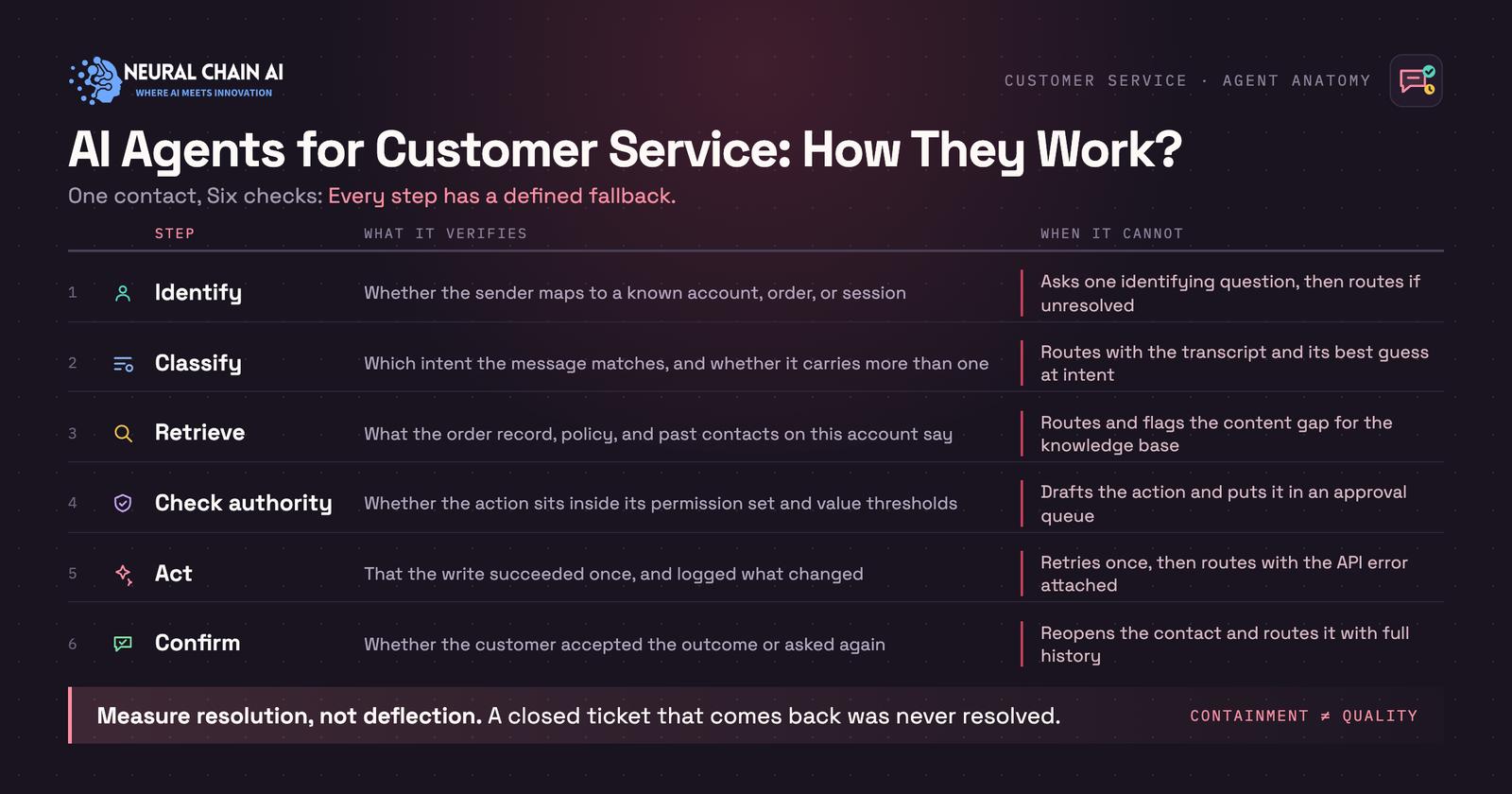
The following 6 decisions follow, each with a point where the agent stops and a person takes over.
| Decision | What the agent checks | What happens when it cannot |
|---|---|---|
| 1. Identify | Whether the sender maps to a known account, order, or session | Asks one identifying question, then routes if the answer does not resolve |
| 2. Classify | Which intent the message matches, and whether it carries more than one | Routes with the transcript and its best guess at intent attached |
| 3. Retrieve | What the order record, policy, and past contacts on this account say | Routes and flags the content gap so the knowledge base gets fixed |
| 4. Check authority | Whether the action sits inside its permission set and value thresholds | Drafts the action and puts it in an approval queue |
| 5. Act | That the write succeeded once, and logged what changed | Retries once, then routes with the API error attached |
| 6. Confirm | Whether the customer accepted the outcome or asked again | Reopens the contact and routes it with full history |
Decisions 1 through 3 are read operations and carry almost no risk. Decision 4 is where the compliance conversation lives, because it governs refunds, credits, cancellations, and anything else a customer could dispute later. Decision 6 is where the money lives, and the rest of this article explains why: most vendors turn that last decision into the thing they bill you for.
Phone contacts run the same six decisions with speech recognition in front and a shorter patience budget behind. Voice compresses decision 1, because the caller’s number often identifies the account before anyone speaks, and it stretches decision 6, because a caller who hangs up tells you far less than a chat user who replies. Teams running voice alongside chat and email usually build one resolution path and expose it on every channel, which is how a custom AI call center agent stays consistent with what the email queue tells the same customer.
Log every one of the six decisions with its inputs and its output. Support leaders who can see which decision an escalation came from fix the right thing: a decision-2 escalation points at intent coverage, a decision-3 escalation points at a content gap, and a decision-5 escalation points at an integration that needs attention. Escalation counts on their own tell you the rate without telling you the cause.
Which Support Requests AI Agents Resolve Today?
Resolution rates vary less by industry than by request type. What separates a request an agent closes from one it routes: whether the answer sits in a record it can read, and whether the action sits in a system it can write to.
| Request type | What it reads | What it writes | Difficulty |
|---|---|---|---|
| Order status and tracking | Order record, carrier API | Nothing | Low |
| Product and how-to questions | Help center, product data | Nothing | Low |
| Invoice copies and billing questions | Billing system, payment history | Document send | Low |
| Address and detail changes | Account record, fulfilment status | Account and order update | Medium |
| Returns and refunds inside policy | Order record, returns policy | Return label, refund posting | Medium |
| Subscription upgrades and cancellations | Plan record, contract terms | Plan change, proration | Medium |
| Complaints and goodwill decisions | Full contact history, account value | Routes to a person | High |
The read column drives the build effort more than the write column does. Agents answering from a help center start working in days. Agents answering from contracts, past tickets, and internal policy documents need retrieval over that corpus first, which is a private RAG deployment inside your own tenant rather than a chatbot configuration.
What an AI Agent Needs Before It Resolves Anything?
Four inputs decide how much of your queue an agent can close, and all four sit on your side of the contract rather than the vendor’s.
Help center coverage sets the ceiling. Questions with no documented answer come back as escalations, so the fastest way to raise a resolution rate is usually to write the six articles the escalation log keeps pointing at. Read access to live account data separates a generic answer from a useful one, and it is the largest single lever in most deployments: an agent that reads the order record answers “where is my order” in one turn, while an agent limited to the help center explains how tracking works and gets escalated anyway.
Action APIs with scoped credentials decide whether the agent finishes the job or drafts it. Scope each credential to the specific action rather than granting broad admin rights, since the audit conversation later depends on being able to show exactly what the agent was permitted to do. And a labelled sample of past contacts, a few hundred with known-correct outcomes, gives you something to score against. Without it, the resolution rate a vendor reports is the only number available, and it describes their traffic rather than yours.
Two of these four are content and data work rather than AI work, which is why support agent projects often spend their first weeks in the help center and the CRM. That effort transfers: the same corpus and the same access pattern serve the next agent you build.
What AI Agents for Customer Service Cost? 3 Billing Units
Vendors agree that usage should drive the bill. They disagree completely about what to count. The three largest sell on three different units, and the unit determines whether you pay for contacts, for successes, or for work performed.
| Model | Billing unit | Published rate | What triggers the charge |
|---|---|---|---|
| Intercom Fin | Outcome | $0.99 per outcome on a $49 monthly base plan that covers the first 50 | Fin answers and the customer confirms it helped or leaves without asking again, billed once per conversation |
| Zendesk AI agents | Automated resolution | Not published. Independent 2026 teardowns report roughly $1.50 on committed volume and $2.00 pay as you go | A resolution above the plan allowance, which since May 2026 counts only resolutions a verification step confirms |
| Salesforce Agentforce | Action, or conversation | $500 per 100,000 Flex Credits, which is $0.10 a standard action and $0.15 a voice action, or $2 a conversation | Every discrete action the agent performs, or every 24-hour session, depending on which model the org runs |
| Self-hosted build | Tokens and infrastructure hours | Set by your model choice and hardware | Usage as it happens, whether the contact resolves or routes |
Disclaimer: The vendor rates in this article reflect pricing published as of August 2026 and appear here for comparison rather than as a quote. Intercom, Zendesk, and Salesforce have each revised these models more than once in the past two years, and the Zendesk per-resolution figure comes from independent teardowns rather than a published rate card. Confirm current pricing, and what each vendor counts as a billable unit, directly with the vendor before you commit. Cost estimates shown are arithmetic run against published rates on the stated assumptions, and your own volume, resolution rate, and actions per conversation will produce different numbers.
Rates come from Fin’s published outcomes documentation and the Agentforce pricing page. Zendesk publishes the unit in its automated resolutions documentation without publishing the rate, so treat the dollar figures there as reported rather than official. All four move, so confirm before signing.
The Billing Unit Moves Your Invoice More Than the Rate
Take 3,000 monthly contacts and an agent that resolves 45% of them, with an average of eight actions per handled conversation. Run the published rates against those figures and the same month costs four different amounts.
- Per outcome at $0.99, the 1,350 resolved contacts bill about $1,340.
- Per resolution at $1.50, they bill $2,025.
- Per action at $0.10 across eight actions on all 3,000 conversations the agent touches, the month bills $2,400.
- Per conversation at $2.00, every session the agent enters counts, so 3,000 contacts bill $6,000 whether the agent resolved them or handed them over.
Those four numbers describe identical work. The spread comes from what each vendor decided to count, which makes the unit the first thing to settle in a negotiation and the rate the second.
These questions get you there:
- Does a contact the agent routes to a person still bill?
- Does a customer who goes quiet count as a success?
- Does a single contact that triggers twelve backend lookups bill once or twelve times?
Get the answers in the contract rather than the sales deck.
Seat costs sit underneath all of this. Every platform above still charges per human agent, so the AI meter adds to the support stack rather than replacing part of it. The volume where a build starts costing less than a meter depends on your contact mix, and it is the same arithmetic that decides where AI agents pay back first across any department.
Companies past a few thousand resolutions a month often find that self-hosted infrastructure inside their own network converts an uncapped variable meter into a largely fixed cost, and keeps customer records out of a vendor cloud at the same time.
Resolution Rate: The Number Every Estimate Depends On
Every cost estimate above multiplies by a resolution rate, so that percentage carries more weight than any other input. Vendor marketing quotes rates near 80%. Published customer results run lower: Intercom’s pricing page carries a customer reporting a 50% resolution rate, and figures in the 40s appear across published case studies.
The things that move your number include:
- Help center coverage sets the ceiling on how many questions have an answer to find.
- Access to live account data decides whether the agent can personalize rather than generalize, and it is usually the single largest lever.
- Contact mix determines how much of your volume falls into the low-difficulty rows of the table above.
Measure the rate on your own traffic during a pilot before signing an annual commitment. A vendor benchmark reflects the vendor’s best-performing customers, and it moves with the messiness of your inputs rather than with the model.
AI Agents for Customer Service: Where the Handoff to a Person Belongs?
A good handoff carries the identity the agent established, the intent it classified, the records it retrieved, and the actions it attempted. A person picking up that contact should never ask the customer to repeat anything already said.
Set the handoff triggers explicitly rather than leaving them to model confidence alone. Four earn their place in most deployments: the customer asks for a person, sentiment turns sharply negative, the request crosses a value threshold your policy names, and the agent has attempted the same action twice without success. Each one is countable, which means you can report on how often it fires and tune from evidence.
Track the reasons behind escalations weekly. They tell you which knowledge is missing, which system access is absent, and which request type is ready to move inside the agent’s authority next. Support teams that read escalation reasons as a work queue improve their resolution rate month over month without touching the model.
Working out which contact types your agent should resolve first, or which billing unit fits your volume? Our agentic AI consulting and development team builds support agents for SMB and mid-market companies, deployed inside your own infrastructure. Book an AI strategy session and leave with your contact mix scored.