Robotics consulting is the advisory and engineering work that turns an automation idea into a robot system that runs safely, reliably, and at a defensible cost. This guide covers what robotics consultants deliver, how engagements are structured and priced, what the work costs at current market rates, and how to scope a project so the budget matches what actually gets built.
Factories worldwide installed 542,000 industrial robots in 2024, bringing the global operational stock to 4,664,000 units, according to the International Federation of Robotics. Few of those deployments were designed entirely in-house. One working cell draws on mechanical design, controls engineering, safety validation, vision software, and increasingly machine learning, and those five skills rarely report to the same manager.
That gap is what robotics consulting fills. Engagements run from a three-week feasibility study to a multi-year build staffed by a dedicated engineering pod. The sections below set out the services, the commercial models, the cost benchmarks, and the questions worth settling before anyone signs.
What Does a Robotics Consultant Do?
A robotics consultant evaluates whether a task suits automation, designs the system that performs it, and carries the engineering decisions that determine whether the result holds up in production. The work spans five areas.
Feasibility and ROI Modelling
The first question is whether the application suits a robot at all. Answering it means measuring cycle times, quantifying part variability, checking whether fixturing can present parts repeatably, and building a payback model against real labour, scrap, and downtime numbers. The strongest studies price the complete cell rather than the arm, and they treat a recommendation to stop as a valid outcome. For plants running this exercise across several lines, the same modelling underpins broader manufacturing and industrial AI work.
System Architecture and Integration Engineering
Robot selection, end-of-arm tooling, fixture design, vision placement, safety layout, and the controls layer that ties them together. Integration decisions include the fieldbus (EtherCAT, PROFINET, or DeviceNet), the PLC interface, and how the cell reports upward to an MES or ERP. Offline programming and simulation belong here too, since proving reach and cycle time in software costs a fraction of proving it on the floor.
Perception, Control, and AI Software
Bin picking, weld seam tracking, deformable part handling, and inline quality inspection depend on perception rather than taught points. This is where 2D and 3D vision, pose estimation, force and torque control, motion planning, and ROS 2 development sit. It is also where a consulting team with machine learning depth differs from a traditional integrator, because the work resembles model development more than mechanical design.
Safety, Compliance, and Validation
Risk assessment under ISO 12100, safeguarding design, functional safety performance levels, validation testing, and the documentation package that satisfies an auditor or an insurer. The reference standards changed substantially in 2025, covered further down.
Data Strategy for Robot Learning
Teams building learned policies rather than scripted motion need a data plan before they need a model: what to record, at what rate, with which sensors, under what consent terms, and in what format. This is the newest line of robotics consulting work and the one with the least settled pricing.
Robotics Consulting Engagement Models
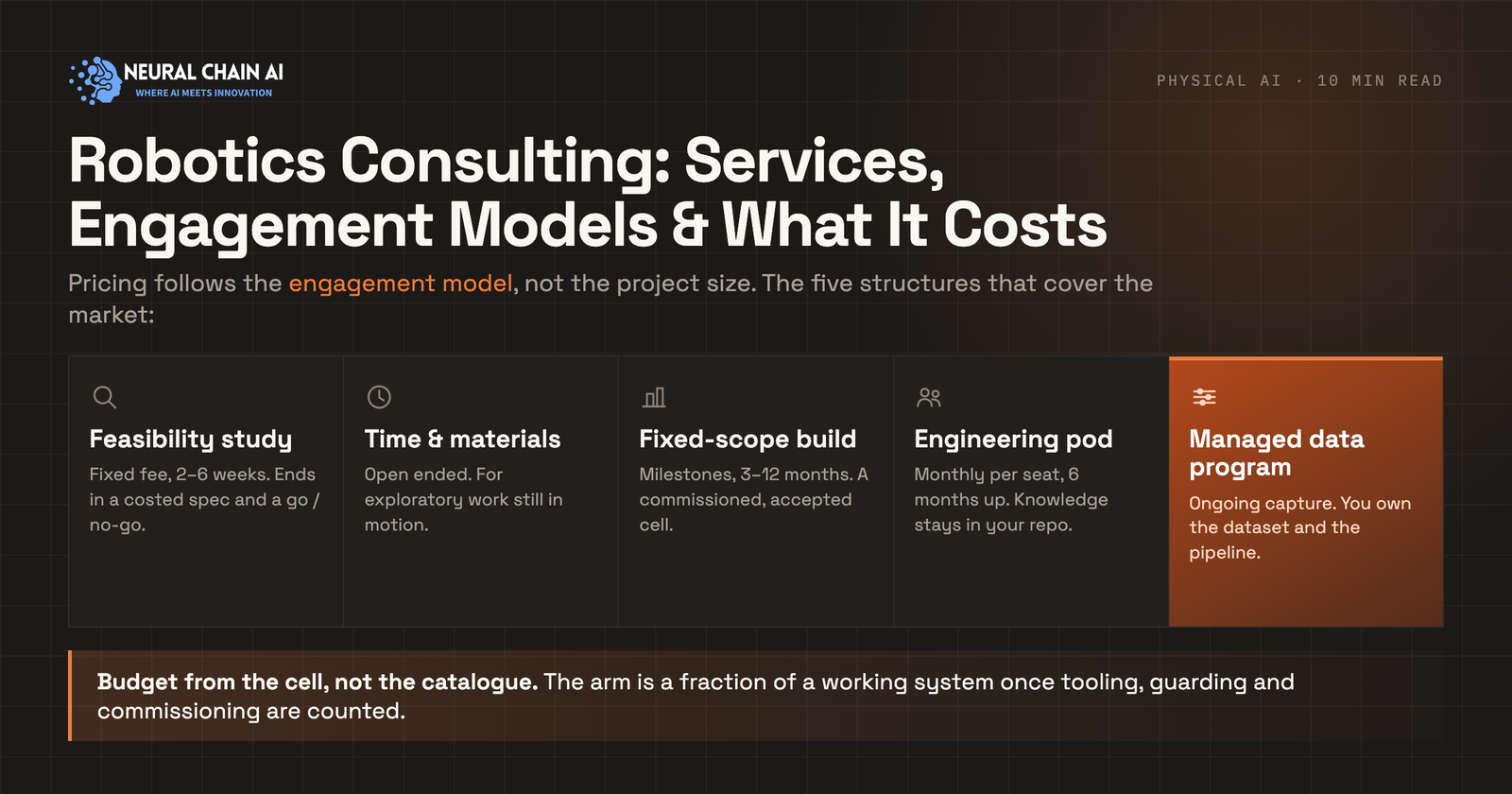
Five commercial structures cover most of the market. The right one depends on how well defined the problem is rather than how large the budget is.
| Engagement model | Pricing basis | Typical duration | Suits | What you hold at the end |
|---|---|---|---|---|
| Feasibility study | Fixed fee | 2–6 weeks | Unproven applications and capital approval | A costed specification and a go or no-go recommendation |
| Time and materials | Hourly or daily rate | Open ended | Exploratory work and requirements still in motion | Whatever was built, billed as it was built |
| Fixed-scope build | Milestone payments against a written spec | 3–12 months | Well specified cells with a stable process | A commissioned system with acceptance criteria met |
| Dedicated engineering pod | Monthly retainer per seat | 6 months and up | Product companies building robots continuously | Continuous delivery and knowledge retained in your repo |
| Managed data or operations program | Per episode, per operator hour, or per month | Ongoing | Robot learning teams that need demonstration data | A dataset and a capture pipeline you own |
Two patterns are worth copying. A fixed-fee study ahead of a fixed-price build gives both sides a scope that survives contact with the shop floor, because the study produces the specification the build quotes against. And a pod arrangement suits teams whose requirements shift monthly, since re-scoping a fixed-price contract every few weeks costs more in contract administration than it saves in certainty.
What Robotics Consulting Costs?
Rates vary by region, application, and how much hardware sits inside the scope. The reference figures below come from published 2025 and 2026 sources, so a budget can be built before the first quote anchors it.
| Cost element | Reference range | Basis |
|---|---|---|
| Six-axis industrial robot arm | USD 25,000–180,000 | Payload class and brand tier, per 2026 supplier pricing guides |
| Collaborative robot arm | USD 20,000–50,000 | Payload and reach, per 2026 cost breakdowns |
| Arm as a share of total cell cost | 25–40% | Tooling-heavy cells fall below 25%, per published TCO models |
| Fully integrated single cell | 2–4× the arm price | Welding and assembly cell breakdowns including tooling, safety, peripherals |
| Integration and programming labour | 20–40% of project cost | Supplier cost guides; turnkey builds sit toward the lower end |
| Robotics consultant compensation benchmark | About USD 59 per hour base | US average for the role, per Glassdoor. Billed rates run above payroll cost |
| Teleoperation data collection | USD 28–60 per operator hour | All-in benchmark covering wages, supervision, facility, hardware amortisation, per a 2026 vendor benchmark |
| Five-year total cost of ownership | About 2.5–3× initial hardware cost | Modelled two-shift US cell, per Robotomated |
One ratio carries most of the budgeting weight. The robot arm accounts for roughly a quarter to two-fifths of a working cell, and total acquisition commonly lands at two to four times the arm price once tooling, guarding, peripherals, and commissioning are counted. Budget from the cell, not the catalogue page.
Where the Budget Goes After Go-Live?
Capital approval usually stops at commissioning, and the spending does not. Maintenance, spare parts, consumables, software licensing, and reprogramming for new part numbers continue for the life of the asset. A modelled five-year picture for a two-shift cell puts acquisition at roughly a third of lifetime cost, with maintenance, changeover programming, licensing, energy, compliance, and supervision making up the rest.
Changeover is the line most often missed at quote stage. A cell that handles one part perfectly and needs three engineering days for every new SKU has a different economic profile from one designed for fast reteaching. Ask how a part change is handled before signing, and ask who performs it.
What the 2025 Robot Safety Standards Changed?
ISO 10218-1 and ISO 10218-2 were revised in early 2025, the first substantial update since 2011. The Association for Advancing Automation adopted them in the United States as ANSI/A3 R15.06-2025, approving Parts 1 and 2 in August 2025 and Part 3 in October, with the complete three-part standard running to 403 pages. Canada is publishing the parts as Z434.
Four changes affect how work gets scoped:
- Most of ISO/TS 15066 on collaborative operation moved into Part 2. Collaborative is now a property of the application rather than the robot, so specifying a cobot does not by itself make a cell collaborative.
- Robot classifications were introduced, each carrying matching functional safety requirements and test methods.
- Cybersecurity guidance now sits inside safety planning rather than alongside it.
- Terminology shifted, including safety-rated monitored stop becoming monitored standstill.
Ask any prospective partner which edition your validation package will be written against, and whether existing cells on the same line carry documentation to the 2012 edition. Retrofits, line moves, and tooling changes are the usual triggers for a fresh risk assessment.
Robotics Consulting for Physical AI and Learned Policies
A growing share of robotics companies work involves no taught waypoints at all. Vision-language-action models and imitation-learned policies handle tasks that resist scripting: deformable materials, variable part presentation, and contact-rich assembly. For these programs the consulting question moves from cell design to data.
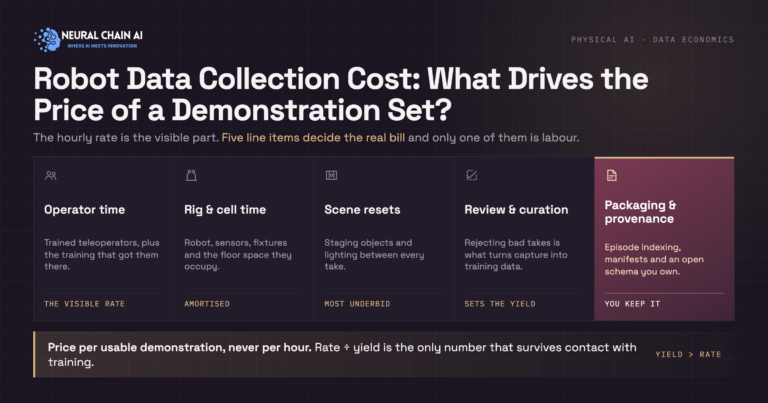
The economics deserve attention before commitment. Teleoperated collection runs close to one hour of skilled operator time for every hour of usable robot data, a constraint researchers at AgiBot describe directly. Requirements scale quickly with ambition: recent multi-task diffusion transformer work reports thousands of demonstrations amounting to nearly 2,000 hours of teleoperated data, while large VLA programs operate at tens of thousands of hours.
Rig choice turns those operator hours into a budget, and the spread runs from handheld capture under 1,500 US dollars to dexterous glove systems past 400,000. Our guide to robot teleoperation systems, data quality and cost per hour covers the rig families and the cost per usable episode calculation.
Methods that reduce the operator-hour bill are advancing fast. The Real2Render2Real work reported policies trained on data synthesised from a single human demonstration matching policies trained on 150 teleoperated demonstrations, measured across 1,050 physical robot evaluations. Human video capture, human-robot co-training, and simulation each change the ratio of paid hours to usable episodes, and a partner should be able to argue for a mix rather than defaulting to brute-force teleoperation.
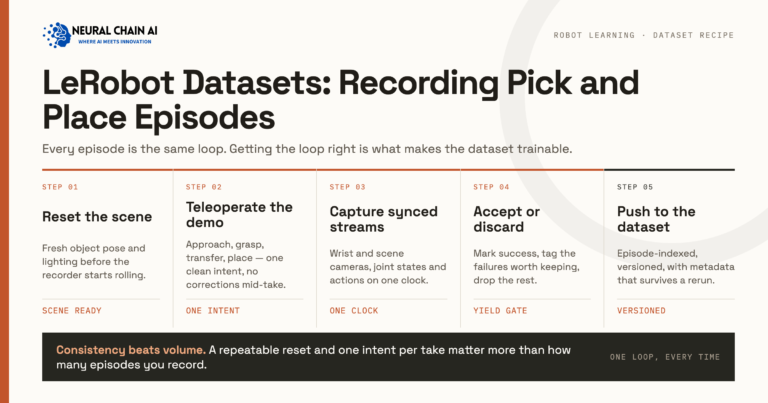
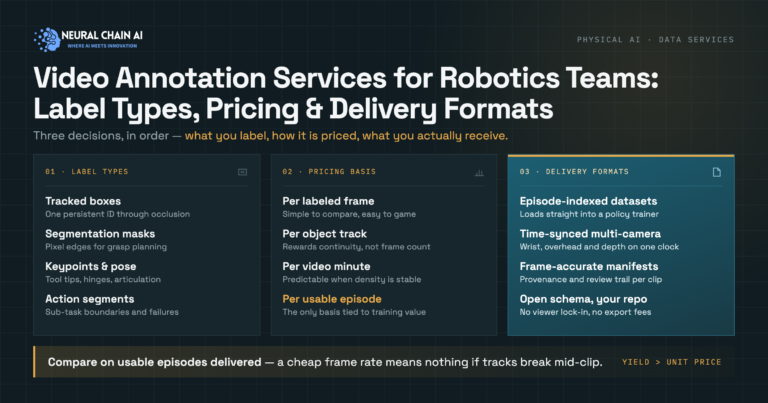
A team working in this space should specify sensor suite, capture rate, episode format (LeRobot and HDF5 are the common targets), provenance, and consent terms before the first episode is recorded. NeuralChainAI runs robot data collection services and embodied AI training data programs alongside its engineering work.
How to Scope a Robotics Consulting Engagement?
- Write the acceptance test first. Cycle time, first-pass yield, uptime, and changeover time, with the measurement method and the person who signs off named.
- Ask what share of the quote is hardware. If it runs above half, the tooling, guarding, and commissioning work is probably underscoped.
- Confirm the standards edition. R15.06-2025 or the 2012 edition, and who authors and signs the risk assessment.
- Settle ownership in writing. PLC logic, robot programs, CAD, trained models, and datasets. Ownership belongs in the contract rather than the kickoff call.
- Ask for the commissioning plan. Site acceptance test protocol, ramp schedule, and what support looks like in week six.
- Price the second cell. The marginal cost of the next unit tells you how repeatable the design is.
- Name the internal owner. Deployments move at the speed of the person on your side who can approve a layout change.
Planning a robot deployment or a robot learning program? The Physical AI and robotics consulting team at NeuralChainAI scopes feasibility, integration architecture, safety validation, and training data collection. Bring the application and the constraints; you get back a costed path with the assumptions written down.