You have an AI project on the table — a support chatbot, a document-processing pipeline, a forecasting model, maybe your first serious step into agentic workflows. The build is clear enough in your head. The harder question is who does the work: a single AI consultant or a full AI agency.
The two look similar from the outside. Both promise strategy, models, and a working system at the end. They price differently, staff differently, and carry different risks. Pick the wrong one and you either overpay for coordination you did not need or under-resource a project that quietly stalls. This guide breaks down the real differences, the costs, and a decision framework you can apply to your own build today.
AI Consultant vs. AI Agency: What is the difference?
An AI consultant is an individual expert you engage directly. They assess your problem, recommend an approach, and often build the solution themselves. You work with one person who holds the full context of your project. Scope tends to be advisory, prototype, or single-workstream delivery.
An AI agency is a company with a team — data scientists, ML engineers, project managers, and sometimes designers and DevOps staff. An agency takes on larger, multi-part builds, spreads work across specialists, and delivers under a defined contract with account management on top.
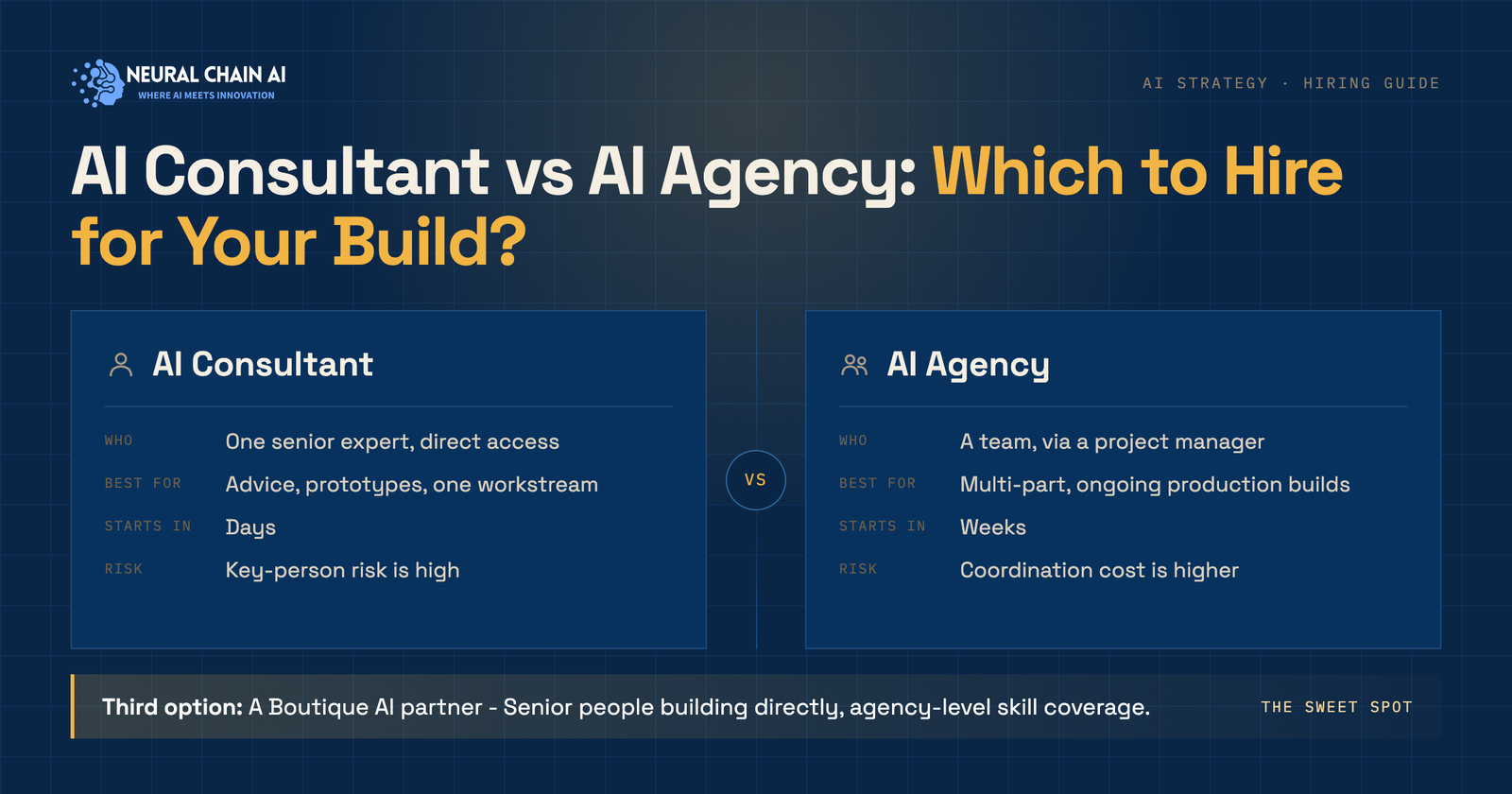
The shortest way to hold the distinction: a consultant is a person, an agency is a team. That single fact drives almost every practical difference in cost, speed, risk, and the kind of project each one suits.
| Factor | AI Consultant | AI Agency |
|---|---|---|
| Who you work with | One expert, direct access | A team, usually via an account or project manager |
| Best-fit project size | Advisory, prototype, single workstream | Multi-part builds, ongoing platforms |
| Typical cost | $150–$400/hr or fixed project fee | $25k–$250k+ per engagement |
| Speed to start | Days | Weeks (scoping, contracting) |
| Breadth of skills | Deep in a few areas | Wide, multiple specialists |
| Key person risk | High — one person | Low — team coverage |
| Flexibility | High, informal | Moderate, process-bound |
| Post-launch support | Case by case | Usually a retainer or SLA |
What does an AI consultant do?
A consultant earns their fee on judgment. Companies bring them in when the question is not only “can we build this” but “should we, and how.” The work usually covers three things.
Assessment. A consultant looks at your data, your workflows, and your goals, then tells you which problems AI can solve and which it cannot. This step alone saves money — many AI projects fail because the wrong problem was picked, not because the model was weak.
Strategy and roadmap. They map a sequence: what to build first, what data you need, which tools fit, and what the realistic timeline looks like. For a company new to AI, this roadmap becomes the plan the rest of the organization works from.
Hands-on delivery. Many consultants build too. A single experienced practitioner can ship a working prototype, fine-tune a model, or stand up a retrieval pipeline without the overhead of a larger team.
The trade-off is bandwidth. One person has a fixed number of hours and a bounded skill set. A consultant strong in NLP may not be your best choice for a computer-vision system, and a project that needs three disciplines at once will stretch a solo operator thin.
What does an AI agency do?
An agency sells capacity and coverage. Instead of one skill set, you get a bench. That structure suits work with several moving parts running in parallel.
A typical agency engagement pulls in a data engineer to build pipelines, an ML engineer to train and deploy models, a project manager to keep timelines honest, and sometimes a front-end developer to wrap it all in a usable interface. Nobody person needs to be expert in everything, because the team covers the gaps.
Agencies also bring process. Defined milestones, documentation, testing, and handover are baked into how they operate. For a regulated business, or one that needs the system maintained long after launch, that process has real value.
What you pay for it is coordination cost and less direct access. Your questions often route through a project manager rather than landing with the engineer writing the code. Timelines carry more overhead because more people need aligning. And the entry price is higher — most agencies will not take a build below a certain contract size because the model does not work for small jobs.
AI Consultant vs. AI Agency: How much does each option cost?
Cost is where the decision gets concrete. The ranges below reflect the North American market for mid-market and SMB AI work in 2026. Rates vary by region, seniority, and problem complexity.
| Engagement type | Consultant | Agency |
|---|---|---|
| Hourly rate | $150–$400 | $150–$300 (blended) |
| Strategy / discovery | $5k–$20k | $15k–$50k |
| Prototype / MVP | $10k–$40k | $40k–$120k |
| Full production build | Often out of scope | $80k–$250k+ |
| Ongoing support | Ad hoc | $3k–$15k/mo retainer |
Pricing is indicative and varies by scope, region, data readiness, and seniority. Treat these figures as planning ranges, not quotes.
Read the table for shape, not just numbers. A consultant’s hourly rate can sit higher than an agency’s blended rate, because you are paying for one senior person rather than a mix of junior and senior staff. But total project cost usually runs lower with a consultant, since you are not funding a full team or account-management layer. The agency costs more in absolute terms and returns more capacity and coverage for it.
AI Consultant or AI Agency: Which is faster and less risky?
Speed and risk pull in different directions depending on project size.
A consultant starts faster. There is no contracting marathon, no team to assemble — one conversation and a signed statement of work can have them building within days. For a prototype or a time-boxed experiment, that head start matters.
An agency starts slower but scales better. Scoping, contracting, and team assembly add weeks up front. Once running, though, an agency can push several workstreams at once, which a solo consultant cannot. On a large build, the agency often finishes sooner despite the slower start.
A consultant carries key-person risk: if they get sick, take another client, or simply run out of hours, your project is exposed. An agency spreads that risk across a team and usually guarantees continuity in the contract. Against that, an agency introduces coordination risk — more people means more that can slip between them, and you are one step removed from the person writing the code.
| Dimension | Consultant wins when… | Agency wins when… |
|---|---|---|
| Speed to start | You need to move this week | You can absorb a few weeks of setup |
| Speed to finish | Scope is small and single-track | Scope is large and parallelizable |
| Continuity risk | Project is short enough that one person suffices | Project runs for months and must not stall |
| Coordination risk | You want one point of contact | You accept process in exchange for coverage |
What about Hybrid and Boutique models?
The consultant-versus-agency split is cleaner in theory than in the market. A third option sits between them, and it often fits SMB and mid-market buyers best.
A Boutique AI firm runs a small, senior team — the coverage of an agency without the layers. You still get direct access to the people building your system, but with a data engineer and an ML engineer working together instead of one generalist stretched across both. Boutiques take on production builds that a solo consultant would decline, at a cost below what a large agency charges for the same work.
Two other arrangements are worth knowing:
- Consultant plus contractors. A lead consultant scopes and directs the work, then pulls in specialist freelancers as the project needs them. Lean, but the consultant carries the coordination burden themselves.
- Fractional AI leadership. A senior practitioner acts as your part-time head of AI, setting direction and overseeing whoever executes — internal staff, contractors, or an agency. Useful when you have builders but no one to steer them.
The boutique model is why the strict binary misleads so many buyers. The real question is rarely “one person or a big firm” — it is “how much senior attention can I keep on my project while still getting the range of skills it needs.” A small senior team often answers that better than either extreme.
Weighing firm size specifically? Our guide on Big 4 vs Boutique Consulting compares who ships faster, at what cost, and with how much senior attention.
How do you choose the right one for your build?
Run your project through five questions before you sign anything. Each one points toward a consultant, an agency, or a boutique in between.
| Ask yourself | Points toward |
|---|---|
| Is this advice, a prototype, or a full production system? | Advice/prototype → consultant · Production → agency or boutique |
| Does the build need one skill or several at once? | One → consultant · Several → team |
| What is your budget ceiling? | Under ~$40k → consultant/boutique · Higher → agency |
| Will the system need maintenance after launch? | Yes → agency/boutique with a retainer |
| How much can you risk on one person? | Low tolerance → team coverage |
A pattern emerges from the answers. Early-stage work — figuring out whether AI fits, building a proof of concept, pressure-testing an idea — favors a consultant. Production systems that several people will use and someone must maintain favor a team. And when you need senior hands on a real build without agency-scale cost, a boutique firm sits in the gap.
AI Consultant or AI Agency: Which should you choose?
Match the engagement to the stage of your build, not to a preference for one label over another.
Choose an AI consultant when you are early, exploring, or scoping. If you need a roadmap, a second opinion on feasibility, or a quick prototype to show stakeholders, one senior expert is the fastest and most cost-efficient route. You get direct access, quick starts, and a lower bill.
Choose an AI agency when the build is large, multi-disciplinary, and has to keep running. If you are shipping a production system that pulls together data engineering, model development, and deployment — and you want continuity and formal support after launch — a full team earns its higher cost.
Choose a boutique AI partner when you want the best of both: senior people building your system directly, the range of skills a real build needs, and a cost that fits a mid-market or SMB budget. For most companies past the prototype stage but not running enterprise-scale programs, this is the practical sweet spot.
At NeuralChainAI, we work as that boutique partner, a small senior team taking companies from AI strategy through to production systems in generative AI, machine learning, computer vision, and agentic workflows. If you are weighing your options for a specific build, our AI Solutions page lays out how we scope and deliver these engagements. Bring us the problem and we will tell you plainly which model fits — even when that answer is a solo consultant rather than us.