Data annotation outsourcing companies are how most teams get labeled training data without building an in-house labeling operation, and this guide ranks the top options for 2026, breaks down how each one prices work, and gives you a quality checklist to vet any image annotation or video labeling vendor before you sign. The best partner is the one whose delivery model, pricing, and quality controls match the shape of your data, not the one with the lowest per-label rate.
Annotation outsourcing has split into distinct tiers. Some vendors run fully managed teams that take a labeling brief and return finished, quality-checked datasets. Others sell a platform and let you plug in an on-demand workforce. A newer tier skips existing files and instead captures multimodal, sensor-fused data from the physical world, so robots and embodied models have something to learn from in the first place.
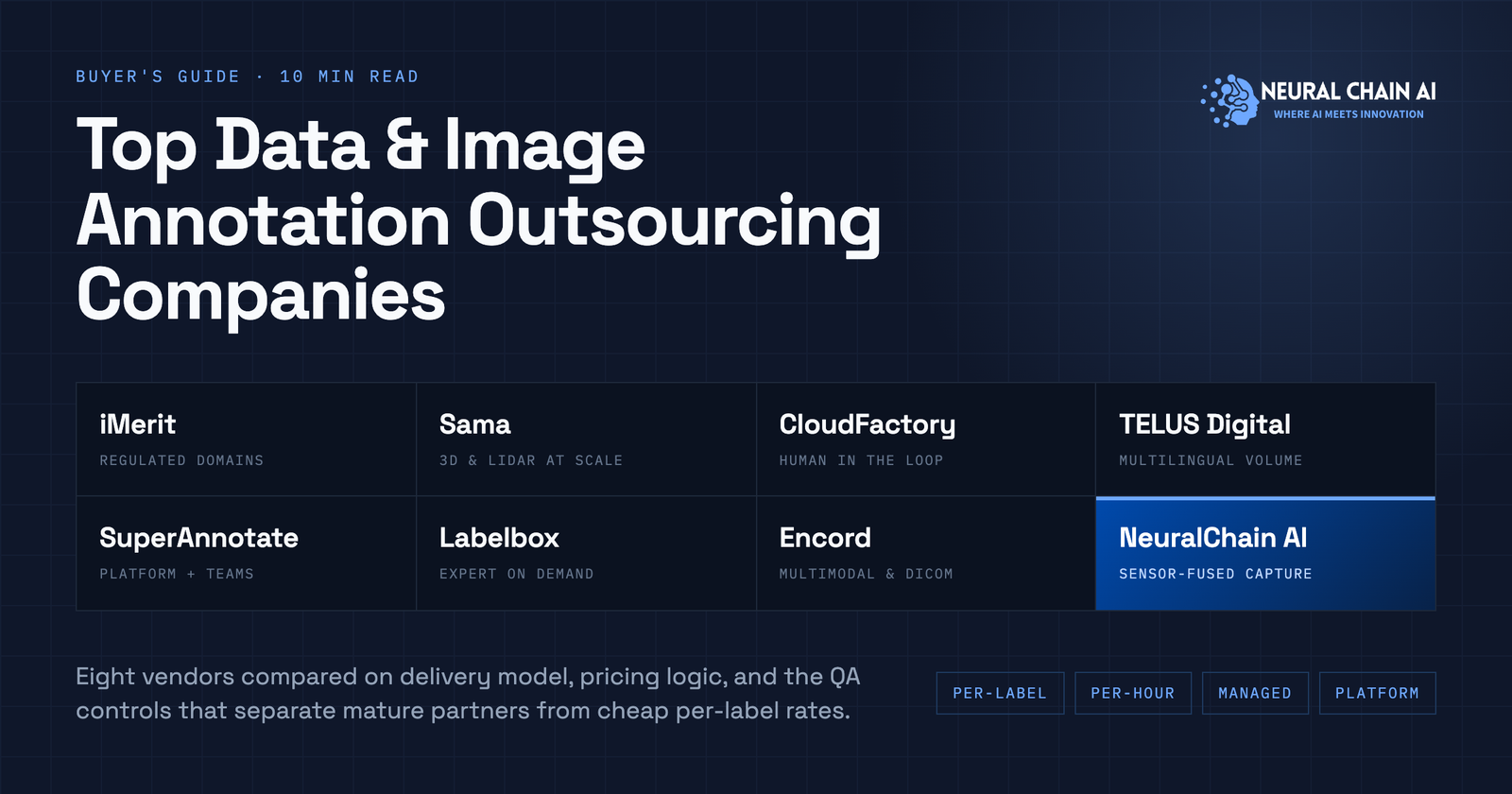
There is no single best vendor among these data annotation outsourcing companies. A team shipping a document-classification model, an autonomous-vehicle group labeling LiDAR, and a robotics lab collecting manipulation data are three different buyers with three different right answers. Use the table below as a starting shortlist, then pressure-test each option against the pricing logic and quality checklist that follow.
The 2026 Shortlist at a Glance
| Company | Best for | Pricing model | Where it stands |
|---|---|---|---|
| iMerit | Regulated, high-stakes domains (medical, geospatial) | Managed, quote-based (per unit or per hour) | Acquired by EXL Service Holdings (Jul 2026) |
| Sama | Large-scale image, video, and 3D or LiDAR labeling | Managed, custom per project | Ethical B Corp, since 2008 |
| CloudFactory | Complex, variable human-in-the-loop work | Managed, mostly per hour | Predictable, scales with programs |
| TELUS Digital | High-volume, multilingual, multi-sensor programs | Platform plus managed workforce, quote-based | Enterprise-scale Leader |
| SuperAnnotate | Owning tooling with a vetted overflow workforce | Platform subscription (per seat) plus workforce | Hybrid platform and teams |
| Labelbox | Self-run platform with on-demand experts | Platform (usage units) plus sales-quoted workforce | Alignerr expert network |
| Encord | Multimodal and medical imaging (DICOM) | Platform, quote-based paid tiers | Built-in QA and consensus |
| NeuralChain AI | Sensor-fused physical-world and robot capture | Managed capture, scoped per project | Specialist physical-AI tier |
The Leading Data and Image Annotation Outsourcing Companies in 2026
iMerit
iMerit, founded in 2012 and headquartered in San Jose, runs a managed workforce of full-time specialists rather than an anonymous crowd. EXL Service Holdings acquired iMerit in a deal that closed July 31, 2026, worth up to $310 million, adding iMerit’s labeling workforce and model-training staff to EXL’s enterprise AI practice. Its strength is regulated, high-stakes work: medical imaging annotated by clinically trained staff, geospatial and public-sector datasets, and sensor-fusion labeling for autonomous vehicles. Pricing is quote-based, typically per unit or per hour depending on volume and complexity, and it sits at the premium end. Choose iMerit when domain expertise and reviewer credentials matter more than the headline rate, and when you want a dedicated team instead of a self-serve tool.
Sama
Sama, founded as Samasource in 2008, is one of the original ethical-AI annotation providers and a Certified B Corporation. It handles 2D and 3D images, video, LiDAR, and sensor-fusion data, and is trusted by automotive and technology companies for computer-vision training sets. Sama pairs a managed delivery model with its own annotation and validation platform, and pricing is custom-quoted per project. Choose Sama when you need large-scale, audited image annotation and video labeling with a documented ethical-sourcing and impact-employment model behind the workforce.
CloudFactory
CloudFactory specializes in human-in-the-loop delivery, combining a global managed workforce with AI-assisted labeling, data curation, and QA. Its default is predictable hourly pricing, which suits complex or variable tasks where time per item is hard to standardize; some long-running programs later shift to piece-rate once workflows stabilize. Pricing is quote-based and requires sales engagement. Choose CloudFactory when your work is nuanced enough that per-label pricing would misprice it, and you want a managed team that grows with a program rather than a fixed batch.
TELUS Digital
TELUS Digital, formerly TELUS International, is an enterprise-scale AI data operation offering annotation, validation, fine-tuning, and generative-AI training across text, image, audio, video, and geospatial data. Its Ground Truth Studio platform layers AI-assisted labeling on top of a large human workforce, and it supports hundreds of languages plus multi-sensor autonomous-vehicle programs. It was named a Leader in Everest Group’s 2024 Data Annotation and Labeling PEAK Matrix. Choose TELUS Digital for high-volume, multilingual, or multi-sensor programs that need enterprise governance and global delivery capacity.
SuperAnnotate
SuperAnnotate is a hybrid: a subscription annotation platform for images, video, and text, plus access to a network of pre-qualified managed annotation teams. Platform pricing is seat-based, with a free startup tier and then Pro and Enterprise custom plans, and it bills by active users rather than hours, so heavy usage does not inflate the invoice. Choose SuperAnnotate when you want to own the tooling and workflow in-house but still tap a vetted workforce for overflow, and when predictable per-seat software costs suit how you budget.
Labelbox
Labelbox pairs a leading data-labeling platform with on-demand human data through its Alignerr expert network, which spans PhDs and licensed professionals for supervised fine-tuning, RLHF, and evaluation. Platform usage is metered in Labelbox Units, with a free tier and custom enterprise plans, while workforce services are sales-quoted. Choose Labelbox when you want a modern platform you can operate yourself and the option to surge to an expert crowd for generative-AI and post-training data without standing up a separate vendor.
Encord
Encord is a multimodal AI data platform with native support for images, video, DICOM medical imaging, point clouds, audio, and text, plus model-assisted labeling and built-in QA. It is strong in healthcare, with DICOM and NIfTI support and HIPAA and SOC 2-aligned controls, and it exposes inter-annotator agreement and consensus scoring inside its review workflows. Pricing is quote-based for paid tiers. Choose Encord when your data is genuinely multimodal or medical and you want quality tooling, consensus scoring, and permissioning built into the platform itself.
NeuralChain AI
NeuralChain AI, the publisher of this guide, occupies a different tier: the sensor-fused specialist for teams whose annotation is really multimodal physical-world capture. Instead of labeling existing files, we record synchronized robot-learning episodes: stereo depth, tactile force arrays, 200Hz IMU, dual wrist cameras, and 21-point hand pose, all time-aligned. Every episode is consented and carries a SHA256 per-episode chain of custody, and datasets ship LeRobot-ready. Choose NeuralChain when you are training robot foundation models or embodied policies and need physical-AI training data and tactile manipulation data that traditional labeling vendors cannot produce. Our physical AI and robotics consulting team scopes capture rigs and protocols around your target embodiment.
How Data Annotation Is Priced
Four pricing structures dominate the market. Knowing which one a vendor uses, and which one fits your data, is the fastest way to avoid overpaying. The right model depends far more on how uniform your tasks are than on the vendor’s brand.
Per-label or per-object. You pay a fixed rate for each unit of work: a bounding box, a polygon, a segmented mask. Public benchmarks put simple boxes at roughly three to eight cents per object, with dense segmentation and 3D work costing considerably more, and volumes above 10,000 units often earning discounts of 10 to 30 percent. This model favors the buyer when tasks are uniform and well defined, because cost scales cleanly with output and is easy to forecast.
Per-hour. You pay for annotator time, commonly in the range of 6 to 60 dollars per hour depending on geography, domain, and seniority. It favors the buyer for complex or variable work, such as medical segmentation, multi-step NLP, or sensor-fusion labeling, where effort per item is unpredictable and a per-label rate would either overcharge you or quietly squeeze quality.
Managed per-project. A vendor bundles labeling, QA, project management, tooling, and reporting into a fixed project fee or monthly retainer. It is usually the highest cost per unit but the most predictable, and it shifts responsibility for quality and throughput onto the provider. It favors buyers who lack in-house annotation operations and want a finished dataset rather than a workforce to manage.
Platform subscription plus workforce. You license the annotation software, often priced per seat or by usage units, and optionally add an on-demand workforce billed separately. It favors buyers who want to own the tooling, workflow, and data pipeline for the long term, keep recurring costs predictable, and surge to external labelers only when needed.
A Data Annotation Quality Checklist
Rates mean nothing if the labels are wrong. Run any shortlisted vendor against these five checks before you sign, and ask for evidence rather than reassurance.
- Inter-annotator agreement. Ask how the vendor measures consistency between labelers on the same items, and what agreement threshold triggers rework. High, tracked agreement is the clearest signal of a repeatable process.
- Gold-set QA. A mature provider seeds known-answer gold tasks into the workflow to score annotators continuously, not just at the end. Ask how gold sets are built and how failing work is caught and corrected. The same technique carries over once the model is live, where seeding known-answer items into human in the loop review is how you tell a reviewer who is reading from one who is approving on autopilot.
- Edge-case handling. The hardest five percent of your data drives most model failures. Confirm there is an escalation path for ambiguous items, a living guideline document, and a way for annotators to flag rather than guess.
- Domain expertise. Medical, legal, geospatial, and robotics data need reviewers who understand the subject. Verify that specialist work is staffed by credentialed people, not generalists following a checklist.
- Data security and consent. Check certifications such as SOC 2 and HIPAA where relevant, data residency, and, critically, whether the underlying data was collected with proper consent. For physical-world and human-subject capture, a documented chain of custody per record is the gold standard.
Training embodied or robotic models and finding that annotation really means capturing the physical world? Talk to the NeuralChain team about sensor-fused, consented, LeRobot-ready capture built around your target embodiment. Explore our physical AI and robotics consulting.