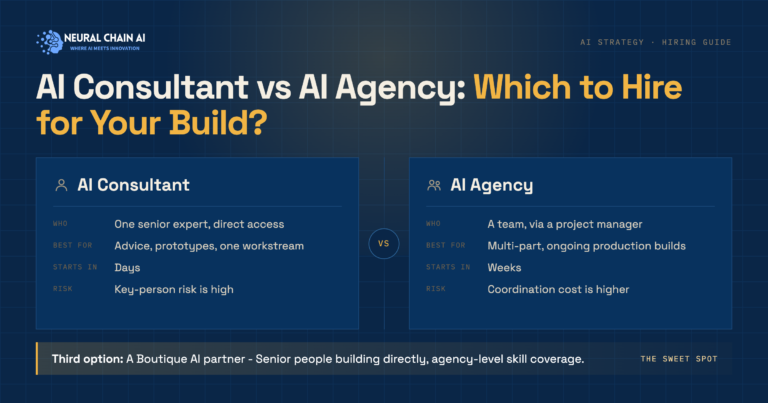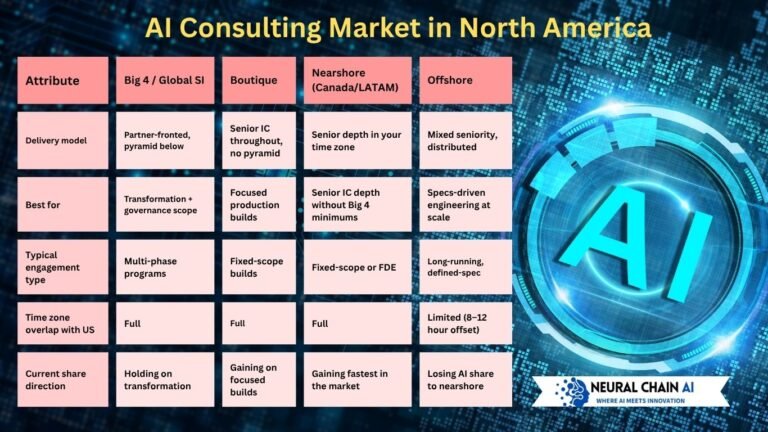
Hiring an AI consultant is worth it when three conditions hold. You have a business problem with a dollar value attached. Your team cannot close the gap between prototype and production on its own. And someone inside your company will own the system after the consultant leaves. When all three hold, the fee is usually the smallest number in the equation. When any one is missing, no consultant can save the engagement.
This exclusive guide shows you how to test each condition before you spend anything.
Do You Really Need an AI Consultant?
“Should I hire an AI consultant?” is rarely a question about consultants. It is a question about whether your AI problem is real.
A real problem has 3 properties.
- It is specific: you can name the process, the team, and the bottleneck.
- It is measurable: you know what it costs you today in hours, errors, or lost revenue.
- It is owned: one person inside your company cares whether it gets fixed.
Most companies asking about consultants have not done this work yet. They have a mandate from the board, a competitor’s press release, or a vague sense of falling behind. That is not a consulting problem. Spending money on outside help at that stage produces a roadmap document that ages quietly in a shared drive.
So before comparing consultants, run your problem through the test below. If it passes, a consultant is likely a good investment. If it fails, you have cheaper homework to do first.
What it Really Costs? The Number That is Not in The Proposal
The fee is only the visible part. Depending on scope, a first serious engagement typically runs from the low five figures for a discovery sprint into six figures for a production build. Pricing by engagement type is a separate topic we cover in depth elsewhere. What matters for the worth-it decision is the total first-year cost, and three items in it never appear in proposals.
Your team’s time. Discovery sessions, data walkthroughs, weekly reviews, testing. Plan for 10 to 20 percent of one internal lead’s time for the length of the engagement. If that person earns $150,000 a year and the project runs five months, that is $6,000 to $12,000 of hidden cost. If they have no time to give, the project fails regardless of consultant quality.
Data preparation. Most AI projects stall on data, not models. If your records are inconsistent, scattered across systems, or trapped in PDFs, either the engagement grows to absorb the cleanup or the cleanup becomes a prerequisite phase. Ask any consultant to estimate this before quoting the build.
Run costs after handover. Inference, hosting, monitoring, and periodic model updates continue for the life of the system. A system that costs $80,000 to build might cost $1,500 a month to run. Get this number in writing before you approve anything. A build you cannot afford to operate is not an asset. It is a liability with good branding.
Total first-year cost, then, is: fee + internal time + data work + twelve months of run costs. That is the number your return has to beat.
A Worked Example Does The Math Clear
Numbers make this concrete. The figures below are illustrative, but the structure is the one we use.
A distribution company processes 400 supplier invoices a week by hand. Two clerks spend most of their time on it. Fully loaded, that labour costs about $130,000 a year. Manual entry errors add roughly $20,000 a year in overpayments and reconciliation time. Annual cost of the current process: about $150,000.
The company first tried to fix this internally. A developer spent a quarter on a prototype that worked on clean invoices and broke on real ones. That is the normal outcome of a first attempt, and it is the strongest argument for experienced help. The failure modes of a system like this are well known to people who have shipped one before, and invisible to people who have not.
An AI consultant quotes the build at $70,000. Experience shapes the scope from the first conversation: an 80 percent automation target instead of a doomed chase for perfection, run costs put in writing at $900 a month, and a design the clerks can trust. Internal time adds an estimated $8,000. Total first-year cost: roughly $89,000.
The result: 80 percent of invoices flow through without human touch, one clerk moves to higher-value work, and error costs fall by half. First-year value: about $95,000 in labor plus $10,000 in error reduction, around $105,000.
First-year return: $105,000 against $89,000. Positive in the first year, which internal attempts rarely manage. Year two is where the hire pays for itself several times over. Costs drop to run costs and light maintenance, perhaps $18,000, while the full value recurs. By month 30 the cumulative return is several multiples of the spend.
| Period | Cost | Value | Cumulative return |
|---|---|---|---|
| Year 1 | $89,000 | $105,000 | +$16,000 |
| Year 2 | $18,000 | $105,000 | +$103,000 |
| By month 30 | ~$116,000 total | ~$262,000 total | Several multiples of spend |
Two contributions never appear on the invoice.
- Speed: The system shipped in months, and every month saved was worth about $12,500 of the problem’s ongoing cost.
- The Judgment: The right target, the run-cost discipline, and the architecture came from having built this before.
The math cleared because experience scoped it to clear. Notice, too, what kind of problem this was: specific, measured, and boring. Boring problems pay back. Ambitious ones make slide decks.
Where The Payback Actually Comes From?
Across engagements that paid for themselves, the value came from one of these places. Knowing which one applies to you sharpens the whole decision.
- Hours returned. The system absorbs repetitive work: document processing, triage, drafting, classification. Value is easy to measure because it maps to salaries. This is the most common and most reliable pattern.
- Errors and risk removed. The system catches what tired humans miss: compliance gaps, pricing mistakes, missed deadlines. Value is lumpier and harder to forecast, but a single avoided incident can repay the entire engagement.
- Speed converted to revenue. Quotes go out in hours instead of days. Customer questions get answered at midnight. Value shows up in win rates and retention rather than cost lines. Hardest to attribute, but often the largest of the three.
If you cannot place your project in one of these patterns, that is a warning sign. “It will make us more innovative” is not a pattern. It is a hope.
When Hiring an AI Consultant is Not Worth it?
This section will save you more money than the rest of the article. Keep your wallet closed in these situations.
- Your data is not ready. A consultant billing senior rates to standardize spreadsheet columns is the most expensive data-entry service you will ever buy. Fix the data first, mostly with internal effort.
- An off-the-shelf tool already does it. Meeting transcription, standard chatbots, email drafting, and generic document summarization are solved. A subscription costs a fraction of a custom build. An honest consultant tells you this in the first call; it is worth asking just to test them.
- The problem is too small. A task that costs $10,000 a year cannot repay a $60,000 build. Batch small problems or automate them with no-code tools.
- You want the consultant to find the strategy. Consultants execute direction. They cannot generate conviction. When a client says “tell us what we should do with AI,” the engagement produces a list of use cases nobody champions. Own the why. Rent the how.
- Nobody will own it afterward. Every system we have seen survive past twelve months had a named internal owner before the engagement started. Every orphaned system decayed. If no name comes to mind, the project is not ready, whatever the ROI math says.
- You are buying urgency, not capability. If the honest driver is “the board wants an AI update,” commission a two-week readiness audit, not a build. It costs a fraction as much and produces something true to report.
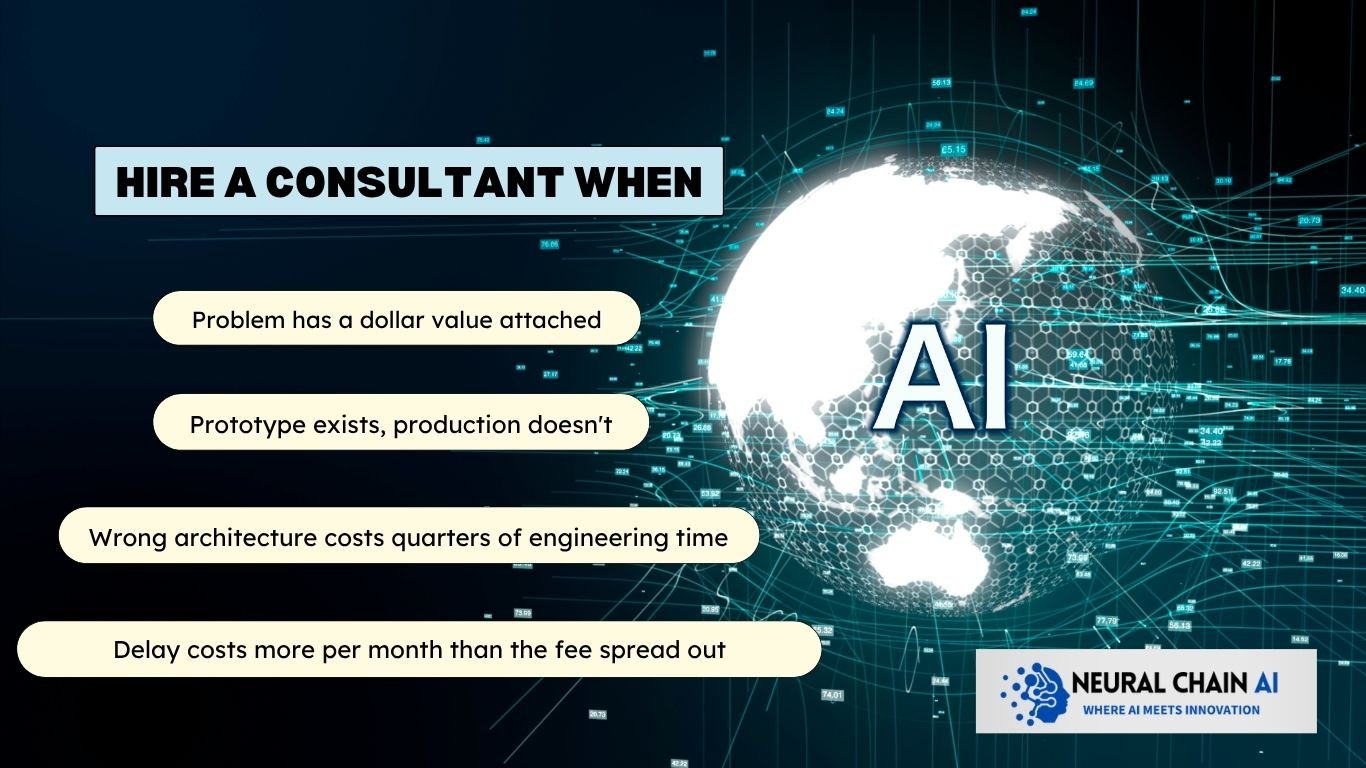
| Hire a Consultant When | Skip It When |
|---|---|
| Problem has a dollar value attached | Value is “innovation” or fear of missing out |
| Prototype exists, production doesn’t | Data isn’t ready |
| Wrong architecture would cost quarters of engineering time | Off-the-shelf tool already solves it |
| Named internal owner exists | Nobody will own it afterward |
| Delay costs more per month than the fee spread out | Problem costs under $10,000 a year |
The Cost of Waiting to Hire An AI Consultant
Deferring the decision has a price too, and it deserves the same scrutiny as the fee.
Return to the invoice example. Every month of delay costs that company about $12,500 in labor and errors. A six-month delay costs $75,000, roughly the price of the build itself. Waiting is not free. It is a purchase of time at the current process’s monthly cost.
But the waiting math can also argue against hiring. Model prices keep falling and tooling keeps improving, so a build quoted today may cost less in a year. That cuts in favour of waiting only when the monthly cost of the problem is low. High monthly cost, act now. Low monthly cost, revisit in two quarters. The mistake is not choosing either path. It is never running the numbers on the delay.
The 5 minute Worth-it Test
Run this before any discovery call.
Step 1: Name the process. One sentence. “We manually review 400 supplier invoices a week” passes. “We want to use AI” fails.
Step 2: Attach a number. Annual cost of the current process in salaries, errors, or lost revenue. Estimate conservatively.
Step 3: Estimate total first-year cost. Fee, plus 15 percent of one internal lead’s time, plus data work, plus twelve months of run costs.
Step 4: Apply the ratio. Annual value at least three times total first-year cost: proceed to conversations. Between one and three: start with a small paid discovery, not a build. Below one: do not hire. Fix it another way or leave it alone.
Step 5: Name the owner. A specific person who will hold the system after handover. No name, no project.
| Annual Value ÷ First-Year Cost | What to Do |
|---|---|
| 3x or higher | Proceed to conversations |
| 1x to 3x | Start with a paid discovery sprint only |
| Below 1x | Do not hire; fix it another way |
The test is deliberately blunt. It kills some projects that might have worked. It also kills nearly every project that would have failed, and those outnumber the survivors.
Making AI Consulting Worth it: How NeuralChainAI Works?
AI consulting pays off when the engagement is built around production, ownership, and clear math. It fails when it is built around decks.
That conclusion shaped how we work at NeuralChainAI. Our consultants are forward-deployed engineers. They do not advise from the outside. They embed with your team, work inside your systems, and build alongside the people who will run the result. Knowledge transfer is not a closing workshop on the last day. It happens through the entire build. By handover, the internal owner this article keeps insisting on already exists, because the engagement created one.
We also put the uncomfortable numbers first. Run costs, data gaps, and internal time commitments belong in the first conversation, not the final invoice. And if the five-minute test above says your project does not clear, we will tell you that too. Walking away from bad-fit work is cheaper for both sides than a failed build.
You do not have to start big. A strategy session or a short discovery sprint tests the problem, the math, and the working relationship before any larger commitment. And before you commit to anyone, including us, take the time to evaluate AI consulting firms the best way. The right questions quickly reveal who ships working systems and who presents slides.
Disclaimer: The cost figures, rates, and ROI calculations in this article are illustrative estimates based on typical North American market ranges and are provided for general guidance only. They are not quotes, guarantees, or financial advice. Actual costs and returns vary with scope, data readiness, industry, and vendor. Run the numbers on your own situation, and validate any engagement pricing directly with the firms you evaluate, before making a hiring or investment decision.