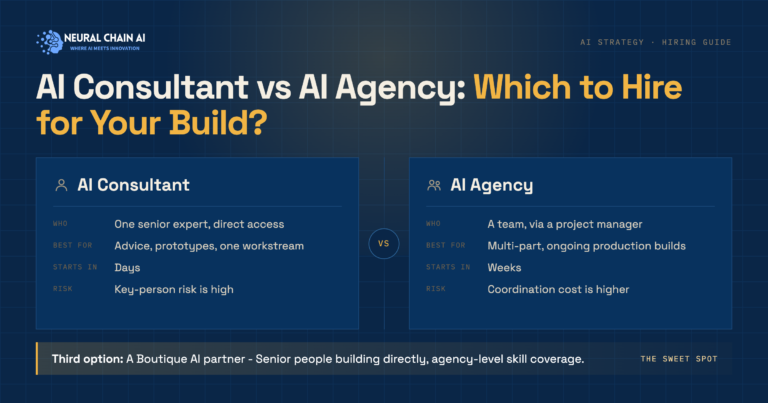

The Big 4 — Deloitte, PwC, EY, and KPMG — bring brand, scale, and procurement-ready governance. Boutique consulting firms bring senior practitioners on the keyboard, faster turnaround, and a lower cost per shipped outcome. For most projects, especially AI and digital builds under $1.5M, a specialist boutique ships faster and cheaper. The Big 4 earn their premium when change management, multi-country rollout, or audit posture matter more than the build itself.
Increasingly, the strongest answer is a hybrid: a Big 4 for governance, a boutique for the build.
Big 4 vs Boutique Consulting: At a Glance
The choice usually comes down to a handful of real-world variables. Here is the honest comparison most procurement decks leave out — directional, not absolute, and shaped by what AI and digital buyers reported in 2025–2026 procurement audits.
| Dimension | Big 4 (Deloitte, PwC, EY, KPMG) | Boutique consulting firm |
|---|---|---|
| Typical seniority on the project | Junior to mid-level; partners ride point | Senior practitioners do the actual work |
| Time to first working build | 12–20 weeks | 3–8 weeks |
| Blended effective rate (US, 2026) | $320–$480/hr | $180–$300/hr |
| Decision speed | Multi-layer sign-off | Single team, one channel |
| Best-fit project size | $1M+ with board visibility | $50K–$1.5M with clear ROI |
| Niche domain depth | Broad but shallow | Deep but narrow |
| Procurement and risk acceptance | Built-in | Often a friction point |
| Post-launch ownership | Hand-off to internal team | Often stays through stabilization |
Every firm has exceptions, but the pattern is consistent enough to plan around.
What Is a Big 4 Consulting Firm?
The Big 4 (Deloitte, PwC, EY, and KPMG) are the four largest professional services firms in the world. In FY2025 Deloitte reported US$70.5 billion in revenue and over 470,000 people, PwC US$56.9 billion and 364,000 people, EY US$53.2 billion and 406,209 people, and KPMG US$39.8 billion and 276,030 people, spread across audit, tax, advisory, and digital. Their consulting arms compete with strategy houses like McKinsey, BCG, and Bain at the top of the market and with global systems integrators like Accenture, Capgemini, and IBM Consulting in the middle of it.
In AI specifically, every Big 4 now runs a named practice: Deloitte’s Zora AI agent platform, PwC’s agent OS platform, EY.ai with its Forward Deployed Engineering arm, and KPMG’s Trusted AI framework. PwC put nearly US$1.5 billion into scaling its AI capabilities in FY2025, and KPMG anchored its framework on KPMG Workbench, the multi-agent platform it launched in June 2025. They sell to CIOs and CFOs of Fortune 1000 enterprises, frequently as part of multi-year transformation programs that bundle change management, training, and platform implementation.
What Is a Boutique Consulting Firm?
A boutique consulting firm is a specialist practice — typically 5 to 250 people — that competes on depth rather than breadth. They pick a domain and go deeper into it than any generalist firm can afford to.
In AI and digital work, the boutique landscape is dense: firms focused on retrieval-augmented generation, model evaluation, agentic workflow design, MLOps platform engineering, computer vision in specific industries, vertical applications in healthcare or insurance, and adjacent disciplines like product engineering or data infrastructure.
Boutiques sell to a different buyer. The typical client is a VP of Engineering, a Head of Data, a Chief Product Officer, or a founder who needs the work done — not the strategy slide. Engagements start in days, scope is fixed early, and the people who sell the work are usually the same people who do it.
Cost Reality: Rate Cards vs Total Cost of Engagement
Comparing hourly rates is the wrong question. The right question is total cost per shipped outcome.
A Big 4 mid-sized AI engagement — say a production RAG implementation across a customer service team — typically lands between $900K and $2.4M over 6–9 months. A boutique with senior engineers will quote $250K to $700K for comparable scope, delivered in 10–16 weeks. The same pattern shows up in non-AI engagements: process redesign, ERP adjacent work, data platform builds.
The gap does not come from cheaper labor. It comes from staffing pyramids. A Big 4 team for a mid-sized engagement typically includes two partners, a director, two managers, and six consultants — most of whom are billed but write none of the production code or final deliverables. A boutique team for the same work is usually three senior practitioners and a tech lead, all producing the actual work.
For modern AI projects, the quiet hours accumulate in integration: authentication, data plumbing, evaluation harnesses, observability, drift monitoring. Big 4 engagements treat this as a separate workstream with its own billing line. Boutiques fold it into the build. The result is fewer hours billed for the same shipped capability.
Talent Density: Where the Senior Practitioners Actually Sit?
This is the most overlooked variable in the comparison. In 2026, the senior practitioner labor market — engineers, data scientists, designers, product leads with 8+ years of production experience — is the tightest it has been in a decade. The same is true in AI specifically, where current LLM and platform fluency narrows the pool further.
A Big 4 firm with 50,000 consultants might have a few hundred genuine senior AI engineers. They are partner-protected, hard to assign at full capacity, and often spread across the firm’s most strategic clients. The rest of the staffing model fills with newly hired associates rotating through an AI capability tag.
The pyramid itself is being redrawn. On June 1, 2026, Deloitte US retired the analyst, consultant, and manager ladder for its roughly 181,500 US employees and replaced it with titles tied to job families (a senior consultant becomes, for example, Software Engineer III), internal levels such as L45 and L55, and a new “Leaders” tier above the senior ranks. Fortune reported the change alongside Deloitte’s $3 billion generative AI commitment through fiscal 2030 and the firm’s own admission that the old structure was built for “traditional consulting profiles.” When a Big 4 firm stops describing its people by rung, ask the same question you would ask a boutique: who, by name, is on the keyboard?
A specialized boutique inverts the ratio. A 40-person AI boutique might have 25 senior engineers, every one available to staff on a project at meaningful FTE. The math is uncomfortable for procurement: a $500K boutique engagement often delivers more senior engineer-hours than a $1.5M Big 4 engagement of the same scope.
This is also why the Forward Deployed Engineer model has spread so quickly through both kinds of firms. Whoever shows up with senior practitioners willing to embed wins the project.
Speed and Time-to-Value
For most enterprises, a time-to-first-value is the single biggest predictor of whether a project survives its second budget cycle. Initiatives that show production results inside three months keep their funding. Those that do not quietly disappear into the next reorganization.
Big 4 engagements are structurally slower. The contract takes 6–12 weeks to negotiate, the discovery phase is built around a deliverables document rather than a working prototype, and meaningful production code typically does not land until month four or five. The operating model is designed for organizations that prize predictability over speed.
Boutique engagements move faster because they have to. A typical engagement starts with a fixed-scope pilot — one use case, one team, one measurable outcome — and a working v0.5 in the first month. The trade-off is less margin for organizational politics: if your stakeholders are not aligned going in, a boutique cannot absorb that slippage the way a Big 4 program can.
Process, Governance, and Risk
Here the Big 4 earns its premium. Regulated industries — financial services, healthcare, defense, public sector — frequently require a vendor with a SOC 2 Type II report, ISO 27001 certification, named PII handlers, signed data processing agreements, and partner-level indemnification. A Big 4 has all of this on day one and can survive a third-party risk review without breaking stride.
Boutiques vary widely. Established AI and digital boutiques are often SOC 2 certified and carry meaningful E&O insurance, but smaller firms may not. For buyers in a regulated industry, the due-diligence overhead of vetting a boutique can offset its cost advantage — unless the boutique has already built the compliance posture out and can hand over the artifacts on request.
This is also where the hybrid model, covered below, starts to make economic sense.
Specialization and Innovation in AI Work
AI engineering has fragmented faster than consulting firms can train people. RAG architectures, eval frameworks, multi-agent orchestration, prompt-injection defense, fine-tuning versus prompt routing, model selection across more than 30 frontier and open-weight options, agentic workflow design — each is a deep specialty. Two years ago, none of them were.
Big 4 firms compensate with capability methodologies — internal playbooks, accelerators, reference architectures — that let a less specialized team execute against a known pattern. This works well for use cases the firm has shipped before. It works poorly for anything genuinely novel, which is precisely the category most ambitious AI projects fall into.
Boutiques compete on the opposite vector. A firm built around production RAG has shipped dozens of variations and knows which evaluation suite fits which use case. A firm built around computer vision in manufacturing knows the four failure modes that kill defect-detection projects in the first 90 days. That depth shows up in scoping, in build quality, and most visibly in post-launch performance.
For a buyer, the practical filter is one question: which firm has shipped a system that looks like the one you need, in production, in the last 18 months?
You may also like to go through our related guide: Build vs Buy vs Partner for AI: The Enterprise Decision Framework
When the Big 4 Are the Right Choice?
The Big 4 are usually the right partner when:
- Project budget is $1.5M+ and reports to the board.
- Change management across thousands of employees is the hard part — not the technology itself.
- Regulatory, audit, or vendor-tier constraints require a tier-one signature on the contract.
- Multi-country or multi-business-unit rollout is part of scope from day one.
- The internal sponsor needs the brand on the slide for political cover or board confidence.
These conditions are real, common, and not embarrassing. They simply describe a different kind of problem than the one most digital and AI projects are trying to solve.
When a Boutique Is the Right Choice?
A boutique is usually the right partner when:
- The bottleneck is shipping working software or a working capability, not gaining executive alignment.
- Budget sits between $50K and $1.5M.
- The use case is specific enough that depth matters more than breadth.
- The team needs senior practitioners on the keyboard within two weeks.
- ROI must be visible inside a single budget cycle.
- The internal team will own the system after launch, with the boutique on standby rather than embedded forever.
Most digital and AI projects below $1M land cleanly inside this list.
The Hybrid Model: Big 4 and Boutique Consulting
The most effective procurement pattern emerging in 2026 is not Big 4 or boutique — it is both. A growing number of enterprises now run a two-vendor model: a Big 4 firm owns program management, change management, training, and audit posture; a specialist boutique owns the build.
The economics are sharper than either alone. The Big 4 handles the workstreams it is genuinely best at — stakeholder management, organizational design, training rollout, post-go-live adoption — at full rate. The boutique handles the build and integration at a fraction of the Big 4’s blended rate, with senior practitioners doing the actual work. Total cost of the engagement is typically 20–40% lower than a Big 4-only equivalent, with measurably faster delivery and stronger technical outcomes.
Procurement teams sometimes resist the model because it requires managing two vendors instead of one. In practice, the savings and outcome quality usually justify the coordination overhead. This is consistent with what NeuralChainAI sees in its own engagements and aligns with broader patterns covered in AI Consulting Services vs Building an In-house AI Team.
Big 4 vs. Boutique – Which one to pick?
Score your project across these six dimensions, 1–5 each. Higher totals favor the Big 4. Lower totals favor a boutique. The middle is exactly where the hybrid model wins.
- Regulatory load. How much audit, compliance, or vendor-tier scrutiny will this engagement face? (1 = light, 5 = heavy)
- Stakeholder complexity. How many executive sponsors and political dynamics must be navigated? (1 = single sponsor, 5 = enterprise-wide)
- Rollout breadth. How many teams, regions, or business units will adopt the solution at launch? (1 = one team, 5 = global)
- Novelty of the work. Is this a known pattern or genuinely novel? (1 = novel, 5 = well-established)
- Budget elasticity. How tolerant is the budget of a 30% cost increase? (1 = highly sensitive, 5 = price-insensitive)
- Time-to-value pressure. How quickly must the first measurable outcome arrive? (1 = within weeks, 5 = within a year)
Scoring guide:
- 24–30: A credible Big 4 case. The non-technical workstreams are the hard part.
- 15–23: Strong hybrid territory. Split the build from the governance.
- 6–14: A specialist boutique is the clear answer. Anything else over-pays for capability you do not need.
The framework is deliberately simple. Most procurement decisions go wrong not because the math is missing but because the wrong question is being asked.
Nowhere is this trade-off more consequential than in AI transformation work — where the same engagement scope can land at very different price points and execution speeds depending on whether you bring in a Big 4 firm or a specialist boutique.
Red Flags to Watch For — On Both Sides
Big 4 red flags. An SOW that names no senior engineers by name. A six-week discovery phase before any working artifact. A project plan with more than 60% of hours in “program management” and “governance.” The people in the pitch meeting being different from the people staffed on the project.
Boutique red flags. No SOC 2 or equivalent posture for sensitive data. A single senior partner who is the only person who actually writes code. A fixed-price quote without a clear scope-change protocol. Case studies that cannot name client outcomes even at a directional level.
In both cases, the right test is identical: ask to meet the three practitioners who will produce the most work on your project, and ask each one to walk through a similar engagement they have shipped end-to-end.
Frequently Asked Questions
Big 4 versus Boutique Consulting – What Next?
The Big 4 versus boutique decision is not a brand choice. It is an operating model choice. Buyers who get it right start by separating two questions: who needs to be on the slide for this project to get funded, and who needs to be at the keyboard for it to actually ship? Many of the strongest engagements answer those two questions with two different firms.
If you want an honest read on whether your next project is a Big 4 fit, a boutique fit, or a hybrid, a 45-minute architecture review will get you a directional answer with no pitch attached — and a one-page scoping summary you can take to procurement either way.
Disclaimer: This article reflects publicly available information and patterns observed across 2025–2026 buyer engagements. Cost ranges, timelines, and staffing patterns are directional and vary by firm, geography, and engagement structure. Verify specifics for your situation before making procurement decisions.