The most common AI consulting buying mistake isn’t picking the wrong vendor. It’s treating the decision like buying SaaS, choosing on brand recognition, sales-led demos, and analyst rankings, then discovering nine months later that the engagement is somehow already over budget, over time, and underdelivering against a roadmap nobody can quite remember signing off on.
AI consulting outcomes are bimodal. Engagements either ship working systems that compound value, or they quietly burn budget and leave the buyer worse off than if they’d hired one senior engineer. The difference between the two outcomes rarely correlates with firm size, price tier, or analyst quadrant placement.
What it correlates with is the buyer’s evaluation process specifically, whether the buyer screened for engagement model, team composition, and post-launch ownership, or screened for logos.
By the end of it, you’ll have a defensible decision process and a much better sense of what you’re actually buying.
What is AI consulting?
AI consulting is the work of an external team helping a company plan, build, and deploy AI systems against a specific business outcome.
It spans three categories:
- Strategy-only engagements (roadmaps, use case prioritization, AI readiness audits)
- Build-and-handoff engagements (the consultancy designs and ships the system, then hands it to the client’s team),
- Build-and-operate engagements (the consultancy stays on to run the system).
It is not SaaS implementation. It is not generic management consulting with an AI keyword sprinkled on the deck. It is not a single freelancer with a ChatGPT subscription. The scope of AI consulting work spans large language model and agent applications, classical machine learning, MLOps and deployment, AI governance, and the data engineering required underneath all of it. A firm that doesn’t credibly cover the full stack at least through partnerships — isn’t an AI consultancy. It’s a feature.
When do you need an AI Consulting firm?
The signals that tell you a consultancy is the right call.
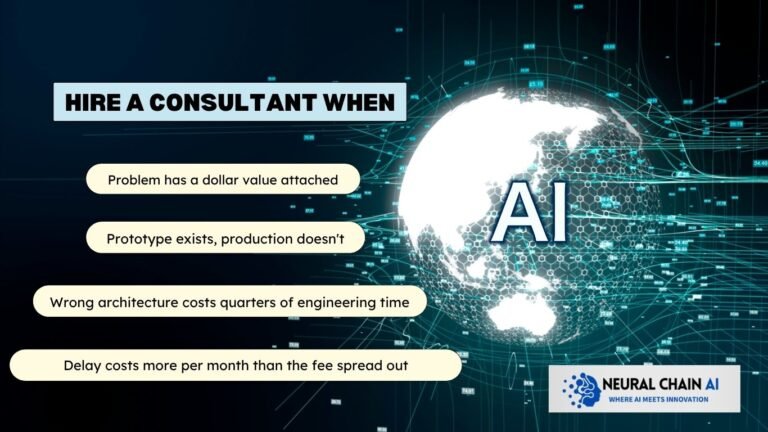
- You have no in-house AI or ML talent and won’t have any for at least two quarters.
- Time-to-value matters enough that an 18 month hiring cycle is too slow.
- And you want to transfer delivery risk through fixed-scope engagements rather than absorb it on your own headcount.
The different signals tell you it isn’t.
- AI capability is genuinely core to your product, which means you should be hiring rather than renting.
- You have a steady pipeline of AI work stretching 12-24 months ahead, which means a consultancy will eventually cost more than a small in-house team.
- Or your actual problem is solvable with off-the-shelf SaaS, in which case a consultancy will sell you a custom system you don’t need.
The companies that get the most out of consultancies usually fit this profile: they need AI capability now, can’t justify hiring yet, but expect to grow into an in-house team 18-24 months out. That sequenced model: consultancy first, in-house second outperforms both pure paths for most mid-market companies. The honest framing on AI consulting vs. In-house AI team covers when each fits.
For smaller buyers (sub-$100M revenue), the calculus is different again. SMBs typically can’t absorb either a senior data scientist hire or a Big 4 engagement minimum — they need productized packages from boutique firms specifically sized for their scale. Our AI consulting guide for small and mid-sized businesses lays that out in more detail.
Types of AI Consulting Firms
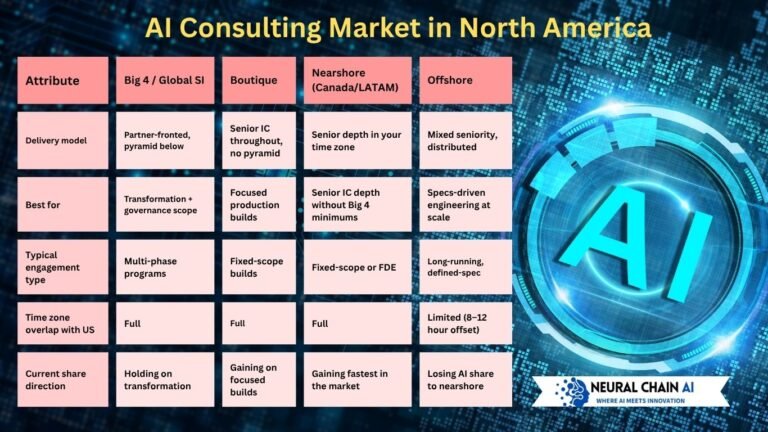
Most buyer confusion in this market traces back to one mistake: treating all consultancies as a single category and comparing them on price. They aren’t a single category. They’re 4 distinct categories optimized for different problems, and the price gaps reflect real underlying differences in cost structure, talent depth, and risk transfer.
1. Big 4 and Global SI firms
Accenture, Deloitte, McKinsey Digital, IBM Consulting, Capgemini. These firms bring scale, governance frameworks, brand-name credibility for board-level conversations, and the ability to staff hundreds of consultants on a single engagement. Accenture alone reported 104 client bookings of $100 million or more in the first nine months of its fiscal 2026. They’re typically partner-fronted but built by junior consultants on a pyramid staffing model. Engagement minimums start around $250k and run to $5M+ for transformation programs. Best for: enterprise transformation with regulatory scrutiny, programs where executive-level political cover matters, very large engagements where firm-level liability matters.
2. Boutique Specialist Firms
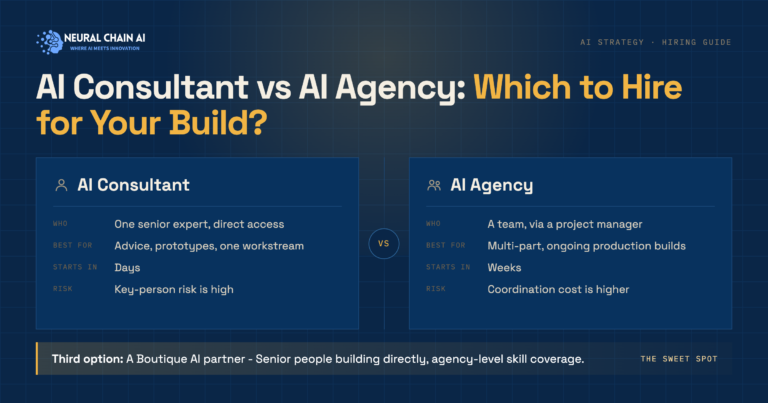
Typically 10–50 people. Senior individual contributor (IC) depth, domain specialization, fixed-price engagements typically $25k–$250k. The senior engineer you meet on the sales call is usually the one who builds the system. Best for: focused AI builds where execution depth matters more than process scale, mid-market and growth-stage companies, engagements where speed beats branding. The Big 4 vs Boutique Consulting trade-off is sharper than most procurement frameworks admit.
3. Nearshore Firms (Canada, LATAM)
Nearshore Consulting companies work in same time zone as US buyers, similar legal frameworks (USMCA for Canada, friendly bilateral agreements with several LATAM jurisdictions), senior engineering depth, typically 20–40% lower fully loaded cost than US-based equivalents at the same seniority level. Best for: US enterprises wanting US-quality engagements at sub-Big-4 pricing without offshore time-zone friction.
4. Offshore firms (India, Eastern Europe)
Largest talent pools, lowest hourly rates, deepest variance in execution quality. Time-zone overlap is limited to a few hours of synchronous work per day. Best for: large-scale, well-specified engineering work with strong written specs and tight delivery management. Worst for: ambiguous strategic engagements that require real-time iteration with the client.
The decision isn’t “which type is best.” It’s “which type is best for this specific engagement.” A board-level AI strategy review for a Fortune 500 fits a Big 4. A focused production agent build for a growth-stage SaaS company fits a boutique. A US enterprise wanting senior engineering without Big 4 pricing fits a nearshore firm. A massive data engineering migration with hard specs fits offshore. The buyers who treat these as interchangeable end up overpaying for the wrong fit, both ways.
Types of AI Consulting Firms : Comparison Table
The table below compares the four main types of AI consulting firms by size, cost, and best-fit scenario.
| Firm Type | Typical Size | Engagement Range | Cost vs. US Big 4 | Best For |
|---|---|---|---|---|
| Big 4 / Global SI | Hundreds per engagement | $250k–$5M+ | Baseline (highest) | Enterprise transformation, regulatory scrutiny, board-level cover |
| Boutique Specialist | 10–50 people | $25k–$250k | Lower | Focused builds where execution depth beats process scale |
| Nearshore (Canada, LATAM) | Varies | Mid five to six figures | 20–40% lower | US-quality work, same time zone, sub-Big-4 pricing |
| Offshore (India, E. Europe) | Large pools | Lowest hourly | Lowest | Large, well-specified engineering with tight delivery management |
Engagement Models: Fixed-Price, T&M, Retainer, FDE
The engagement model determines how delivery risk is allocated between the consultancy and the client. It’s the single most overlooked decision in the buying process — and the one where most engagements fail.
1. Fixed-price:
This transfers delivery risk to the consultancy. The scope is defined upfront, the deliverables are written into the SOW, the price doesn’t change unless the scope formally changes. Works well when scope can be defined cleanly and the consultancy has done similar work before. The strongest indicator that a firm understands its own delivery — they can quote a real number.
2. Time and Materials:
This transfers risk to the client. Every hour the consultancy bills, the client pays, regardless of outcome. Appropriate for genuinely exploratory work where neither side can scope it upfront. Problematic when used as a default — billable-hours pricing creates the wrong incentives. Watch for firms that propose T&M for work that should be fixed-price.
3. Retainer:
Monthly fee for ongoing advisory or fractional capability. Best fit when the client wants senior AI judgment on call without a project-shaped engagement. Reasonable for fractional AI advisor roles; rarely appropriate as the primary engagement model for a build.
4. FDE (Forward Deployed Engineer)
A senior engineer embedded with the client team for a defined period, billed at a fixed monthly or quarterly rate. Sits between consulting and contracting — the FDE or Forward Deployed Engineer reports to the client operationally but is employed by the consultancy. Strongest fit when the work is genuinely co-developmental and the client has internal capacity to direct it.
Engagement Models & Risk Allocation Table
The table below shows who carries delivery risk under each AI consulting engagement model and when each fits.
| Model | Who Holds Delivery Risk | Best Fit | Watch Out For |
|---|---|---|---|
| Fixed-Price | Consultancy | Cleanly scoped, defined-scope builds | Scope-change clauses that reopen pricing |
| Time & Materials | Client | Genuinely exploratory work | Used as a default for scopable work |
| Retainer | Shared | Ongoing advisory / fractional capability | Rarely right as the primary build model |
| FDE (Forward Deployed Engineer) | Shared / client-directed | Embedded co-development with internal capacity | Client lacks capacity to direct the engineer |
The right model usually falls out of the work shape.
Defined-scope build → fixed-price. Exploratory advisory → retainer or T&M. Embedded co-development → FDE.
A firm that proposes the same model for every engagement is selling its preferred billing structure rather than scoping the work honestly.
5 Questions That Reveal Which AI Consultancies Ship
Most AI consulting evaluation processes screen on the wrong inputs — case study slide decks, partner pedigree, certification logos. Real evaluation comes down to asking the right questions. The clear and correct answers reveal a firm that ships. The wrong answers reveal one that bills.
1. “Can I see production systems you’ve shipped — not slide decks?”
Real consultancies have a portfolio of deployed systems. They can show you the architecture, the metrics, the engineering decisions, the failure modes they hit and recovered from. PowerPoint shops show you sanitized case study decks with vague outcome numbers. If a firm can’t walk you through a production system in technical detail — what models, what stack, what evaluation harness, what monitoring — they probably haven’t built one.
2. “Who specifically will be on my engagement, and what’s their seniority?”
This question surfaces the pyramid-staffing problem. The senior partner you meet during the sales process is almost never the person who builds the system at Big 4 and global SI firms — those firms make their margin by selling senior time and delivering with junior time. Boutique and nearshore firms more often staff with the senior person you met on the sales call. The right answer names specific engineers, lists their seniority and recent work, and commits to that team in writing.
3. “What’s your evaluation and monitoring approach?”
This separates teams with eval discipline from prompt-engineering hobbyists. A real AI consulting firm builds evaluation harnesses before they build the model — they have a structured approach to measuring output quality, catching prompt drift, monitoring production behaviour, and detecting silent regressions. A firm that can’t describe their evaluation methodology in concrete terms — what’s measured, how often, how regressions get caught — will ship you a system that quietly degrades after launch.
4. “What does handoff look like? Will my team own the system afterward?”
The right answer is the one that protects you from vendor lock-in. A real firm has a documented handoff process: code in your repo, monitoring dashboards in your accounts, evaluation harnesses your team can run, knowledge-transfer sessions, and clean exit terms if you want to take the system fully in-house. A firm that gets evasive on handoff — or whose “handoff” requires their ongoing involvement to run the system — is selling you a dependency, not a build.
5. “How do you price, and what would change the price?”
This question separates fixed-scope teams from billable-hours shops. A serious firm prices the work, not the hours, and can name specifically what would move the price (data quality, integration complexity, model size, post-launch support depth). A firm that quotes hourly with vague “approximate” totals is transferring all the delivery risk back to you — and the longer the engagement runs, the more they earn.
Run every consultancy you’re evaluating through these five questions. Firms that answer the first four well and price the fifth honestly are the ones who actually ship.
Red Flags worth walking away from
Patterns that should end your evaluation immediately, regardless of how impressive the rest of the pitch is.
- “We’ll send you a partner:” A senior partner appears on the sales call, signs the deal, then disappears. The actual engagement is run by an account manager with a rotating cast of junior consultants. Demand named team commitments in the SOW.
- Hourly pricing with no fixed deliverables: Translates to “we’ll bill you until you stop us.” Walk.
- Inability to name specific production systems: Every credible firm has a portfolio. If a firm can only describe deliverables in generic terms (we drove a digital transformation), they probably haven’t shipped one.
- No clear handoff plan, or handoff that requires ongoing engagement: A firm whose handoff plan is “we stay on retainer to keep the system running” is selling lock-in disguised as continuity.
- Outcome promises before discovery: A firm that promises specific ROI numbers (we’ll cut your support costs by 40%) before they’ve seen your data, your stack, or your team is selling you a number, not an outcome.
How to Write an AI Consulting RFP that gets Real Proposals?
Most RFPs fail in one of two directions. They’re either so vague that they attract every generalist firm in the market (and the resulting proposals are unscorable against each other), or so specific that they read like a requirements doc — which makes the best firms decline to engage, because they can’t add value when the answer is already specified.
The minimum viable AI consulting RFP is two pages, structured as follows.
Page one (one to two paragraphs each):
- Business outcome you’re trying to drive — not the technology you want to use. “Reduce support ticket resolution time by 30%,” not “we want to build a chatbot.”
- Current state — what’s in place today, what data exists, what’s been tried.
- Success metrics — how you’ll measure whether the engagement worked.
- Timeline — when you need first production value, when the full engagement should complete.
Page two:
- Budget range — honest range, not your max. Firms self-select in or out, which saves everyone time.
- Decision criteria — what matters most in vendor selection (price, speed, brand, references, engagement model). Forces you to clarify your own priorities.
- What you want in the proposal — proposed approach, named team, fixed-price scope, references for similar work, timeline.
- Evaluation timeline and process — when proposals are due, when decisions are made, who’s involved.
That’s it. Two pages, no vendor questionnaires, no 50-page requirements doc. The firms that respond with serious proposals to a tight brief are the ones worth engaging. The firms that demand a discovery call before responding are the ones with real selectivity. Both are good signals.
How Much Does AI Consulting Cost?
Directional ranges by engagement type:
- Strategy and audit engagements — readiness assessments, roadmaps, vendor evaluations: light five figures to low six figures.
- Single use case implementation — one model or agent system built and deployed: mid five figures to low six figures, depending on integration depth.
- Multi-use-case engagement — two to four integrated AI capabilities shipped together: six figures, scaling with scope.
- Enterprise transformation — multi-quarter programs spanning strategy, multiple builds, governance, and change management: seven figures and up.
- Fractional advisory or fractional CAIO — ongoing senior judgment without a build commitment: low four figures monthly.
Variables that move the price within these ranges: data quality (worse data means more prep work), integration complexity (more systems means more glue code), custom modeling versus off-the-shelf APIs (custom costs more but performs better in specialized domains), regulatory environment (HIPAA, GDPR, financial services), and post-launch support depth.
AI Consulting Cost by Engagement Type
The table below outlines typical AI consulting price ranges by engagement type and what each delivers.
| Engagement Type | Typical Price Range | What It Delivers |
|---|---|---|
| Strategy & Audit | Light 5 to low 6 figures | Readiness assessment, roadmap, vendor evaluation |
| Single Use Case | Mid 5 to low 6 figures | One model or agent built and deployed |
| Multi-Use-Case | 6 figures, scaling with scope | Two to four integrated AI capabilities |
| Enterprise Transformation | 7 figures and up | Multi-quarter strategy, builds, governance, change mgmt |
| Fractional Advisory / CAIO | Low 4 figures monthly | Ongoing senior judgment, no build commitment |
The above is a general guide, not a quote. Actual pricing varies by scope, data, complexity, and provider.
How to scope your first engagement?
Never start with a transformation engagement. The cost of a wrong-fit firm on a multi-quarter, seven-figure program is roughly the same as the original program cost — there’s no cheap way to recover from that mistake.
Start with a discovery sprint or paid pilot. A short audit (2-4 weeks, low-five-figure cost) that produces a roadmap before any build commitment. This serves both parties: the consultancy gets paid for discovery, the client gets a concrete plan and a working relationship sample before committing to a larger engagement.
This staged approach exists for a reason: most AI work fails in the crossing from pilot to production, not in the modeling. The stages of the AI development lifecycle show exactly where that gap opens, which is what a paid pilot is meant to de-risk.
Use that first engagement to evaluate the firm itself, not just the deliverable. Did the named team actually show up? Did they tell you things you didn’t want to hear? Did the deliverable contain specifics, or did it dissolve into generic recommendations? Did they kill ideas as well as endorse them?
If the first engagement clears those bars, a larger build engagement is the natural next step. If it doesn’t, you’ve spent low five figures finding out — a fraction of what the wrong six-figure engagement would have cost.
What good handoff looks like?
The end of an AI consulting engagement is where most buyers discover they bought less than they thought. Good handoff produces six things.
- Code in your repository: Not a private repository the consultancy controls. Yours.
- Monitoring dashboards in your accounts: Datadog, CloudWatch, Grafana — whatever stack you run, but in your tenant.
- Evaluation harnesses your team can run: With documentation of what each evaluation measures and how to interpret results.
- Architecture and decision documentation: Why each major engineering choice was made, what alternatives were considered, what would need to change if your scale or requirements shifted.
- A knowledge-transfer plan: Sessions with your engineers, not just a written handover document. Real transfer happens in conversation.
- Clean optional retainer terms: If you want continued involvement for surgical problems, you have a retainer option. If you want to take the system fully in-house, you can. Either path is supported.
An AI consulting agency that delivers all the above produced a real engagement. A firm that delivers two or three sold you a deliverable with a long-term tail.
Good Handoff Checklist
The table below defines what a clean AI consulting handoff includes and what “done right” means for each deliverable.
| Handoff Deliverable | What “Done Right” Means |
|---|---|
| Code | In your repository, not one the consultancy controls |
| Monitoring dashboards | Datadog, CloudWatch, or Grafana in your tenant |
| Evaluation harnesses | Runnable by your team, with docs on what each measures |
| Architecture & decision docs | Why each choice was made and what would change it |
| Knowledge transfer | Live sessions with your engineers, not just a document |
| Exit terms | Optional retainer or full in-house takeover, both supported |
Why NeuralChainAI Is Your Best Bet?
NeuralChainAI is an AI consulting and solutions partner for SMB and mid-market firms built around the criteria this guide screens for. The engineers who scope your engagement are the ones who build it — from strategy roadmap to production build and managed run, end to end.
Work starts with a free 45-minute strategy session and a 90-day sprint to ship a real pilot before any larger commitment, and every system runs in your own tenant with the code, evaluations, and monitoring in your hands.
Operating from Canada, NeuralChainAI delivers same-time-zone nearshore AI consulting at mid-market economics — enterprise-grade outcomes without Big-4 prices or year-long engagements.
AI Consulting Evaluation – How The Winning Buyers Actually Decide?
The buyers who win the AI consulting decision aren’t the ones who picked the firm with the most case studies. They’re the ones who ran a tight evaluation process screening for engagement model, team composition, evaluation discipline, and handoff terms. The wrong consultancy costs a year of momentum and substantial budget. The right one compounds advantage across every engagement that follows.
Insist on real production references. Avoid hourly pricing for defined-scope work. Walk away from any firm that gets evasive on handoff. And start with a paid pilot before signing a transformation engagement. None of these are sophisticated moves. They’re discipline. And the gap between buyers who apply this discipline and buyers who don’t is the gap between AI investments that compound and AI investments that stall.
What’s the AI consulting evaluation you’re running right now? Which firm type are you leaning toward right now: Big 4, boutique, nearshore, or offshore — and what’s the deciding factor?
Disclaimer: This article reflects general industry observations as of publication; AI consulting pricing, firm capabilities, and engagement models evolve quickly. Validate any specific consultancy against your own due diligence before committing to an engagement.