TL;DR: The best local LLM for your business in 2026 isn’t a single model, it’s whichever open model matches the job, your GPU budget, and your license requirements. Qwen3 is the strongest general-purpose all-rounder, Llama 4 wins on long-context document work, DeepSeek leads on deep reasoning and math, and Gemma 3 or Phi-4 are the easiest to run on a single GPU. This guide ranks the strongest open local LLMs by use case, calls out the best local LLM for coding, and walks through the quality-versus-hardware trade-offs you need to settle before you deploy any of them privately.
What “Best” Means When You Run Models Locally?
Leaderboards rank models on benchmarks your business will probably never run. When you’re deploying privately, on hardware you own or lease, “best” is really four separate questions: How good are the answers on your actual tasks, not a public benchmark? How much GPU memory and compute can you afford to dedicate to it? What license governs commercial use, and does it fit a company your size? And how far does the model’s context window and modality (text-only versus text-and-image) stretch to match your documents and workflows?
Open local LLMs also move fast — a model that topped the charts six months ago is often matched or beaten by a smaller, cheaper-to-run successor today. The rankings below reflect model families rather than single frozen versions, because the family (and its license and tooling support) is what you’re really committing to when you standardize on one.
The Top Open Local LLMs, Ranked by Use Case
Qwen3 — best all-around
Apache 2.0, no royalty clauses, strong multilingual coverage and tool-calling, with active support in Ollama and vLLM. The safest default to standardize on across chat, RAG, and light coding.
Llama 4 — best for long documents
Scout and Maverick use a mixture-of-experts architecture; Scout’s unusually large context window is built for ingesting entire contract sets, codebases, or knowledge bases in one pass.
DeepSeek — best for reasoning and math
The R1 line is reasoning-first, trained to work through problems step by step; V3-generation models trade some of that for speed. Both ship under the MIT license.
Phi-4 & Gemma 3 — best single-GPU
Phi-4 punches above its size on a single mid-range GPU; Gemma 3 spans 1B-27B parameters with image understanding from 4B up — a reliable one-box, one-GPU option.
Best for multilingual and European-language coverage: Mistral
Mistral’s Small and Large model lines remain a strong choice where French and broader European language quality matters, and they’re a common pick for EU-based companies balancing data residency requirements with language coverage. Licensing varies by model and version, so check the specific release before committing to a production deployment.
Open-Weight Models Businesses Run Locally
Every model ranked above is one of the open weight models a business can download and run on its own hardware. Open-weight means the lab publishes the trained weights under a licence, so the model answers prompts on your servers and every prompt stays inside your network. The everyday name for these models is open source LLM, and the two labels overlap only in part. The Open Source Initiative’s Open Source AI Definition 1.0 asks for the model parameters, the complete code used to train and run the system and detailed information about the training data. Many open-weight releases publish the weights and the inference code while keeping the training data private, so read each model’s licence and model card before you standardize on it.
Self-hosting also settles the data question for models from labs such as DeepSeek and Qwen. When the weights run on vLLM or Ollama inside your own network, prompts and outputs stay on infrastructure you control, whoever trained the model.
gpt-oss: OpenAI’s Open-Weight Models
OpenAI released gpt-oss on August 5, 2025, as two open-weight models under the Apache 2.0 licence. According to OpenAI’s announcement, gpt-oss-120b has 117 billion total parameters, activates 5.1 billion per token and runs on a single 80 GB GPU. The smaller gpt-oss-20b has 21 billion total parameters, activates 3.6 billion and runs on devices with 16 GB of memory. Both handle up to 128,000 tokens of context with low, medium and high reasoning effort, and OpenAI’s announcement cites early partners hosting them on-premises for data security. For a business, gpt-oss-120b on one data-center GPU suits drafting, internal Q&A and tool calling for a team, and gpt-oss-20b fits a single workstation. Our self-hosted vLLM deployment service serves models like these behind an OpenAI-compatible API on your own GPUs.
Small Language Models for One GPU, a Laptop or the Edge
A small language model trades some breadth of knowledge for a footprint that fits one modest GPU, a laptop or an edge device. Microsoft describes its Phi family, which includes Phi-4 and Phi-4-mini, as small language models released under the MIT licence and built to run directly on a device without a cloud connection. Google’s Gemma 4 E2B and E4B are 2B and 4B effective-parameter models built for mobile, edge and browser deployment. Small models suit narrow, high-volume AI jobs: classifying tickets, extracting fields from forms, routing requests and masking personal data before a prompt reaches a larger model. Test each one on your own documents, and send the harder questions to a larger model running beside it.
The Best Local LLM for Coding
Coding is enough of a distinct workload that it deserves its own ranking. Qwen3’s coding-focused releases are purpose-built for agentic development work: reading a repository, planning multi-file changes, and calling tools, with variants sized for everything from a single workstation GPU up to full MoE deployments for an engineering organization. DeepSeek’s coding-tuned models remain competitive on real-world software engineering benchmarks, and Mistral’s Codestral is a lighter, single-GPU-friendly option worth testing if your team is small and your hardware budget is tight.
The practical guidance: match the model to your team size, not the leaderboard. A solo developer or small team is usually better served by a 7B-32B coding model running comfortably on one GPU than by squeezing a much larger MoE model onto hardware it was never sized for.
Quality vs. Hardware Trade-offs
This is the part that determines whether a model is actually usable on your infrastructure, not just impressive in a demo:
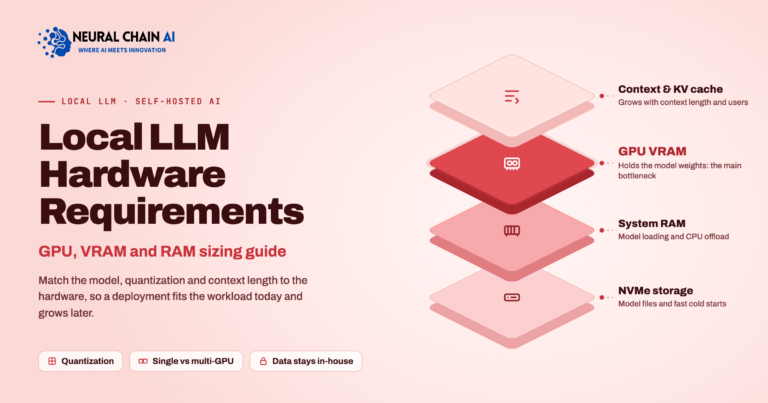
- 7B-8B models typically need 6-8GB of VRAM at 4-bit quantization, up to around 16GB at full precision.
- 27B-32B models generally need 20-24GB of VRAM at 4-bit quantization — the range of a single high-end workstation GPU.
- 70B+ dense models usually require multiple GPUs or aggressive quantization to run at usable speed.
- Large MoE flagships (200B+ total parameters) only activate a fraction of their parameters per token, but still need enterprise-grade, multi-GPU servers to hold the full weight set in memory.
- Quantized formats (4-bit and 8-bit GGUF, AWQ, GPTQ) trade a small, usually acceptable amount of quality for a large reduction in memory footprint — the right call for most SMB hardware budgets.
Public benchmarks are a starting filter, not a final answer. Test finalist models against your own prompts and documents before you commit hardware budget to any single one.
Running the Best Local LLM Privately for Your Business
Picking a model is the easy half of the decision. The other half is running it in a way that actually protects your data: on hardware you control, with no prompts or documents ever leaving your network to reach a third-party API. That’s the difference between experimenting with an enterprise LLM and actually deploying one.
For most SMB and mid-market teams, the fastest path from “which model” to “model running securely in production” is a managed private deployment. We install and tune Ollama on your own servers or private cloud, select the right quantized build of whichever model wins for your workload, and connect it to your existing tools so nothing about your enterprise LLM usage ever leaves your network. See our private local Ollama deployment service for what that looks like end to end, from model selection through hardware sizing and ongoing support.
Want the right local LLM picked and run privately for your business?
Best Local LLM – Which is BesT for Your Business?
There’s no single best local LLM — Qwen3, Llama 4, DeepSeek, Gemma 3, and Phi-4 each win on a different axis of quality, context length, or GPU footprint. Test finalists against your own prompts, then run the winner on hardware you control instead of sending your data to a third-party API.