Scale AI competitors and alternatives moved to the top of every AI team’s shortlist after Meta took a 49% stake in Scale AI in June 2025. This guide compares the best options for 2026 by use case: Surge AI and Mercor for RLHF, Labelbox and Encord for annotation, plus physical AI data capture. Meta’s $14.3 billion move did more than mint a new AI power center, it cracked open the data-labeling market, and within days Scale’s biggest customers started heading for the exits.
Google, Scale AI’s largest customer, moved to wind down its work. OpenAI confirmed it was shifting data-labeling to other providers, and Microsoft and Elon Musk’s xAI were reported to be pausing or reviewing their contracts. No frontier lab wants a direct rival holding a near-half stake in the vendor that sees its most sensitive training data.
That has sent teams hunting for Scale AI competitors and alternatives. But “alternative” means different things depending on what you buy from Scale, so this guide is organized by use case rather than as a single ranked list. Each pick notes what it is best for, its workforce model, and where it stands in 2026.
Why Teams Are Looking for Scale AI Competitors and Alternatives in 2026
Scale AI has not shut down. It remains well capitalized at a $29 billion valuation after the Meta deal, and in July 2026 it named Francis deSouza, the former Google Cloud COO, as CEO, succeeding interim chief Jason Droege. DeSouza is steering the company toward enterprise AI outcomes: Scale closed 2025 with well over $1 billion in new business and expects revenue to pass $1 billion in 2026, with an enterprise line running at roughly $200 million annualized. For the frontier labs, the issue is trust.
When one AI lab owns 49% of the company handling another lab’s data pipeline, the competitive risk is obvious. Customers routinely share proprietary datasets, evaluation sets, and prototype behaviors with their labeling vendor. With Meta on the cap table, Scale’s frontier-lab clients decided that exposure was no longer worth it, and the scramble for alternatives began.
The good news for buyers is that the market has real depth. The catch is that no single vendor replaces everything Scale did, so the right move is to match a provider to the specific job.
How We Grouped the Best Scale AI Alternatives
Scale AI sold four fairly different things under one roof: expert human feedback, self-serve annotation software, fully managed labeling operations, and specialized data capture. We grouped the alternatives the same way, because the strongest choice in one category is rarely the strongest in another.
- RLHF and expert human data for frontier model post-training.
- Annotation platforms you run in-house with your own or a hybrid workforce.
- Managed annotation services that hand you finished labels.
- Physical AI and robotics data capture, the fastest-growing gap Scale never specialized in.
Scale AI Alternatives in 2026 at a Glance
Figures below reflect public reporting through September 2026 and move quickly in this market. Confirm current numbers with each vendor.
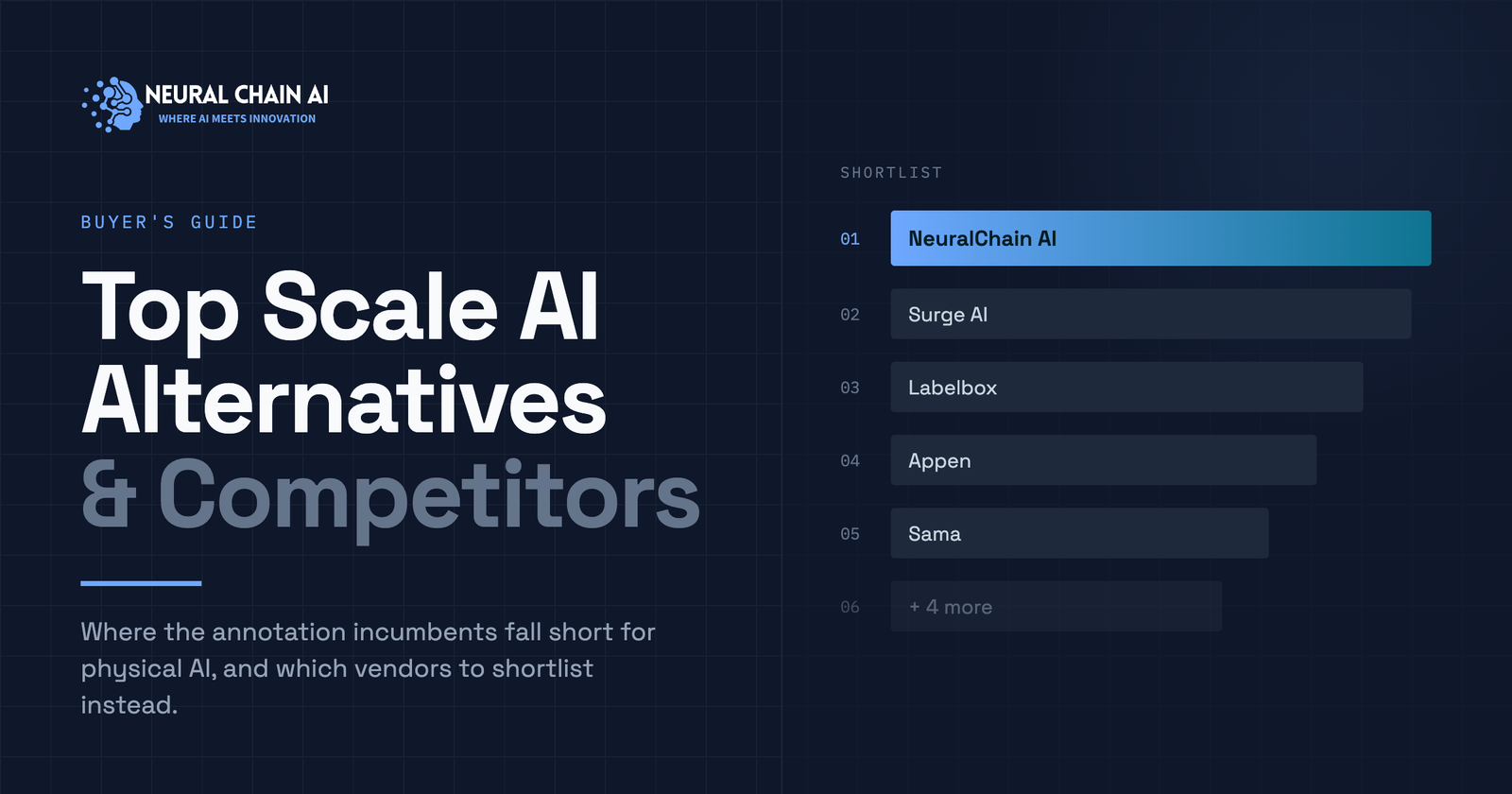
| Provider | Best for | Workforce model | Where it stands |
|---|---|---|---|
| Surge AI | Frontier RLHF and expert feedback | ~50,000 vetted experts | ~$1.4B revenue; raising near $15B to $25B |
| Mercor | Specialized expert RLHF and evaluation | 30,000+ domain experts | ~$2B ARR; ~$10B, talks near $20B |
| Labelbox | General-purpose annotation platform | Software plus on-demand labeling | Established, automation-forward |
| SuperAnnotate | Hybrid platform and workforce | Self-serve or managed | Image, video, text, LiDAR, audio |
| Encord | Multimodal and medical imaging | Platform plus services | Leading multimodal pipeline tool |
| iMerit | Managed geospatial and public sector | Managed expert teams | Part of EXL since August 2026 |
| Sama | Managed, ethical data pipeline | Managed workforce | Image, video, 3D point cloud, sensor |
| NeuralChain AI | Physical AI and robotics capture | Managed multimodal capture | Sensor-fused, consented, LeRobot-ready |
RLHF and Expert Human Data: Surge AI and Mercor
This is the category the frontier labs care about most, and the one Scale AI is bleeding. Two newer names now bid for the same expert supply. Handshake AI recruits PhDs and master’s students through its university career network and reached roughly $1.1 billion in annualized gross revenue by April 2026. TechCrunch reported in August 2026 that micro1, which supplies vetted doctors, lawyers, scientists, and senior engineers, had gone from a $100 million to a $500 million gross annual run rate in eight months.
Surge AI: The Profitable RLHF Heavyweight
Surge AI pioneered scalable reinforcement learning from human feedback, the technique that turned raw language models into usable assistants. Bootstrapped since 2021 and profitable, it reached roughly $1.2 billion in revenue in 2024 and about $1.4 billion in 2025, working with a dozen frontier labs including OpenAI, Google, Anthropic, and Microsoft. In mid-2025, on the back of the Scale disruption, Surge opened its first outside raise, seeking around $1 billion at a valuation reported between $15 billion and $25 billion. With roughly 50,000 vetted expert contractors, it is the closest like-for-like replacement for Scale’s frontier-lab work.
Mercor: The Expert Marketplace Scaling Fastest
Mercor connects AI labs with vetted domain experts, doctors, lawyers, and engineers, for high-skill feedback and evaluation. Its growth has been extraordinary: it crossed $2 billion in annualized revenue in mid-2026, roughly doubling in four months, after raising a $350 million Series C at a $10 billion valuation in October 2025, with later reporting of talks to raise around $500 million near a $20 billion valuation. It pays its 30,000-plus contributors well over $1.5 million a day. If your bottleneck is specialized human expertise rather than raw volume, Mercor is the standout.
Annotation Platforms: Labelbox, SuperAnnotate, and Encord
If you want to run labeling in-house with software plus an optional workforce, these platforms give you the most control.
Labelbox
Labelbox is a broad platform spanning data labeling, model-assisted automation, and model evaluation across vision and language use cases. It suits teams that want a mature, general-purpose tool with an optional on-demand labeling workforce attached.
SuperAnnotate
SuperAnnotate is a hybrid: an advanced annotation platform paired with access to a vetted workforce, so you can switch between self-serve and managed. It covers image, video, text, LiDAR, and audio, with auto-segmentation and model-assisted labeling built in.
Encord
Encord is the strongest pick for multimodal pipelines, handling image, video, DICOM medical imaging, text, audio, and documents in one platform, with AI-assisted labeling, model evaluation, and active learning. Teams building across several data types under enterprise security tend to shortlist it first.
Managed Annotation Services: iMerit and Sama
If you would rather hand off the work and receive finished labels, these managed providers own the operations.
iMerit
iMerit combines automation, annotation tooling, and analytics as a managed service, with particular strength in geospatial, public-sector, and privacy-sensitive domains that need real domain expertise rather than crowd labor. It is now part of EXL, which completed a $310 million acquisition on 3 August 2026 and brought iMerit’s Ango platform and its Scholars expert network into its enterprise AI business. Ask how your delivery team is staffed after the close before you commit to a long contract.
Sama
Founded in 2008, Sama built its reputation on an accurate, scalable, and ethical data pipeline, and covers image, video, 3D point cloud, and sensor-data labeling plus validation and curation. It is a strong fit for teams that weigh workforce ethics alongside quality.
Physical AI and Robotics Data Capture: NeuralChain AI
Here is the category the annotation-first vendors barely touch, and where demand is climbing fastest. Training robots, humanoids, and vision-language-action models does not start with labeling an existing dataset. It starts with capturing the physical world in the first place, with the right sensors, synchronized and consented.
That is our lane. At NeuralChain AI we run managed multimodal capture for robot foundation models: synchronized stereo depth, tactile force arrays, 200Hz IMU, dual wrist cameras, and 21-point hand pose, delivered LeRobot-ready. Every episode carries a signed consent release and a SHA256 chain of custody, so the provenance question that now haunts scraped-data vendors is answered before you train. Where Scale, Surge, and the annotation platforms label pixels and text, we produce the measured physical signal a manipulation policy actually needs, across physical AI, world-model, and tactile manipulation datasets.
How to Choose a Scale AI Alternative
Match the provider to the job rather than chasing a single “best” name:
- Frontier RLHF and evaluation: Surge AI for scale and profitability, Mercor for specialized expert labor, Handshake AI or micro1 for academic and engineering depth.
- In-house annotation with software control: Labelbox, Encord, or SuperAnnotate.
- Fully managed labeling operations: iMerit or Sama.
- Robotics, humanoid, and physical AI training data: NeuralChain AI for sensor-fused, consented capture.
Two governance questions now separate serious vendors from the rest: who collected the data and under what consent, and can you audit that chain later. Post-Meta, those questions are no longer academic.
Building robots, humanoids, or world models and need training data Scale AI was never built to capture? At NeuralChain AI we capture multimodal physical-world data, stereo depth, tactile, IMU, and hand pose on one synced clock, consented at the source and delivered LeRobot-ready. Bring us your tasks and embodiment, and we scope a representative sample pack. No deck, no pressure.
Scale AI Competitors and Alternatives: The Bottom Line
The Meta deal turned Scale AI from the default choice into one option among many competitors, and the market split cleanly along the lines of what you buy. Surge AI and Mercor own frontier RLHF; Labelbox, Encord, and SuperAnnotate own platform annotation; iMerit and Sama own managed operations; and physical AI capture, the part none of them were built for, is a category of its own. Pick by use case, insist on provenance you can audit, and you will end up in a stronger position than a single-vendor dependency ever offered.