Agentic AI companies come in two groups: platform vendors that sell the software AI agents run on, and build partners that design, connect and run agents for you. This guide compares the top agentic AI companies in 2026 across both groups, with what each is best at, how each prices according to its own pages and how to choose one for your first AI agent.
The list covers the AI agent companies a small or mid-sized business is most likely to meet: cloud and software vendors, automation platforms, customer service startups and consulting firms with agent practices. Entries appear by group, in no ranked order. Prices are as each vendor published them on November 3, 2026. One entry is NeuralChainAI, and we say so where it appears.
How to Choose an Agentic AI Company
Five questions sort the options.
- Where will the AI agent run? In the vendor’s cloud, in your own cloud tenant or on servers you control. This decides where prompts, documents and logs end up.
- What does it connect to? Check for native connectors to your CRM, ERP, inbox and phone system, plus MCP support so the agent can reach systems that lack a native connector.
- How does pricing scale? Platforms charge per user, per conversation, per credit or per compute hour. Model a month of your real volume on each.
- Who builds and maintains it? A platform gives you tools. Someone still writes the instructions, connects the systems, tests the agent on real cases and updates it when a model or process changes.
- What governance comes with it? Look for approval steps, audit logs, role-based access and a way to evaluate the AI agent on your own cases before launch.
Agentic AI Platforms
Platform vendors sell the software. You or a partner build the AI agent on it.
Microsoft Copilot Studio
Copilot Studio is Microsoft’s tool for building AI agents. Microsoft’s pricing page says users licensed for Microsoft 365 Copilot can build and use internal agents at no additional cost. Standalone use is billed in Copilot Credits: $200 a month per capacity pack of 25,000 credits, prepaid commit units that save up to 20% or a pay-as-you-go meter. Agents built in Copilot Studio can call MCP servers. It is best for organizations already standardized on Microsoft 365.
Salesforce Agentforce
Agentforce puts AI agents inside Salesforce for sales, service and field service. Salesforce’s Agentforce pricing page lists Flex Credits at $500 per 100,000 credits and $2 per conversation for customer-facing agents. Agentforce add-ons cost $125 per user per month, and Agentforce 1 Editions start at $550 per user per month. It is best for companies whose customer data already lives in Salesforce.
Google Cloud Gemini Platform
Google Cloud runs AI agents on its Gemini platform through Agent Runtime, with memory, sessions and an agent gateway. Its pricing page bills Agent Compute at $0.085 per vCPU-hour after the first 50 free hours each month and Agent Memory at $0.009 per GiB-hour after the first 100. Model tokens are billed separately, and runtime sandboxes for code execution and computer use draw on the same compute and memory meters. It suits teams building on Google Cloud and Gemini models.
Amazon Bedrock AgentCore
AWS describes AgentCore as a platform to build, connect and optimize AI agents, with runtime, gateway, memory, identity, observability, browser, code interpreter, policy and evaluation services. AWS says it works with any open-source or custom framework and with any foundation model, in or outside Amazon Bedrock. Pricing is consumption-based with no upfront commitments or minimum fees: runtime on microVMs costs $0.0895 per vCPU-hour and $0.00945 per GB-hour, and gateway calls cost $0.005 per 1,000. It fits engineering teams already on AWS.
OpenAI
OpenAI’s Agents SDK is an MIT-licensed framework for multi-agent workflows with handoffs, guardrails, sessions and tracing. Its README says it supports OpenAI’s APIs plus 100+ other LLMs. ChatKit embeds agent chat in your own product. OpenAI’s Agent Builder guide says the visual Agent Builder is being deprecated and is scheduled to shut down on November 30, 2026, while ChatKit remains available. Model calls bill at OpenAI’s per-token API rates. It suits developers building custom agents in code.
UiPath
UiPath adds AI agents to its RPA platform through Agent Builder in UiPath Studio and ScreenPlay computer-using agents, with Maestro orchestrating agents, robots and people. Its pricing page lists a free Community plan, a Basic plan from $25 a month and Standard and Enterprise plans through sales. It is best for companies with an existing UiPath bot estate.
n8n
n8n is a workflow automation platform with an AI Agent node that connects a chat model to tools, plus MCP client and server nodes. Its pricing page lists cloud plans from €20 a month billed annually for 2,500 workflow executions, a Business plan that is self-hosted only and a standard self-hosted version on GitHub. It fits teams that want AI agents and workflows in their own cloud account.
Sierra and Decagon
Sierra and Decagon are agentic AI startups focused on customer service agents across chat, voice and email. Sierra uses outcome-based pricing, charging when the agent achieves an agreed outcome such as a resolved support conversation. Its own agent engineers design and ship agents with customers. Decagon offers per-conversation or per-resolution pricing and lets CX teams write agent logic as natural-language Agent Operating Procedures. Both companies’ published pricing posts describe the model without dollar rates.
Agentic AI Build Partners
Build partners design the AI agent, connect it to your systems, test it and keep it running. They range from global consultancies with agent platforms of their own to an AI agent development agency working at small and mid-sized business scale. Partners price per engagement.
Accenture
Accenture builds AI agents on its AI Refinery platform. In March 2025 it added an agent builder that lets business users create and customize agents without coding, and said it was developing more than 50 industry-specific agent solutions using NVIDIA Llama Nemotron reasoning models. It fits large enterprises that want a global integrator.
Deloitte
Deloitte sells Zora AI, which it calls a “digital workforce platform, built on NVIDIA AI”, with digital workers for finance, tax, audit, procurement, HR, IT and order management. Zora AI integrates with Oracle Fusion Cloud Applications and works with SAP Joule Agents as a multiagent system. It fits enterprises running Oracle or SAP back offices.
NeuralChainAI (disclosure: that is us)
NeuralChainAI is an AI consulting and solutions firm for SMB and mid-market companies. We design and build goal-driven AI agents and multi-agent teams that call your APIs and enterprise systems, using frameworks such as LangGraph, CrewAI, the OpenAI Agents SDK, Google’s Agent Development Kit and Microsoft Agent Framework. Agents run in your cloud tenant or self-hosted, including OpenClaw or Hermes Agent in an isolated VM in your cloud account and n8n in containers on AWS, Azure or Google Cloud. Our agentic AI services run from mapping goals and workflows through building, integrating and handing over. We offer a free 30-minute strategy session to scope a first agent.
PwC
PwC’s agent OS is a platform to orchestrate multiple AI agents into workflows, with oversight built in. PwC says it works across Anthropic, AWS, GitHub, Google Cloud, Microsoft Azure, OpenAI, Oracle, Salesforce, SAP and Workday, plus frameworks such as CrewAI and LangGraph. It fits enterprises connecting agents from several vendors.
Agentic AI Companies Compared
The table sums up each company’s group, best fit and published pricing model as of November 3, 2026.
| Company | Group | Best for | How it prices |
|---|---|---|---|
| Microsoft Copilot Studio | Platform | Microsoft 365 organizations | $200 a month per 25,000 Copilot Credits; pay-as-you-go meter |
| Salesforce Agentforce | Platform | Salesforce CRM users | $2 per conversation; Flex Credits at $500 per 100,000; add-ons at $125 per user a month |
| Google Cloud Gemini platform | Platform | Teams on Google Cloud | $0.085 per vCPU-hour after 50 free hours; model tokens extra |
| Amazon Bedrock AgentCore | Platform | Engineering teams on AWS | Consumption; runtime from $0.0895 per vCPU-hour |
| OpenAI Agents SDK | Platform | Developers building agents in code | MIT-licensed SDK; per-token API rates for model calls |
| UiPath | Platform | Existing UiPath bot estates | Community free; Basic from $25 a month; larger plans through sales |
| n8n | Platform | Self-hosted agents and workflows | Cloud from €20 a month billed annually; self-hosted version on GitHub |
| Sierra | Platform (startup) | Customer service agents | Outcome-based |
| Decagon | Platform (startup) | Customer service agents | Per conversation or per resolution |
| Accenture | Build partner | Large enterprise AI programs | Per engagement |
| Deloitte | Build partner | Oracle and SAP back offices | Per engagement |
| NeuralChainAI | Build partner | SMB and mid-market agents, including self-hosted | Per engagement |
| PwC | Build partner | Multi-vendor agent orchestration | Per engagement |
How to Pick a Platform and a Build Partner for One Workflow
Begin with one workflow that has a clear trigger, a measurable outcome and a person who signs off, such as answering inbound leads or processing supplier invoices. Then work through the choice in order.
- Match the platform to where your data lives. Copilot Studio fits Microsoft 365 and Agentforce fits Salesforce. The Google Cloud and AWS agent services fit teams already on those clouds.
- Choose a framework or self-hosted runtime for cross-system or sensitive work. When the workflow spans several systems, handles client or regulated data or must run in your own environment, an SDK, n8n or a self-hosted agent runtime gives you that control.
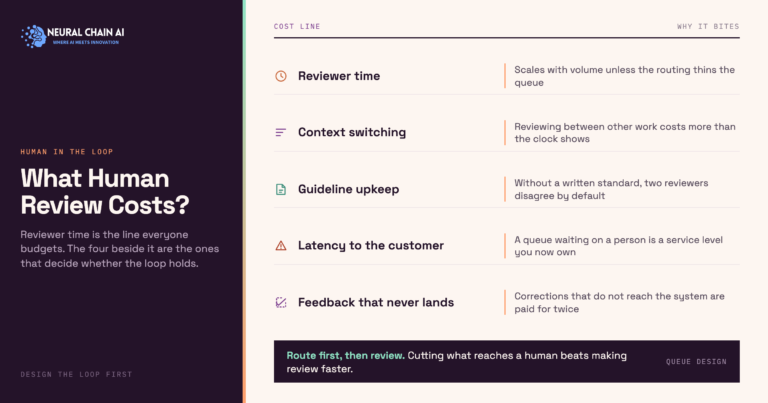
- Price a month of real volume. Include model tokens, platform fees and the staff time spent reviewing the agent’s work.
- Decide who builds and maintains the AI agent. An internal team works when you have engineers with time. A build partner fits when you want the agent designed, connected, tested and handed over.
- Ask for an evaluation on your own cases. Test before launch, with approval points for anything that moves money or sends messages.
For small and mid-sized businesses, the first AI agent usually takes on a role a person does today, such as the front desk, the inbox, sales follow-up or paperwork. Framing the agent as a role makes the result easier to measure and makes it clearer what the agent may do on its own.
NeuralChainAI builds AI agents for everyday business roles, connected to the tools you already use and run in your own environment when your data calls for it. See our AI automation agency services or book a free AI strategy session to scope your first agent.