
AI transformation consulting helps an organization move from scattered AI experiments to a coordinated, revenue-driving capability. That spans strategy, use-case prioritization, infrastructure, governance, and systems that actually reach production.
It’s one of the most consequential investments on an executive’s desk and one of the most misunderstood. The market is loud with firms promising “transformation.” Few can explain what the work involves, what it should cost, or how to spot a real engagement from an expensive slide deck. This guide cuts through that: what it is, when you need it, and how to tell value-compounding engagements from budget-draining ones.
This guide is written for CEOs, COOs, CIOs, CTOs and Chief AI Officers who want a clear-eyed answer to four questions: what is AI transformation consulting, what does it actually do, what does it cost, and how do we hire well?
What Is AI Transformation Consulting?
AI Transformation Consulting is a specialized advisory and delivery service that helps an organization redesign its strategy, operating model, processes, data, and technology around the capabilities of modern AI. The goal is to make AI a core source of competitive advantage instead of a set of disconnected experiments.
A useful way to think about it: traditional digital transformation moved analog work onto software. AI transformation moves decision work; judgment, routing, drafting, forecasting, classification, summarization onto models. That requires changes that go well past procuring tools:
- A strategy that names where AI will create durable advantage (and where it won’t).
- A target operating model that defines how humans and AI agents share work.
- A data foundation that makes the company’s proprietary knowledge usable by models.
- An execution engine: MLOps, governance, change management that lets you ship and trust AI in production.
- A value system that ties each AI use case to a number the CFO will recognize.
A good AI transformation consultant operates across all five layers. A bad one sells you a stack and leaves.
In one line: AI transformation consulting is what stands between an organization that uses AI and an organization that is changed by it.
How AI Transformation Consulting Differs From Related Categories?
Executives are routinely sold five different things under the same label. Knowing the difference is the first protection against overpaying for the wrong engagement.
| Category | What it actually does | When you need it |
|---|---|---|
| AI strategy consulting | Defines where AI should be applied, value at stake, prioritized roadmap, governance. | You don’t yet have a thesis tied to P&L. |
| AI implementation / build services | Builds a specific model, pipeline, or agent. | You already know the use case and want it shipped. |
| Digital transformation consulting | Modernizes software, cloud, and processes. AI is one of many levers. | Legacy systems are the bottleneck, not models. |
| Generative AI consulting | Focused on LLMs, RAG, copilots, agentic AI. | Your priority use cases are language-, document-, or knowledge-work-heavy. |
| AI transformation consulting | Reshapes strategy, ops model, data, and execution around AI as a core capability. | You want AI to change how the business runs — not bolt onto it. |
Most of the failed “AI transformations” executives describe are actually implementation engagements that were sold as strategy work or, less often, the reverse. Matching the engagement type to your real problem is half the battle.
Why AI Transformation Matters Right Now? A Reality Check
The data has shifted decisively in the last twelve months.
- 95% of GenAI pilots return no measurable P&L impact (MIT NANDA, State of AI in Business 2025).
- Enterprise AI maturity is rebounding, but execution still lags ambition. ServiceNow’s 2026 Enterprise AI Maturity Index puts the average score at 51, up from 35 a year earlier across a survey of 4,500 executives, yet AI-enabled workflows still score just 40, the weakest of its seven pillars.
- Budgets keep growing anyway. Enterprise AI spend continues to expand double-digits, with most of it concentrated in sales- and marketing-facing pilots.
- The biggest realized ROI is in the back office: process automation, document handling, support deflection which is precisely where the least AI budget is being spent.
- Agentic AI is shifting the unit of work. Instead of a copilot suggesting the next sentence, autonomous agents now execute multi-step tasks: ticket triage, claims adjudication, lead enrichment, code review. This changes what “transformation” means: you’re not just augmenting people, you’re redesigning the workflow.
The combination i.e. money in, value out flat, maturity finally climbing on paper but execution still thin is exactly the condition under which transformation consulting earns its keep. Doing nothing is no longer cheap, and doing it badly is now the dominant outcome.
The NeuralChain AI Transformation Framework: Core → Capability → Cadence
We use a three-layer mental model with executives. It is deliberately compact because executive bandwidth is the actual scarce resource in any transformation.
Layer 1 – Core: What only your company can do?
Every durable AI advantage starts with proprietary signal; the data, decisions, and tacit know-how that competitors can’t replicate by buying the same model API. Most failed transformations skip this and start with a vendor. We start by inventorying:
- The decisions your business makes thousands of times a day.
- The data trails those decisions leave behind.
- The expert judgment that is currently locked in a few people’s heads.
- The customer interactions that produce unique language and intent.
This is the “core” and your moat. Everything else orbits it.
Layer 2 – Capability: What you need to industrialize the core?
Five capabilities convert proprietary signal into deployed AI:
- Data foundations: governed, queryable, model-ready data products (not a data lake of CSVs).
- Model / agent stack: fit-for-purpose foundation models, fine-tunes, retrieval, evaluation harnesses.
- MLOps & AgentOps: CI/CD for models and agents, observability, drift detection, rollback. (See our MLOps consulting services.)
- Governance: risk, policy, model cards, audit trails, EU AI Act and NIST AI RMF alignment.
- Adoption & change: workflow redesign, training, incentives, FAQs, escalation paths.
Treat these as muscles to build, not boxes to tick.
Layer 3 – Cadence: How you ship without losing the plot?
Strategy without cadence becomes a slide deck. We push organizations to commit to:
- Quarterly value reviews: every funded use case carries a CFO-recognized number.
- A 70/20/10 portfolio: 70% scaling proven wins, 20% adjacent extensions, 10% explore.
- A 90-day clock: every use case has a “kill or scale” decision within one quarter.
The companies pulling away in 2026 don’t have better models. They have a tighter cadence and a clearer core.
What an AI Transformation Consultant Actually Does?
A real engagement, end-to-end, looks like this. Times shown are typical for a mid-sized enterprise; very large or very small organizations compress or extend them.
| Phase | Duration | Output the executive cares about |
|---|---|---|
| 1. AI value diagnostic | 2–4 weeks | A ranked list of 10–20 use cases with value-at-stake, feasibility, and dependencies. |
| 2. Strategy & operating model | 3–6 weeks | A 12–24 month transformation roadmap, target operating model, governance charter, funding plan. |
| 3. Data & platform readiness | 4–12 weeks | A model-ready data architecture; identity, access, and lineage in place; agent-ready APIs. |
| 4. Lighthouse builds | 8–16 weeks | 2–4 production AI use cases live, instrumented, and tied to a P&L metric. |
| 5. Scale & enablement | 6–12 months | Reusable patterns, internal capability uplift, hiring plan, exit criteria. |
| 6. Run & optimize | Ongoing | MLOps, evaluations, agent monitoring, governance reviews. |
The work is roughly 10% algorithms, 20% data and platform, 70% people, process and adoption, a ratio popularized by McKinsey’s QuantumBlack and consistent with what we see in practice. Most failed transformations get this ratio backwards.
Where AI Transformation Creates the Most Value by Function?
The patterns below recur across real-world production deployments in retail, marketing, manufacturing, logistics, customer services, etc.
| Function | High-leverage AI use case | Why it works in 2026 |
|---|---|---|
| Customer service | Agentic support — full ticket resolution, not just suggestions | Modern agents can read CRM, take refunds, update orders end-to-end. |
| Sales | Account research, proposal drafting, churn prediction | LLM + RAG over CRM + product docs collapses prep time 60–80%. |
| Marketing | Personalized content production, performance attribution | Generative + measurement closes the creative-to-ROI loop. |
| Finance & accounting | Invoice processing, anomaly detection, close acceleration | Document AI is now production-grade; clear, auditable wins. |
| Operations & supply chain | Demand forecasting, dynamic routing, inventory optimization | Classical ML still beats GenAI here — and pays back fast. See our ML modeling services. |
| HR & people ops | Resume screening, internal knowledge agents, onboarding | High-volume, high-friction processes with abundant text data. |
| Engineering & R&D | Coding copilots, design exploration, test generation | Measurable productivity uplift; well-bounded risk. |
| Risk, legal & compliance | Contract review, policy Q&A, regulatory monitoring | High-cost manual work; AI accuracy now meets review thresholds. |
| Manufacturing & QC | Computer vision defect detection, predictive maintenance | Continues to be the most under-hyped, highest-ROI AI category. |
The transformation question is not which of these can we do, it’s which two or three will move our specific P&L the most in the next 12 months.
The Hidden Costs of Doing Nothing
Boards almost always model the cost of action. Few model the cost of inaction. This has gotten expensive:
- Cost line drift. Competitors automating back-office work are quietly resetting the cost-to-serve baseline of your industry. You feel it in margin compression, not headlines.
- Talent flight. High performers leave organizations where their work is still manual. AI-native peers ship more, learn faster, and get promoted.
- Compounding data debt. Every quarter you delay building model-ready data, you pay more later and miss the chance to capture proprietary signal in the meantime.
- Procurement lock-in. Vendors are racing to embed agents into your stack. The longer you wait to set policy, the more your future architecture is decided by your SaaS contracts instead of by you.
- Regulatory whiplash. The Digital Omnibus agreed in May 2026 pushed the EU AI Act’s high-risk obligations from August 2026 to December 2027 for Annex III systems and August 2028 for Annex I, though transparency duties for general-purpose AI providers still took effect as scheduled in August 2026. NIST AI RMF remains the de facto US baseline, and sector regulators (FINRA, FDA, HIPAA) keep issuing AI-specific guidance. Catching up under deadline is still more expensive than building in compliance from the start.
A reasonable rule of thumb: in industries where AI genuinely applies, a year of delay costs one to three points of margin to competitors who didn’t wait. That sounds survivable until you remember it compounds. The gap you concede in year one is the gap you spend the next five trying to close.
How Much Does AI Transformation Consulting Cost?
There is no honest single number, but there are honest ranges. AI transformation consulting costs vary widely, because “transformation” spans everything from a focused strategy engagement to a multi-year, organization-wide rebuild. At one end sit light advisory engagements assessing readiness, prioritizing use cases, producing a roadmap. At the other end sit enterprise-wide programs that build production systems, infrastructure, governance, and an internal AI capability.
The variables that move the number most:
- The state of your data (clean, governed data is the single biggest cost lever).
- Whether use cases run on managed APIs or require fine-tuned / self-hosted models.
- Integration depth into existing systems (CRM, ERP, EHR, claims, manufacturing OT).
- Regulatory load (financial services, healthcare, public sector trend higher).
- Build vs. configure mix:” most SMB and mid-market work is 70%+ configuration.
Rule of thumb: Budget for a 3–5x return on the consulting investment within 18 months on lighthouse work, and 8–12x at program scale once capabilities are reused. If a partner cannot model that with you up front, that is itself a signal.
A Simple ROI Model an Executive Can Defend to the CFO
Most AI ROI debates fail because the math is left vague. Use this five-line model:
Annual value created
  = (Hours saved/year × loaded hourly cost)        ← time
  + (Incremental revenue from faster/better decisions)  ← growth
  + (Error / rework / outsourcing cost avoided)    ← cost-to-serve
  − (Cost of false positives or failures × incidence rate)  ← risk

Annual cost
  = (Build + integration, amortized) + (run-rate platform + model usage)
  + (Governance, evals, monitoring) + (Adoption & training)

ROI % = (Annual value − Annual cost) / Annual cost
Payback months = Build cost ÷ (Monthly value − Monthly run cost)
A worked example. A mid-sized insurer deploys an agentic claims-triage assistant:
- 22 adjusters × 6 hours/week saved × $85 loaded × 48 weeks = ~$540K time recovered
- 3-day faster cycle time → 4% conversion lift on retained policies = ~$1.2M revenue effect
- Build + integration: $260K amortized over 2 years = $130K/year
- Platform + model usage + monitoring: $95K/year
- Adoption, evals, governance: $75K/year
Year-one ROI ≈ (1.74M − 300K) / 300K ≈ 480%, payback < 5 months. Real engagements rarely look this clean on the first pass, but the discipline of building the model forces honest conversations about which numbers are real.
What Has Changed? Agentic AI, Evaluations, and Governance
Three shifts make a 2026 transformation different from a 2024 one:
1. Agents have moved from demo to deployment. Multi-step autonomous agents now reliably handle bounded workflows: customer onboarding, RFP response drafting, internal IT support, claims first-touch. The transformation question is no longer “where can we use an LLM?” but “which workflows can we redesign around an agent, and what governance do they need?”
2. Evaluation is now table-stakes. The companies pulling ahead run continuous, task-specific evals on every shipped model and agent, accuracy, hallucination rate, policy compliance, cost per task. Without evals, you cannot operate AI; you can only hope.
3. Governance frameworks have hardened. The EU AI Act risk tiers, the NIST AI RMF, ISO/IEC 42001, and sector-specific guidance now form a real compliance map. Treat governance as a design input, not a bolt-on. It is also a sales asset increasingly, your customers will ask for it.
4. Forward-deployed engineering is the dominant delivery model. Senior engineers embedded with the customer team closing the loop between use case, model, and workflow consistently outperform traditional staff-augmentation models.
How to Choose an AI Transformation Consulting Partner?
A short, ruthless checklist. Ask each candidate directly:
- Show me production AI systems your team shipped in the last 12 months and the metric each one moved. Vague answers here are the single most reliable disqualifier.
- Who specifically will be on the keyboard? Demand named senior practitioners, not a generic “team.” Beware bait-and-switch staffing.
- What is your point of view on build vs. buy for our use cases? Tool-agnostic partners will say it depends and explain why.
- How do you handle evaluations, monitoring, and rollback? If they cannot answer this in detail, they have not run AI in production.
- How do you transfer capability so we don’t need you forever? A confident partner is happy to design themselves out of the run-rate.
- What are your governance and security defaults? Look for SOC 2, ISO 27001, alignment with NIST AI RMF, data-handling specifics.
- What does your pricing look like, and what are you willing to put at risk? Outcome-linked components are a signal of confidence.
AI Transformation Consultant – Red flags to Watch for
- Guarantees of specific ROI before any discovery.
- A pitch that leads with a vendor logo slide.
- A roadmap that starts with a 9-month “foundation” phase before any user-facing value.
- Inability to explain in plain English what their proposed model will do — and not do.
- No discussion of failure modes, evals, or what happens when the model is wrong.
Big 4 vs. Boutique vs. In-house: Which Model Fits?
Most enterprises end up running a hybrid. The question is which provider for which slice of work.
| Provider type | Best for | Trade-offs |
|---|---|---|
| Big 4 / global SI | Multi-country rollouts, board-level air cover, procurement-ready governance | High blended rates, leverage pyramids, slower delivery cadence |
| Boutique AI consultancy | Shipping production AI fast, senior practitioners on keyboard, lower cost per outcome | Less scale for global change management |
| Hyperscaler advisory (AWS, GCP, Azure) | Platform-anchored work, credits, deep integration with their stack | Naturally biased toward their own services |
| Specialist build shop / FDE model | One critical use case, deeply | Less strategy lift |
| In-house AI team | Long-term core capability, proprietary IP | 12–18 months to assemble; expensive talent market |
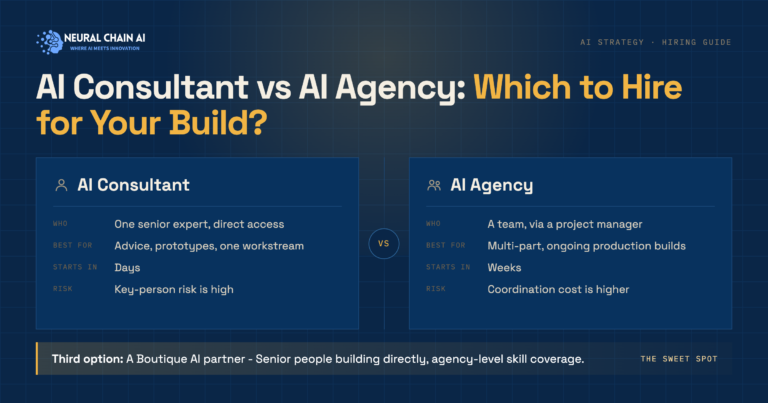
For most mid-market and enterprise programs we see in 2026, the winning pattern is: boutique or hyperscaler partner for strategy + lighthouse builds, in-house team for run + extension, Big 4 only where global change management is unavoidable. Our companion piece: Big 4 vs Boutique Consulting — goes deeper on this trade-off.
Common AI Transformation Mistakes (and How to Avoid Them?)
Patterns we see again and again in failed or stalled programs:
- Starting with the technology, not the decision. “We need a chatbot” is not a thesis. “We want to cut first-response time on tier-1 support from 4 hours to 4 minutes” is.
- Funding 50 pilots, scaling none. Pilots are cheap; scaling is expensive. Fund fewer, scale harder.
- Treating data work as a separate project. Data and AI are the same program. Splitting them creates the seam where value leaks out.
- Outsourcing the thinking. Consultants accelerate your team. They cannot replace executive ownership.
- Underinvesting in change management. Adoption, incentives, FAQs, and escalation paths decide whether the model is used. Plan for it before launch, not after.
- Skipping evaluations. If you cannot measure model quality continuously, you cannot operate AI; you can only hope.
- Ignoring agent governance. Agents that take actions need separate guardrails: scopes, approvals, audit logs, kill switches.
- Letting procurement drive architecture. A stack assembled by procurement looks fine on a spreadsheet and fails on contact with reality.
A 90-Day Plan an Executive Can Run on Monday
If you are at the start of this and want a concrete starting move, this is the plan we hand to executive teams:
Days 1–30: See the field.
- Stand up an AI steering group (CEO/COO/CIO/CFO/CHRO + one business unit head).
- Inventory every AI tool already in use across the company — including the shadow AI nobody registered. The list is always longer than you think.
- Run a one-page value diagnostic on 10–15 candidate use cases. Score on value-at-stake, feasibility, and time-to-value.
- Publish an interim AI usage policy and acceptable-use guidance.
Days 31–60: Pick the fights.
- Select 2–3 lighthouse use cases. At least one back-office automation. At least one customer-facing. At least one with a hard P&L number.
- Define success metrics with the CFO. No metric, no funding.
- Choose delivery model: in-house, partner, or hybrid. Sign a tightly scoped first statement of work.
Days 61–90: Ship and instrument.
- Get the first use case into a controlled production environment.
- Stand up evaluation harnesses, monitoring, and a weekly review.
- Publish results: wins and losses internally. Transparency compounds.
By day 90 you should have one production AI capability, one credible roadmap, and a sharper view of where transformation will pay off. That is the floor a real transformation builds on.
Future Outlook: Where AI Transformation is Heading?
A few directional bets we are comfortable making:
- Agents become the unit of work. Job descriptions will increasingly read “owns a set of agents that handle X,” not “does X.”
- The data moat hardens. Proprietary, well-governed enterprise data, not raw model access becomes the durable advantage.
- AI governance becomes a board agenda item. Expect audit committee involvement and external assurance, similar to the cyber arc of 2018–2022.
- In-house AI capability becomes non-negotiable. Consulting partners will shift from “run it for you” to “build the team that runs it.”
- The winners will be boring on purpose. Disciplined cadence, fewer use cases, ruthless measurement. The flashy programs of 2024 are the cautionary tales of 2026.
Getting Started
If you are responsible for AI outcomes at your organization, the strategic question is no longer whether to transform, it is how disciplined you will be about it. The 95% who get no return from AI are not failing at technology. They are failing at scoping, cadence, and ownership. AI transformation consulting, done well, is the operating system that turns capability into compounding advantage.
At NeuralChainAI, we partner with executive teams across various regulated industries to design and ship AI transformations that show up in the P&L.
Engagements range from a focused 30-day AI value diagnostic to multi-year transformation programs anchored by forward-deployed engineers, MLOps platforms, and agentic AI builds.
Want a starting point? Book a 45-minute executive working session. We’ll map your three highest-value AI use cases and the shortest path to a measurable first win, whether you ultimately work with us or not.
Disclaimer: Cost ranges, timelines, ROI examples, and statistics cited in this article are directional, drawn from publicly reported research and our own engagement experience. They are intended for executive planning, not as a quote or guarantee. Actual figures vary by industry, scope, and data readiness, and are confirmed in writing after scoping.