The leading open-source Glean alternatives in 2026 are Onyx (formerly Danswer), LibreChat, Open WebUI, AnythingLLM, and PipesHub. Onyx is the closest one-to-one match — it mirrors Glean’s architecture with 40+ connectors, permission-aware retrieval, and chat with citations, all self-hosted in your own tenant. LibreChat and Open WebUI fit teams that want a private ChatGPT first and search second. AnythingLLM suits single-corpus document chat. PipesHub is the newest entrant, worth a pilot. Most teams that have outgrown Glean’s per-seat pricing or hit a compliance wall land on Onyx.
Enterprise search AI is now one of the highest-leverage productivity tools a company can deploy: knowledge workers lose nearly a full day a week searching for information they already have (McKinsey), and AI-powered search recovers an estimated 40–60 minutes per employee per day (Goldman Sachs / OpenAI). The productivity math is why the category is growing. Glean is one of the top leaders of the enterprise search AI market. However per seat pricing of Glean compounds and the reason why teams look for Glean Alternatives.
Companies look for Glean alternatives for predictable reasons: per-seat pricing that scales linearly with headcount, data-residency requirements that don’t tolerate vendor multi-tenant storage, or compliance frameworks that need the LLM and the search index inside the company’s own perimeter. The good news is the open-source ecosystem has matured especially in the enterprise search AI space. You no longer have to choose between Glean’s polish and self-hosted control — there are credible alternatives shipping in production at companies you’ve heard of.
This guide compares the 5 most-deployed open-source Glean alternatives, who each is for, and what to weigh when picking. If you already know you want a managed deployment, jump to our self-hosted enterprise search AI service → — otherwise, read on.
What Glean actually does?(and what an “alternative” needs to match)
Before evaluating alternatives, it helps to be precise about what Glean is. The product is three things at once:
- Unified enterprise search across 100+ workplace apps with a single query.
- Chat with citations — grounded answers that link back to the source documents.
- Permission-aware retrieval — every result respects each source app’s native ACLs.
Any real “Glean alternative” should match all three. Most open-source projects nail one or two; only a couple match all three.
5 Best Open-Source Glean Alternatives, Compared
Each tool below is ranked by how completely it replaces Glean’s three core jobs as given above. Onyx comes closest, so we start there.
1. Onyx (formerly Danswer): The Closest Match to Glean
Onyx (formerly Danswer) is the most direct open-source equivalent to Glean. The architecture mirrors Glean’s: connectors sync documents and ACLs into a vector store, the chat layer queries via retrieval-augmented generation, and answers come back with inline citations linked to source documents.
(Disclosure: Onyx is the platform we deploy by default in our self-hosted enterprise search engagements — its connector ecosystem, ACL fidelity, and active development make it the right starting point for most teams.)
What Onyx ships?
- 40+ connectors out of the box — Slack, Google Drive, Confluence, Notion, Jira, GitHub, GitLab, Salesforce, SharePoint, OneDrive, Box, Linear, Asana, Zendesk, Gmail, Outlook, and many more.
- Permission-aware retrieval. Connectors sync source-app ACLs alongside content. Users only see results from documents they have permission to view.
- Agents and deep research. Custom agents run MCP tool calls, OpenAPI actions, and code execution, and deep research answers a question across multiple retrieval steps instead of one.
- Kubernetes Helm chart or Docker Compose deployment. Runs in your VPC, on-prem, or fully air-gapped.
- MIT open-source licence; an enterprise edition adds SSO, multi-tenancy, and managed features.
- Production at scale. Netflix, Ramp, Thales, Nebius, and UC San Diego sit among the 1,000+ customers Onyx publishes.
Where Onyx falls short of Glean? No equivalent to Glean Apps’ depth in custom workflows, and onboarding requires meaningful engineering investment.
We at NeuralChainAI have developed deep expertise in customizing Onyx as per organization’s requirements. Checkout our offerings if you are considering customizing Onyx for your business.
2. LibreChat: Chat-first, Search-Second
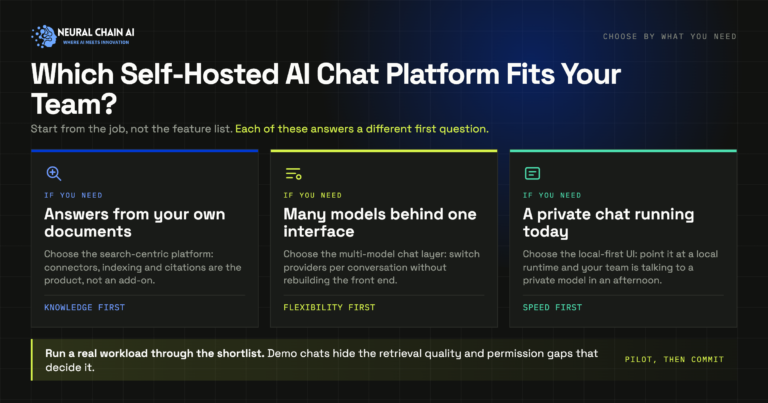
LibreChat is primarily a self-hosted ChatGPT alternative with a polished multi-model chat UI. It supports OpenAI, Anthropic, Gemini, Bedrock, plus self-hosted models via vLLM and Ollama. RAG and document search exist but aren’t the headline feature.
- Use it when you want a private ChatGPT experience first, with enterprise search as a secondary capability.
- Avoid when enterprise search across 40+ workplace apps is the primary need — LibreChat’s connector ecosystem is much narrower than Onyx’s.
- Production users include Shopify, Daimler, Boston University, ClickHouse, and Stripe.
LibreChat sits inside our broader private ChatGPT for business deployment — the right pick when chat is the headline use case, not search.
3. Open WebUI: A UI for Self-hosted LLMs
Open WebUI is the most popular UI for Ollama-served local LLMs. It’s a chat interface, not a search platform. RAG over documents works, but it’s document-upload-driven rather than connector-sync-driven.
- Use it when you want a self-hosted ChatGPT for a small team running models on local GPUs.
- Avoid when enterprise search across SaaS workplace apps is the goal.
4. AnythingLLM: Workspace-centric RAG
AnythingLLM organizes documents into “workspaces” and supports chat over each workspace. It has a decent connector list but smaller than Onyx, and its permission model is workspace-scoped rather than ACL-mirrored from source apps.
- Use it when your knowledge lives in known document sets — legal matter files, M&A data rooms, research corpora — rather than scattered across many SaaS apps.
- Avoid when you need source-app ACL fidelity (Slack channel privacy, Drive folder permissions).
5. PipesHub: The New Entrant
PipesHub is an Apache 2.0 platform now positioned as an open-source “context layer for enterprise AI,” built around a knowledge graph that cites answers down to the page and paragraph and inherits permissions from the source app. Its connector count has grown past 50, spanning Google Workspace, Microsoft 365, Slack, Jira, Confluence, Notion, GitHub, and GitLab. The community is still smaller than Onyx’s, so pilot it before you plan a migration around it.
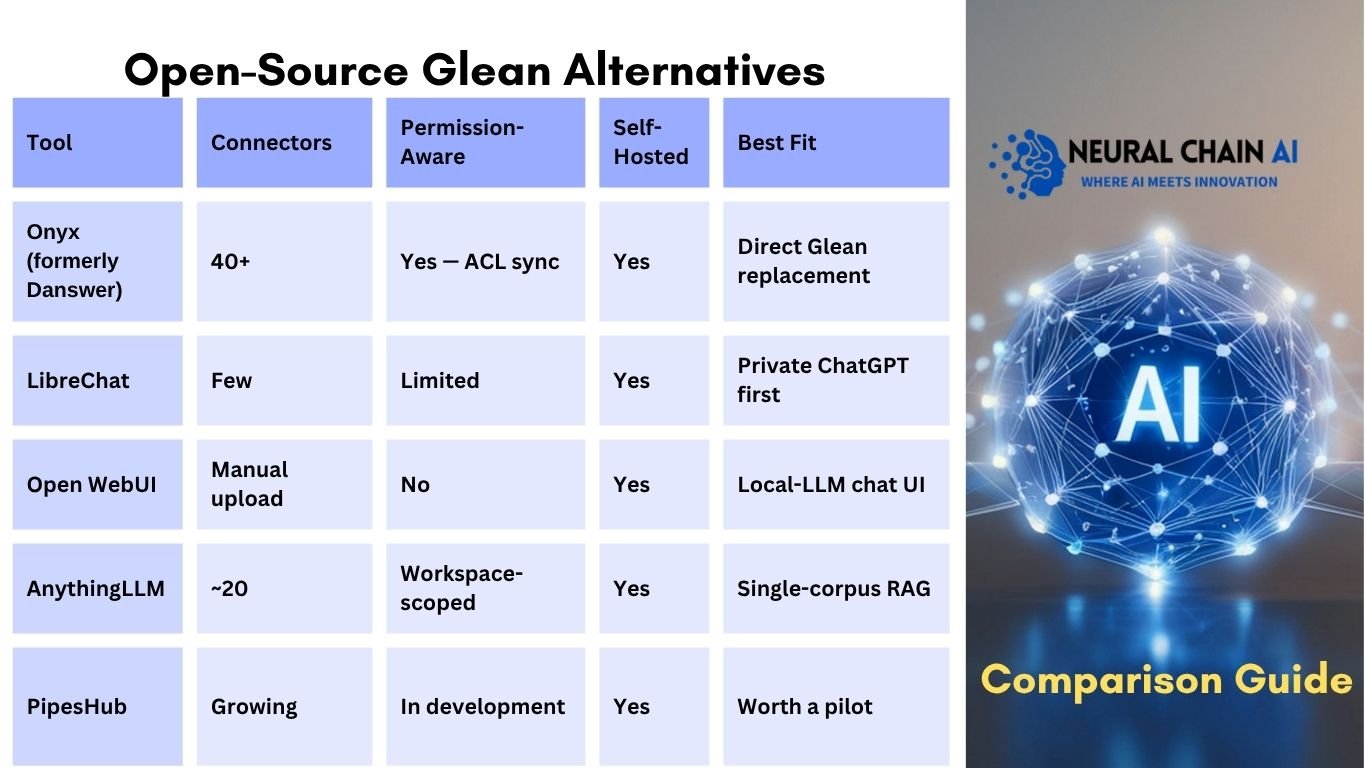
Quick Comparison of Open-source Glean Alternatives
| Tool | Connectors | Permission-Aware | Self-Hosted | Best Fit |
|---|---|---|---|---|
| Onyx (Danswer) | 40+ | Yes (ACL sync) | Yes | Direct Glean replacement |
| LibreChat | Few | Limited | Yes | Private ChatGPT first |
| Open WebUI | Manual upload | No | Yes | Local-LLM chat UI |
| AnythingLLM | ~20 | Workspace-scoped | Yes | Single-corpus RAG |
| PipesHub | 50+ | Yes (source-inherited) | Yes | Worth a pilot |
When Self-hosted Glean Alternatives Make Sense? (and when they don’t)
Self-hosted Glean alternatives win past three thresholds:
- Seat count. Past ~100 users, per-seat SaaS pricing crosses the cost of a deployment plus managed retainer. Past 500, the math is brutal in favor of self-hosted. Glean runs $45–$65 per user per month on customer-reported figures, so 500 seats lands near $300K–$400K/year; an Onyx deployment plus a year of managed service often beats one year of those licences.
- Data sensitivity. Regulated industries — healthcare, legal, financial services, government — frequently can’t pass InfoSec review for vendor multi-tenant storage of corporate documents. Self-hosted moves the data-processor question off the table.
- Connector requirements. If you need iManage, NetDocuments, Epic, ServiceNow, or other industry-specific systems, you’ll need custom connectors regardless of the vendor — and custom connectors against an open-source codebase are cheaper than against a vendor SaaS roadmap.
At small scale (under ~50 seats) and with no strict data-residency requirements, Glean’s polish often wins. Don’t self-host because you can; self-host because the unit economics, compliance frame, or connector landscape require it.
Which Open-source Glean Alternative is Right for You?
For most companies that have outgrown Glean’s pricing or hit a compliance wall, Onyx is the right answer. The architecture matches, the connector ecosystem is comparable, and the production track record is real.
For teams whose primary need is a private chat UI over self-hosted LLMs (without the enterprise-search depth), LibreChat or Open WebUI are simpler answers.
For single-corpus document chat — legal matter files, research libraries, M&A data rooms — AnythingLLM is faster to stand up than Onyx; if you want it as a managed engagement with tuned retrieval, that’s our private RAG / chat-with-documents service.
Deploying a Glean Alternative isn’t a One-evening Project
A real production deployment involves more than a Docker Compose file. The work spans:
- Connector configuration with auth and ACL mapping for every source app
- Vector store sizing and indexing strategy
- LLM routing — self-hosted vs vendor APIs — with fallback rules
- SSO/SAML, role-based access controls, audit logging
- Monitoring, version upgrades (Onyx ships every few weeks), and quarterly reviews
Most teams that try to do this in-house end up two months in with a half-configured Onyx instance and no managed-operations playbook. The deployment isn’t the hard part; operating it through model drift, connector changes, and quarterly version bumps is.
Frequently asked questions
A list of common questions we get about open-source Glean alternatives.
Open-Source Glean Alternatives: What Next?
Glean kicked off the modern enterprise-search-with-AI category, and it’s still the most polished commercial product. But for teams that have outgrown its per-seat economics, can’t ship customer data to a vendor’s multi-tenant cloud, or need connectors against systems Glean doesn’t support, the open-source alternatives have matured into credible production-grade options. Onyx is the closest one-to-one match; LibreChat, Open WebUI, AnythingLLM, and PipesHub each solve adjacent problems and may be the right answer depending on your priorities.
The real work isn’t choosing the tool — it’s the deployment. Connectors, ACL mapping, SSO, RBAC, vector store sizing, LLM routing, monitoring, and operational ownership through version upgrades. NeuralChainAI’s Self-Hosted Enterprise Search AI service handles all of it — Onyx (or another open-source platform if it fits better) deployed in your tenant, with custom connectors against your industry-specific systems and an optional managed retainer for ongoing operation.
Still Deciding Between Glean and An Open-Source Alternative?
Three questions usually decide it for our clients:
- Are you past ~100 seats today, or expecting to be inside a year?
- Does your data sensitivity profile or InfoSec posture rule out multi-tenant vendor storage?
- Do you have connector requirements (iManage, NetDocuments, Epic, ServiceNow) that vendors won’t ship?
If you answered yes to any of those, an open-source deployment is probably the better path.
What’s your situation?Book a 45-minute strategy session →
Disclaimer: This article reflects publicly available information on the open-source enterprise-search ecosystem as of October 2026. Project capabilities, pricing comparisons, and connector lists may shift as the platforms evolve. Specific pricing for Glean, Onyx, and other vendors should be verified directly with the respective providers. This guide is informational and does not constitute purchase, contractual, or legal advice.