ITAR compliance checklists for AI projects answer one question before any model is chosen: who can read the technical data, and where does it sit? This checklist walks aerospace suppliers, MRO shops and engineering firms through classifying ITAR controlled technical data, limiting access to U.S. persons, logging every query and keeping the data on your own network.
AI adds a new reader to every document it touches. A language model has to read the text of a drawing note, a spec or a work instruction in clear to answer a question about it, and the index, prompts and logs around the model hold copies of that text too. Each of those copies falls under the same export rules as the original document, so ITAR compliance for an AI project comes down to controlling where those copies live and who can reach them.
The checklist below is a planning aid for engineering, IT and quality leads. Your export compliance officer or counsel makes the final call on classification, licensing and any specific dataset, and nothing here is legal advice.
What ITAR Compliance Means for an AI Project
Four definitions in the International Traffic in Arms Regulations shape every AI design decision:
- Technical data. Under 22 CFR 120.33, information required to design, develop, produce, operate, repair, test, maintain or modify defense articles, including blueprints, drawings, photographs, plans, instructions and documentation. Public-domain information and general engineering principles are excluded.
- U.S. person and foreign person. 22 CFR 120.62 covers lawful permanent residents, protected individuals, U.S.-incorporated companies and U.S. government bodies. 22 CFR 120.63 defines a foreign person as anyone outside that definition.
- Deemed export. 22 CFR 120.50(a)(2) treats releasing technical data to a foreign person inside the United States as an export.
- Release. 22 CFR 120.56 includes visual or other inspection that reveals technical data, and oral or written exchanges of technical data with foreign persons.
Put together, an AI answer that quotes a controlled drawing to the wrong user is a release in the same way an emailed PDF would be. ITAR controlled technical data needs the same access rules inside the AI system that it already has in your document control system.
AI Use Cases That Touch ITAR Controlled Technical Data
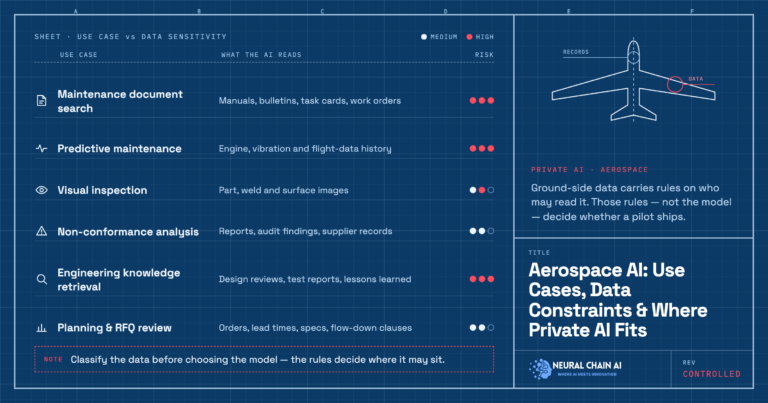
Most aerospace AI projects that meet export rules start with one of five use cases. Each reads a different slice of controlled data, which changes how tight the boundary needs to be.
- Engineering search. Engineers ask questions across drawings, specs, design reviews and test reports. This reads the most sensitive collections, so it usually sets the deployment boundary for everything else.
- RFQ and proposal drafting. An assistant reads customer specs, flow-down clauses and past quotes to draft a response. Customer technical data packages often carry ITAR markings even when the quote itself does not.
- Work instruction and traveler drafting. Models turn engineering changes into shop-floor instructions, and the output inherits the control status of its sources.
- Nonconformance analysis. Quality teams group nonconformance reports by cause and supplier. Those reports reference part numbers and drawing features, so they can count as technical data.
- Test and inspection summaries. Assistants summarize test reports and inspection images, which can reveal design details through visual inspection alone.
Starting with one use case and one collection keeps the first review small. Your compliance lead classifies that collection, the AI team builds against it, and the next use case inherits the controls already in place.
The ITAR Compliance Checklist for AI Projects
Work through these ten checks with your export compliance lead before a pilot touches controlled data. The right-hand column points to the rule or record each check supports.
| # | Check | What to confirm | Rule or record it supports |
|---|---|---|---|
| 1 | Classify the data | Which document collections hold technical data, and under which USML category | 22 CFR 120.33 and the USML in Part 121 |
| 2 | Map the users | Which intended users are U.S. persons and which are foreign persons | 22 CFR 120.62 and 120.63 |
| 3 | Trace every release path | Any route where a foreign person could view or receive the data, including inside the U.S. | 22 CFR 120.50(a)(2) and 120.56 |
| 4 | Set the deployment boundary | Where the model, index, prompts and logs are stored and processed | Your technology control policy |
| 5 | Encrypt storage and transfer | End-to-end encryption with FIPS 140-2 (or successor) modules wherever data moves or rests | 22 CFR 120.54(a)(5) |
| 6 | Enforce access at retrieval | The system checks directory groups before it reads a document for any answer | Your access policy for each collection |
| 7 | Carry markings through | Export-control markings stay on every indexed chunk and show on every answer | Your marking procedure |
| 8 | Log every query | User, documents retrieved and output are logged and exportable | Your recordkeeping under Part 122 |
| 9 | Review vendor access | Who at each vendor could read the data in clear text, and from where | 22 CFR 120.50 and 120.56 |
| 10 | Confirm registration and disclosure steps | DDTC registration is current and staff know the voluntary disclosure process | 22 CFR Part 122 and 127.12 |
Who Owns Each Checklist Item
The checklist crosses four teams, and naming an owner for each item keeps the review moving.
- Export compliance officer. Owns classification, the U.S.-person rules for each collection, registration status and any disclosure, and signs off the access matrix before go-live.
- IT and security. Owns the deployment boundary, encryption, directory groups and log retention, and confirms where every copy of the data sits.
- Engineering or quality lead. Owns the use case, the document collections in scope and the question set used to test the system.
- AI vendor or internal AI team. Owns the retrieval rules, marking propagation and audit export, and documents the data flow for the compliance review.
A short weekly review across those four owners during the pilot catches gaps while they are still configuration changes.
Working Through the Checklist
1. Classify the data before choosing a model
Start with an inventory of the collections the AI will read: drawings, specs, technical data packages, test reports, work instructions and quotes. Tag each with its control status, its USML category where one applies, and the people authorized to read it. Collections that hold only commercial or public information can move faster, and controlled collections set the design for everything else.
2. Map users and every release path
List who will query the system, where they sit and whether each is a U.S. person under 22 CFR 120.62. For a deemed export, 22 CFR 120.50(b) treats the release as an export to every country where that person holds or has held citizenship or permanent residency, which matters for dual nationals on your team. Then trace every way an answer could reach someone: chat windows, exported reports, emailed summaries, support sessions and shared screens. A release covers visual inspection and written exchange, so a foreign national engineer reading an AI answer on a colleague’s screen counts the same way as one reading the source drawing.
3. Set the deployment boundary
Decide where the model, the search index, the prompts and the logs will run. Many suppliers choose a self-hosted model on their own servers, an air-gapped deployment for the most restricted programs, or a private tenant in their own cloud account where the region, keys and administrator access have been approved. The 22 CFR 120.54(a)(5) carve-out covers sending, taking or storing unclassified technical data that stays end-to-end encrypted with no decryption means given to a third party. A model needs the text in clear to answer, so the boundary around the model itself carries the weight.
4. Enforce access, markings and logs inside the AI
Retrieval should check the user’s directory groups before it reads any document, so the model only sees text the user is cleared to read. Each indexed chunk keeps the export-control marking of its source, and each answer lists the markings of the documents it drew on. Every query is logged with the user, the sources retrieved and the output, which gives your compliance team a record they can export and review.
5. Review vendors, records and disclosure
Ask every vendor who could read your data in clear text, from which country, and under what access process. 22 CFR 122.5 requires records to be kept for five years from the expiration of the license or other approval, so decide where AI logs that support those records will live and for how long. Confirm that staff know the voluntary disclosure route, which DDTC strongly encourages and may treat as a mitigating factor.
Four questions cover most vendor reviews:
- Where are prompts, document chunks, embeddings and logs stored, and in which country and tenant?
- Which of your staff could access our data in clear text, and are they U.S. persons?
- Can the system run entirely on our infrastructure, including offline?
- Can we export every query log, and delete our index and logs when the contract ends?
Where Private AI Fits in ITAR Compliance
Private AI keeps the whole stack inside the boundary your compliance program already governs. Open-weight models run on vLLM or Ollama on your hardware, the index and logs sit next to them, and access follows the directory groups your security team already maintains. That design keeps the checklist short, because most items map to controls you run today.
Our ITAR compliance software for AI is built on that pattern for aerospace suppliers: an engineering assistant over drawings and technical data packages, RFQ drafting from controlled specs, markings carried into every answer and a per-query audit log. Your authorized staff load the controlled data, and the system is designed so NeuralChainAI staff do not need access to it.
Planning an AI project on ITAR-controlled technical data? NeuralChainAI builds private ITAR compliance software for AI that runs inside your boundary. Book a strategy session and bring this checklist to map your first collection.
This checklist is general information for planning purposes and is not legal advice. Confirm classification, licensing and deployment decisions with your export compliance officer or counsel.