Searching for the best AI consulting companies in North America? Trying to match top solutions to your next engagement? This executive’s guide maps the four tiers and the market shifts reshaping how US enterprises buy.
The AI consulting market in North America has split into four distinct tiers. Each tier serves a different buyer. Most buyers don’t know which tier they’re buying from until something goes wrong.
That confusion drives more engagement failures than any other single variable. A Big 4 program for a single use case is overkill. A boutique for a regulated transformation lacks the institutional cover. Offshore for a strategy review hits the wrong work shape entirely. The wrong tier costs more than the right one ever would.
This article maps the current state of the market. The four tiers. The buyers each serves. Where each is gaining or losing share. The structural shifts driving the changes — including the rise of nearshore firms over the past two years. What enterprise buyers are demanding now that they weren’t asking for 18 months ago. And what’s likely to shift further through 2027.
Read it as a market map, not as a vendor ranking. The point is to help you pick the right tier for the work you want to ship — not to declare any single tier the winner. There isn’t one.
What “AI consulting” covers?
AI consulting is the work of an external team helping a company plan, build, and deploy AI systems. The category covers strategy, use case prioritization, model development, deployment, MLOps, and governance.
Three engagement types sit under that umbrella. Strategy-only work produces roadmaps and prioritized use case lists. Build-and-handoff work ships production systems and transfers ownership to the client team. Build-and-operate work ships and stays on to run the system.
The scope in 2026 spans generative AI, agentic systems, classical machine learning, computer vision, and the MLOps infrastructure that keeps any of those running in production. A firm that doesn’t cover the full stack — at least through partnerships — isn’t competing for the larger engagements anymore.
The North American AI Consulting Market – 4 Tiers Explained
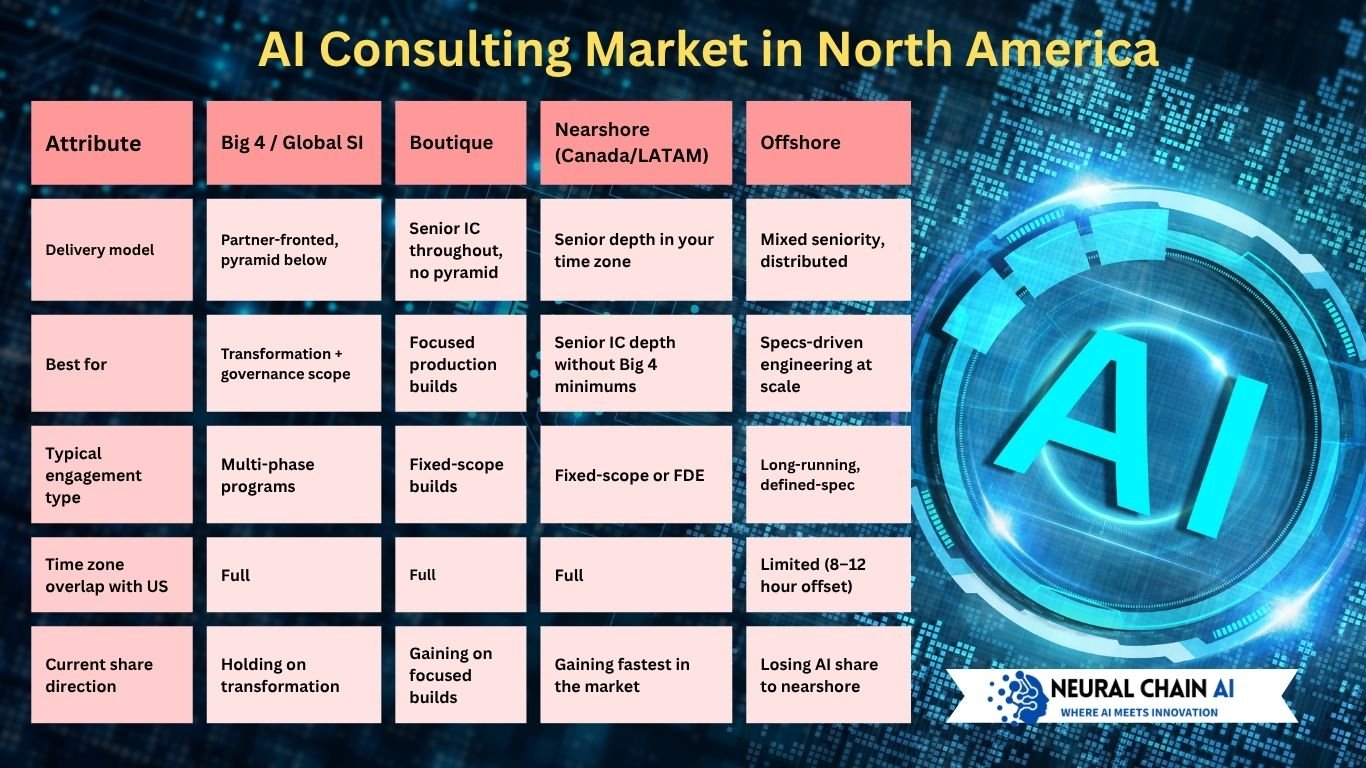
The market has consolidated into four clear tiers. They differ on scale, cost structure, talent depth, and the work shape they’re built to serve.
Tier 1: Big 4 and Global SI Firms
Examples: Accenture, Deloitte, McKinsey Digital, IBM Consulting, Capgemini, BCG.
Engagement minimums start around $250,000 and run past $5 million for transformation programs. Partner-fronted but built by mid-level and junior consultants on a pyramid staffing model. Brand-name credibility helps in board-level conversations and regulated industries.
This tier is gaining share in enterprise-wide AI governance and transformation programs. Losing share on single-use-case implementations to smaller, faster competitors. The minimums that work in their favor on big engagements work against them everywhere else.
Tier 2: Boutique Specialist Firms
Typically 10 to 50 people. Senior individual contributor depth. Domain or technical specialization — generative AI, agentic systems, computer vision, ML platform work. Fixed-price engagements typically $25,000 to $250,000.
The senior engineer on the sales call is usually the engineer building the system. No pyramid below them. This tier is gaining share on focused production builds where speed and execution depth beat brand recognition. The trade-off: smaller firms can’t underwrite enterprise-scale transformation programs.
The Big 4 vs boutique trade-off is sharper because the gap in what each can deliver per dollar has widened on the boutique side.
Tier 3: Nearshore Firms (Canada and LATAM)
Canadian AI consultancies are headquartered in Toronto, Vancouver, Montreal, Ottawa, and Waterloo. LATAM examples cluster in Mexico, Argentina, Brazil, and Costa Rica.
Same time zone as US buyers. Similar legal frameworks — USMCA for Canada, friendly bilateral agreements with several LATAM countries. Senior engineering depth at sub-Big-4 pricing. Fully loaded costs typically 20–40% below US-based equivalents at the same seniority level.
This is the fastest-growing tier in the North American AI consulting market. US enterprises shifting work north has been the dominant procurement trend of the past 18 months. The full breakdown of why is in our Nearshore AI Consulting Guide for US Enterprises.
Tier 4: Offshore firms (India, Eastern Europe)
Examples: TCS, Infosys, Wipro, HCL, Cognizant, EPAM, and many smaller specialists.
Largest talent pools. Lowest hourly rates. Time-zone overlap with the US is limited. Quality variance is wider than the other tiers — which matters more for AI work, where context and iteration speed compound, than it does for classical IT consulting.
This tier is losing share to nearshore on AI work specifically. It remains dominant in large-scale data engineering and traditional IT modernization, where written specs and tight delivery management compensate for the time-zone gap.
What’s shifting in the North American AI Consulting Market?
Five shifts have reshaped the market over the past 18 months.
1. The Structural Rise of Nearshore
Canadian AI consulting in particular has gained share faster than any other category. The drivers aren’t subtle. USMCA-friendly contracting. Same time zone. Senior engineering depth that offshore can’t reliably match. And a US dollar that’s been trading around 1.38 Canadian through mid-2026 — which stretches a US budget roughly a third further on Canadian talent than the nominal figures suggest.
US enterprises that would have defaulted to a Big 4 in 2023 increasingly default to a Canadian boutique or nearshore firm in 2026 — especially for engagements under $500,000. Canadian boutiques like NeuralChainAI have built around this exact gap: senior IC depth without pyramid staffing, USMCA-friendly contracts, fixed-price engagements, and delivery in US business hours. The combination has become the value tier US procurement teams now actively seek out before pricing the Big 4 alternative.
2. FDE Delivery becoming the Default Model
The forward-deployed engineer (FDE) model — senior engineers embedded with client teams — has shifted from a Palantir-specific approach in 2022 to a category-standard model in 2026. Buyers prefer it because it bypasses the consultant-client coordination overhead that slowed earlier engagements.
Boutiques and nearshore firms have adopted FDE delivery aggressively. Big 4 firms are repositioning to match, with mixed results. The pyramid staffing model doesn’t naturally produce the senior IC depth FDE work requires.
3. Evaluation Discipline as a Buyer Demand
Enterprise buyers in 2026 ask about evaluation harnesses, model monitoring, and prompt drift management as part of every RFP. In 2023, those questions barely appeared. Today, a firm that can’t describe its evaluation methodology in concrete terms is often disqualified in the first procurement round.
This shift has favored firms that built eval discipline early. It has hurt firms that ship working demos but degrade silently in production.
4. AI-native Firms vs. Legacy IT Firms Repositioning
Two kinds of firms compete in the AI consulting market today. AI-native firms — most of the boutique and nearshore tier — have been doing AI and ML work since before 2020. Legacy IT firms — much of the Big 4 and offshore tier — have repositioned existing consulting practices as AI consulting.
The gap shows up most clearly on projects requiring deep ML expertise. Repositioned firms tend to default to off-the-shelf API patterns when custom modeling would deliver materially better outcomes. AI-native firms reach for the right tool for the problem more often.
5. Pricing Compression in Some Tiers, Expansion in Others
Nearshore rates have compressed modestly as more firms enter the category. Big 4 rates have held steady or expanded — driven by demand for enterprise AI governance work that smaller firms can’t underwrite. Offshore rates have compressed sharply on AI-specific work as quality variance has become more visible to procurement teams.
Expect the trend lines to continue through 2027. Nearshore will keep compressing as supply grows. Big 4 will keep expanding on governance and transformation. Offshore will keep losing AI-specific share to nearshore.
What Buyers want now that they weren’t asking for earlier?
The buyer side of the market has matured faster than the supply side.
Three demands have become near-universal in 2026 enterprise RFPs.
Named team commitments. Buyers want specific engineers named in the SOW, with seniority and recent work attached. The pyramid-staffing surprise — partner-fronted sales, mid-level delivery — is no longer accepted in writing.
Eval and monitoring deliverables as part of the build. Working code isn’t enough. Buyers want evaluation harnesses with documented metrics, monitoring dashboards in their own accounts, and prompt drift detection built into the system. The bar has shifted up substantially.
Clean handoff terms. Code in the client’s repo. Monitoring in their tenant. Knowledge transfer sessions. Optional retainer terms that don’t require ongoing involvement to keep the system running. Vendor lock-in disguised as “continuity” no longer passes procurement review at most enterprises.
AI Consulting Firms that lead with these as defaults have gained share. Firms that resist them have quietly lost engagements they don’t even know they were considered for.
What’s likely to shift ahead?
Three predictions worth tracking.
1. Consolidation in The Boutique Tier
The number of AI consulting boutiques has roughly doubled since 2023. Not all of them survive a market where buyer sophistication is rising and pricing is compressing. Expect 20–30% of current boutique firms to be acquired or wind down by end of 2027.
2. Nearshore Keeps Gaining
Nearshore Share will continue growing — particularly Canadian Firms. US procurement teams have learned the model. The advantages don’t disappear. Expect Canadian AI consulting to grow from roughly 5–8% of US enterprise AI consulting spend in 2024 to 15–20% by 2027.
3. Big 4 Partnering with Boutique Firms
Big 4 will increasingly partner with boutiques rather than build everything in-house. The pyramid model can’t produce enough senior AI talent fast enough. The most pragmatic Big 4 partners have started subcontracting specialist work to boutiques and nearshore firms. That pattern will accelerate.
The macro takeaway: the market is splitting into a barbell shape. Big 4 at one end, serving transformation-scale buyers with governance scope. Boutique and nearshore at the other, serving focused-build buyers with senior IC depth. The middle is hollowing out — large IT services firms that lack either the brand for transformation work or the technical depth for boutique-tier execution.
AI Consulting – How to position your buying decision?
Three questions resolve most AI consulting purchase decisions cleanly.
1. What’s the engagement scope?
Single use case → boutique or nearshore. Multi-use-case program → boutique or upper-mid system integrator. Enterprise transformation with governance scope → Big 4.
2. What’s the time pressure?
Need first production value in 6–12 weeks → nearshore or boutique. Time horizon over a year → any tier becomes workable, but cost discipline favours the smaller firms.
3. What’s your data sensitivity?
US-only data residency → US-based firm only. USMCA-friendly contracting → Canadian nearshore works. EU residency → European boutique. HIPAA or regulated workloads → vendors with prior regulatory delivery experience in your specific domain.
For most US enterprises buying AI consulting at the $50,000–$500,000 engagement level, nearshore — particularly Canadian — has become the value tier most procurement teams underweight. The deeper breakdown of how to evaluate AI consulting firms walks through the five questions that surface the right tier in any specific evaluation.
If you’re scoping an AI consulting decision now and want a directional read on which tier fits your situation — Book a Strategy Session with NeuralChainAI. No deck, no pitch, one-page summary either way.
The North American AI Consulting Market: What to Watch?
The AI consulting market in North America isn’t one market. It’s four overlapping tiers — each serving a different buyer, each gaining or losing share for different reasons. Get the tier right and the engagement compounds. Get the tier wrong and the engagement stalls — usually months into the build, when the cost of switching exceeds what the right pick would have cost upfront.
Expect this split to deepen. Nearshore will gain share — Canadian firms most of all. Big 4 will hold their transformation-tier moat. Boutique consolidation will sort the strong from the weak. The middle will keep thinning.
The buyer side has matured faster than the supply side. Procurement teams now ask sharper questions than most consultancies are prepared to answer. The firms that win the next phase won’t be the ones with the longest sales decks. They’ll be the ones whose engagement models — named teams, eval discipline as standard, clean handoff — match what serious buyers now require.
Which shift in the AI consulting market in North America doesn’t match what you’re seeing on the ground — and which one is moving faster than this landscape suggests?
Disclaimer: This article reflects general industry observations as of publication. The AI consulting market shifts quickly, and the tier dynamics described here will continue to evolve. Validate any specific firm against your own due diligence before engaging.