Video annotation services turn raw robot and egocentric footage into the labels a manipulation policy can train on: object masks, grasp points, task phase boundaries, and gripper keypoints tied to exact frame timestamps. This guide covers what robotics teams should specify when they buy video annotation, how vendors price the work, which label types matter for pick-and-place and bin-picking models, what model-assisted labeling changes about the cost curve, and how to get output back in LeRobot or RLDS so it loads without a conversion project.
Most published guidance on video annotation was written for autonomous driving and retail analytics. Robotics teams buying against that guidance get bounding boxes on a timeline and discover the labels carry no information about when the gripper closed, which object the operator intended, or where the task started and stopped. The specification differs because the model differs. A perception stack wants to know what is in the frame. A manipulation policy wants to know what the hand did next.
What Video Annotation Services Cover for Robotics Teams?
A robotics video annotation engagement usually spans five kinds of work: schema design, annotation, review, format delivery, and iteration after the first training run. Vendors differ most on the first and the last. Any provider can draw polygons. Fewer will sit with your policy team, read the observation and action schema, and write a labeling guideline that maps onto the features your dataloader already expects.
The schema conversation is worth doing before a single frame is labeled. Decide which streams get annotated (wrist camera, third-person camera, or both), what frame rate the labels attach to, whether labels propagate between keyframes or exist on every frame, and what an annotator should do with an occluded object. Those four decisions set the cost of the project more than the hourly rate does.
Label Types That Manipulation Policies Need
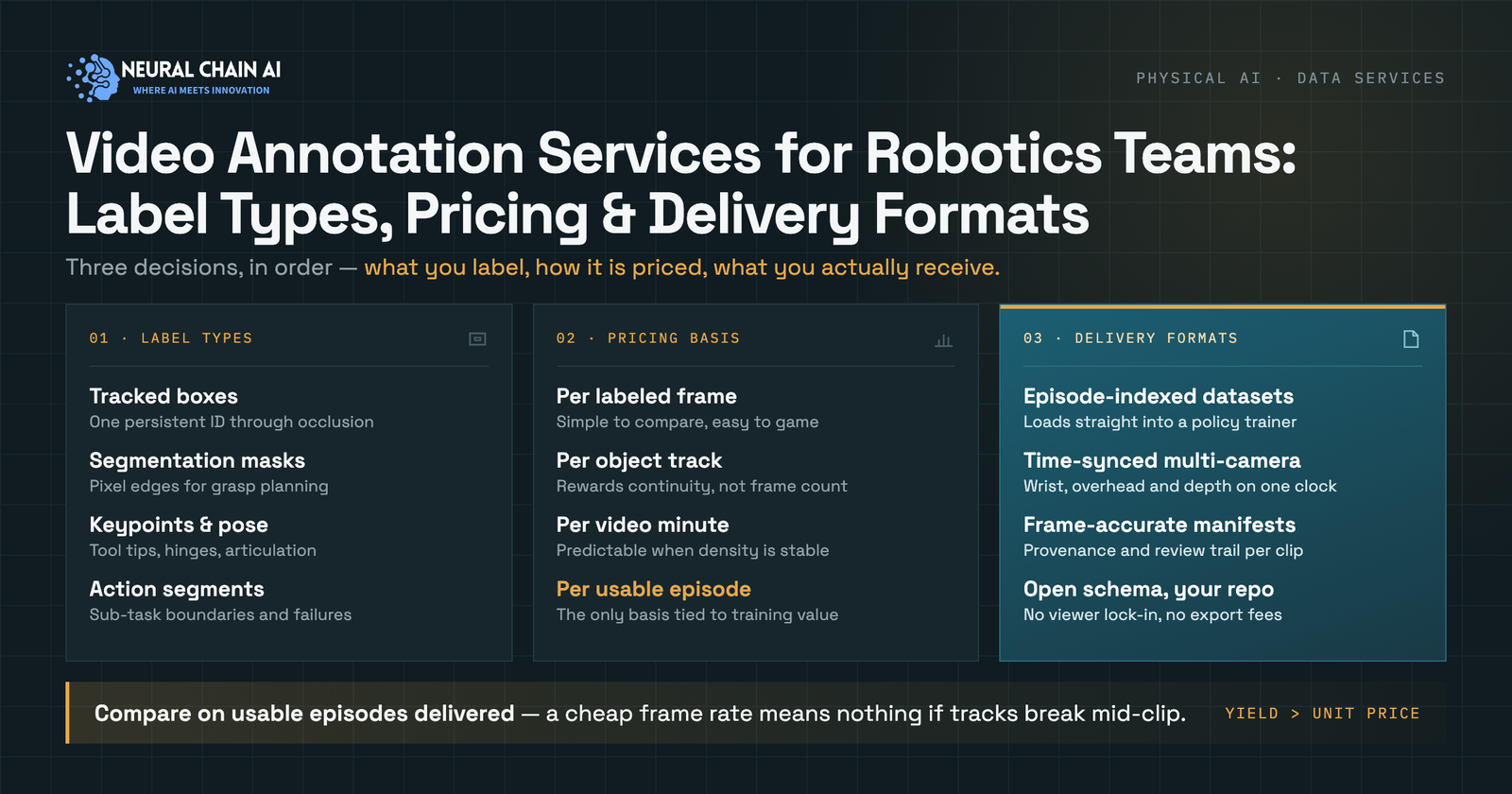
Pick-and-place and bin-picking models draw on a narrower label set than most vendors assume, and one that leans heavily on time rather than geometry. The table below maps each label type to what it trains and how it is usually billed.
| Label type | What it trains | Common billing unit | Primary QA measure |
|---|---|---|---|
| Instance masks with track IDs | Object grounding, target selection in clutter | Per object per frame | Mask IoU, ID switch count |
| Grasp points and approach vectors | Grasp proposal ranking, bin-picking heuristics | Per annotated grasp | Inter-annotator agreement on pose |
| 6D object pose | Placement precision, insertion and stacking | Per object per keyframe | Translation and rotation error |
| Task phase segmentation | Language conditioning, subtask decomposition | Per minute of video | Boundary tolerance in frames |
| Hand and gripper keypoints | Human-to-robot retargeting from egocentric video | Per frame | Keypoint distance error |
| Contact and release events | Reward shaping, success and failure labeling | Per event | Timestamp offset against force data |
Task phase segmentation is the label type most often left out of a first scope and most often added after the first training run. Research teams have started building dedicated benchmarks for it: Macrodata Labs published WGO-Bench, a subtask annotation benchmark of 743 annotated segments across 62 high-level task instructions, drawn from robot and egocentric footage.
How Robotics Video Annotation Differs From Driving and Retail Work?
The following properties separate the two.
- Time carries the signal. In a driving dataset, a frame with correct boxes is a useful frame on its own. In a manipulation episode, the value sits in the transition: the moment the gripper closed, the moment the object left the bin, the moment the operator recovered from a slip. Labels that are geometrically perfect but temporally loose produce a policy that hesitates at exactly the wrong point.
- Labels have to align with non-video streams. Robot episodes carry joint states, actions, force readings, and IMU data at rates far above video frame rate. Open X-Embodiment episodes, for reference, run at control frequencies of roughly 3–10 Hz with an average trajectory around 120 timesteps, per the dataset paper. An annotation that lands on frame 412 has to resolve to a specific row in the tabular data, which means the vendor needs your timestamp convention up front.
- Volume is smaller and value per clip is higher. A driving program labels millions of frames of routine footage. A manipulation program often labels a few hundred hours of deliberately collected demonstrations, where a single mislabeled recovery behavior can teach the policy the wrong thing. This shifts the economics toward smaller batches with tighter review.
How Video Annotation Services Price the Work?
Four pricing models dominate. Published rates give a floor, though robotics schemas sit above generalist rates because they need annotators who understand what a grasp is.
| Model | Published reference point | Best fit |
|---|---|---|
| Per annotator hour | Around $6 per hour at Label Your Data; $5–7 at Annotation Box | Evolving schemas, exploratory labeling |
| Per object or per label | 2D bounding boxes from $0.02 to $0.07 per object | Fixed schema, high volume, simple shapes |
| Per minute or hour of video | Automated subtask pipelines reported at $2.64 per hour of video by Macrodata Labs | Temporal segmentation at scale |
| Per episode, fixed price | Quoted per project; vendors rarely publish | Demonstration datasets with a stable task list |
Two adjustments matter when you read a quote. First, ask what the number covers: annotation only, or annotation plus review plus format conversion. Conversion to a training-ready format is real engineering work and gets quietly excluded. Second, compare the annotation quote against capture cost for the same footage. Published teleoperation collection ranges sit far higher, with DataX Power citing $15–30 per hour of usable data for simple programs and $80–150 per hour for multi-sensor humanoid work. When labeling an existing archive costs a fraction of collecting new episodes, annotate first. When the archive lacks the sensor streams the policy needs, no amount of labeling adds them, and fresh capture is the cheaper path.
What Model-Assisted Labeling Changes?
Foundation segmentation models have moved the cost curve for the mask and tracking portion of a robotics scope. CVAT reports that running Segment Anything 2 in the loop for video segmentation runs 8.4 times faster than manual per-frame annotation with the original SAM, with the model processing around 44 frames per second. SAM 3, released in November 2025 and now integrated across CVAT editions, adds promptable concept segmentation: a text or exemplar prompt segments and tracks every instance of a concept rather than objects the annotator clicks one at a time.
The practical effect on a robotics project is a split scope. Masks, tracks, and object persistence move to model-assisted passes with human correction. Grasp geometry, phase boundaries, and success labeling stay human, because they encode intent rather than appearance. A vendor quoting a single blended rate across both halves is either overcharging for the first or underinvesting in the second. Ask for the split.
Automated pipelines now reach further. The Macrodata Labs work cited above annotates subtasks with no human in the loop at roughly nineteen times lower cost than human annotation. Treat that as a strong pre-labeling layer rather than a finished deliverable: human review of automated phase boundaries is where the remaining quality lives.
Delivery Formats: LeRobot, RLDS, and Why the Choice Matters
Annotation delivered as a folder of COCO JSON is a conversion project waiting to happen. Robotics teams should specify the target format in the statement of work.
| Format | Structure | Best for |
|---|---|---|
| LeRobotDataset v3.0 | Parquet shards for tabular data, MP4 shards per camera, chunked Parquet episode metadata, tasks and stats in meta/ | PyTorch training, Hugging Face Hub distribution, streaming |
| RLDS (TFRecord) | Serialized episode records with per-step observation and action fields | Mixing with Open X-Embodiment and RT-X style pretraining sets |
| HDF5 | Hierarchical arrays per episode | Internal pipelines and bimanual teleoperation stacks |
| COCO or YOLO plus sidecar | Per-frame annotation files, timing held separately | Perception-only models, not policy training |
LeRobot v3.0 changed the storage model from one file per episode to many episodes per Parquet and MP4 shard, with episode boundaries resolved through metadata rather than filenames, and streaming support through StreamingLeRobotDataset. If your vendor last delivered a LeRobot dataset under v2.1, confirm which version they write. RLDS remains the format of record for the cross-embodiment pretraining corpora: Open X-Embodiment pools more than a million real robot trajectories across 22 embodiments and 527 skills, assembled from 60 datasets across 34 labs, all canonicalized into RLDS.
How Much Labeled Video a Manipulation Model Needs?
No vendor can answer this precisely for your task, but published dataset sizes give usable anchors for scoping a first purchase order.
DROID, one of the more widely reused in-the-wild manipulation sets, collected 76,000 demonstrations across 564 scenes using 50 operators on three continents. Open X-Embodiment aggregates over a million trajectories, though individual contributing datasets range from a few hundred episodes to tens of thousands. Fine-tuning an existing VLA checkpoint on one narrow warehouse task sits far below either figure. Treat a few hundred episodes per task variant as a pilot batch, measure the scaling curve on your own task, and buy the next batch against that measurement rather than a vendor’s volume discount.
Scene and object diversity buys more than raw episode count. Two hundred episodes across twenty bin configurations, four lighting conditions, and three operators will generalize further than two thousand episodes of the same operator working one bin. Write that diversity requirement into the annotation scope, because it changes how the vendor batches and reviews the work: a diverse set needs more guideline examples and produces more edge cases at review.
Quality Measures Worth Writing Into the Contract
Accuracy claims in the 95 to 99 percent range appear in most vendor marketing without a stated measure attached. Specify the measure yourself:
- Temporal boundary tolerance. State the acceptable offset in frames for phase transitions, for example ±3 frames at 30 fps. This single number does more for policy quality than any mask threshold.
- Inter-annotator agreement on grasp pose. Have two annotators label the same 50 episodes and report the spread. Grasp annotation is genuinely ambiguous, so a stated spread is more useful than a claimed accuracy.
- Mask IoU threshold and ID switch rate. A track that swaps identity between two similar bin items is a labeling defect that survives every per-frame check.
- Cross-stream timestamp drift. Confirm that labeled events line up with force or joint-state rows within a stated millisecond budget.
- Gold-set audit. Reserve a held-out set that you have labeled yourself and score every delivery batch against it.
Video Annotation Services – A Buyer’s Checklist
Bring these to a first vendor call, in this order:
- Do you write labeling guidelines from our observation and action schema, or from a generic template?
- Which parts of our scope will be model-assisted, and what is the human correction rate you assume?
- Do you deliver in LeRobot v3.0 or RLDS directly, and is conversion inside the quoted price?
- What measure sits behind your accuracy figure, and will you report it per batch?
- Who owns the labels and the derived data, and where do the annotators work from?
- How do you handle occlusion, failed attempts, and operator recovery behavior, and are those kept or discarded?
Question six separates vendors quickly. Failed grasps and recovery attempts are among the most valuable frames in a manipulation dataset, and a labeling process built for clean perception data will drop them as noise.
Annotation, Capture, or Both
Annotation adds meaning to footage that already has the right sensor streams in it. It cannot add a depth channel, a force reading, or a hand-pose track that was never recorded. Teams training vision-language-action models generally need both: labeled archive footage for grounding and language conditioning, plus purpose-built capture for the sensor modalities the policy consumes at inference time.
NeuralChainAI works on both sides of that line. Our physical AI training data practice covers synchronized multimodal capture with per-episode chain of custody, and our embodied AI data work covers demonstration datasets built for robot policies and VLA fine-tuning, delivered LeRobot-ready.
Planning a labeling or capture program for a manipulation model? Talk to our team about physical AI and robotics consulting and development, and we will scope the label schema against your training pipeline before any footage is touched.