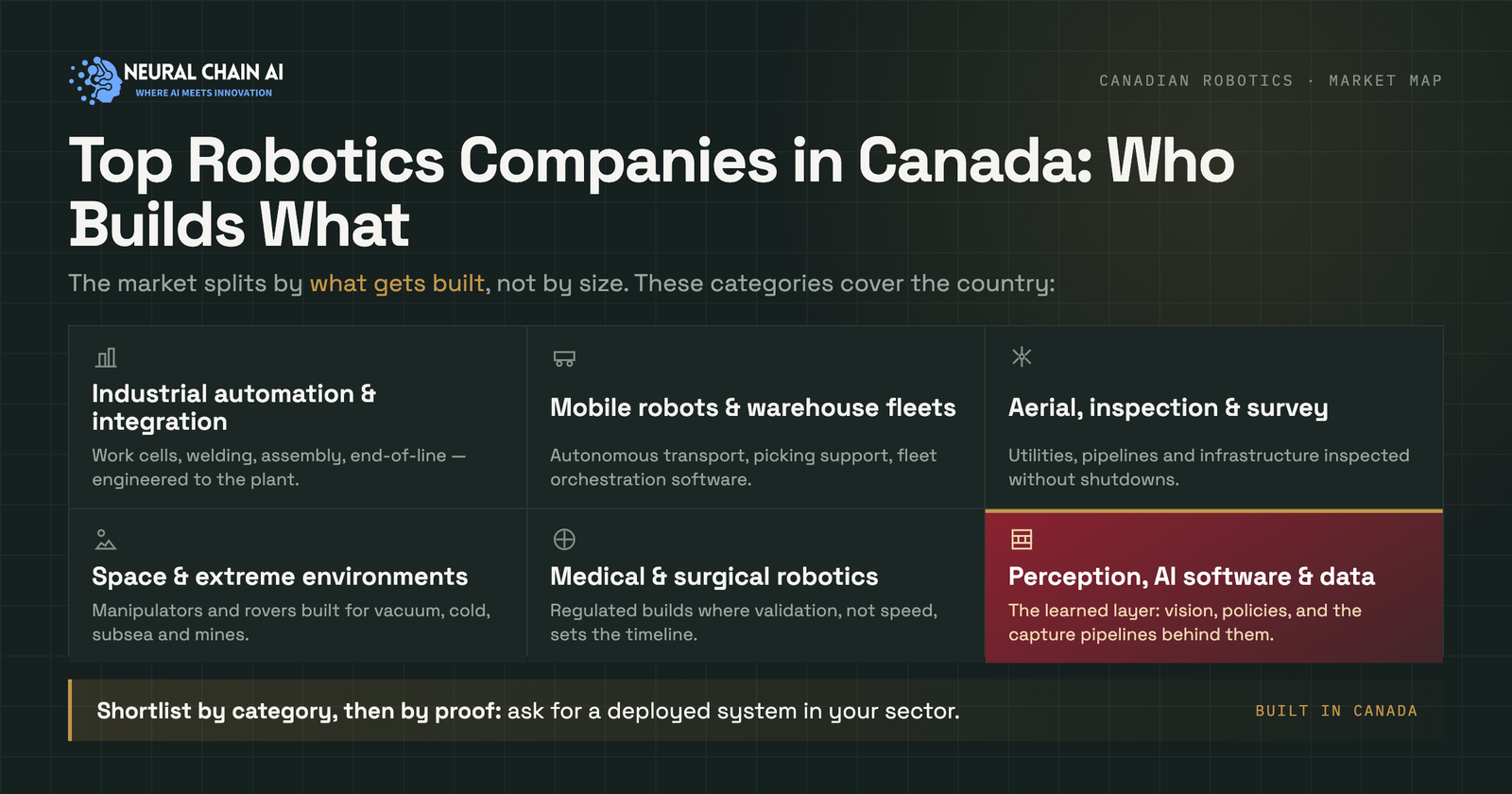
Robotics companies in Canada build distinct things: space arms, autonomous mobile robots, industrial arms and grippers, subsea systems, farm and food robots, and the physical AI software that runs on top of all of them. This guide maps who builds what, where each company sits, who buys from it, and what changed in ownership and strategy through 2025 and 2026. Use it to shortlist a supplier, a partner, or an acquisition target without working from a list that went stale two years ago.
Start with the demand picture. Canadian factories installed 3,800 industrial robots in 2024, a 12% decline from the year before, and the car industry accounted for 47% of them, according to the International Federation of Robotics World Robotics 2025 report. Density paints a warmer picture than volume: Canada runs 241 robots per 10,000 manufacturing employees, above the North American average of 204.
Domestic demand tracks automotive investment cycles. The supply side sells almost entirely abroad. Canadian firms rarely go head to head with FANUC or ABB on general-purpose arms, and most of them never tried. They win the work those arms leave alone: welding pipe spools, scrubbing airport floors, mapping the seabed, picking mushrooms, moving cargo on a lunar orbit.
Canadian Robotics Companies at a Glance
Here is an exclusive list of 16 companies, sorted by what they put in a customer’s hands. Status reflects public reporting as of August 2026.
| Company and base | What it builds | Who buys it | Status in 2026 |
|---|---|---|---|
| MDA Space, Brampton ON | Space robotic arms, satellites, the Canadarm line | Space agencies, satellite operators, defence | Public, TSX: MDA. Canadarm3 work being repurposed for lunar surface operations |
| OTTO Motors and Clearpath Robotics, Kitchener ON | Industrial AMRs, research robot platforms | Manufacturers, warehouses, university labs | Owned by Rockwell Automation since 2023 |
| Avidbots, Kitchener ON | Autonomous floor scrubbers: Neo, Neo 2W, Kas | Airports, malls, hospitals, transit hubs | Private, USD 107 million raised |
| Attabotics, Calgary AB | Cube-based 3D storage and retrieval robots | Grocery and retail fulfilment | Assets bought by Lafayette Systems in September 2025, Calgary operations restarted February 2026 |
| Kinova, Boisbriand QC | Lightweight arms for research, assistive and medical use | Universities, hospitals, nuclear and hazmat teams | Private, founded 2006 |
| Robotiq, Lévis QC | Grippers, force torque sensors, palletizers, tactile fingertips | Cobot users, machine shops, integrators | Private, roughly 160 staff, TSF-85 tactile fingertips launched January 2026 |
| Mecademic, Montreal QC | Ultra-compact six-axis and SCARA industrial arms | Precision assembly, electronics, lab automation | Private |
| Novarc Technologies, Burnaby BC | Welding cobots and welding autonomy software | Pipe fabricators, heavy industry, oil and gas | Private, Caterpillar-backed, Yaskawa agreement signed July 2026 |
| Apera AI, Vancouver BC | 4D vision software for bin picking, sorting, assembly | Automotive OEMs, Tier 1 suppliers, general manufacturing | Private, ranked 10th on Deloitte’s 2025 Technology Fast 50 |
| Sanctuary AI, Vancouver BC | Physical AI models, hydraulic hands, the Phoenix humanoid | Tier 1 automotive suppliers, manufacturers | Private, June 2026 strategy puts its AI on third-party robot hardware |
| Waabi, Toronto ON | Autonomous driving software for trucks, extending to robotaxis | Carriers, truck OEMs, ride-hailing platforms | Private, USD 750 million Series C in January 2026 plus a USD 250 million milestone commitment from Uber |
| Gatik, Toronto ON and Mountain View CA | Driverless middle-mile box trucks | Grocery and retail distribution networks | Private, multi-year Loblaw agreement covering the Greater Toronto Area |
| Kraken Robotics, Mount Pearl NL | Synthetic aperture sonar, subsea batteries, towed underwater systems | Navies, offshore energy, ocean science | Public, TSXV: PNG. Closed the CAD 615 million Covelya acquisition in July 2026 |
| Cellula Robotics, Burnaby BC | Subsea robotic systems and long-endurance underwater vehicles | Defence, offshore energy, science missions | Private |
| Mycionics, Putnam ON | Robotic mushroom harvesting with custom vision | Mushroom growers | Private, founded 2014 |
| Korechi Innovations, Oshawa ON | RoamIO field robots, Pik’r golf course robots | Row-crop farms, orchards, vineyards, golf courses | Private, founded 2016 |
Disclaimer: NeuralChainAI has no affiliation, partnership, or commercial relationship with any company named on this page. Nothing here is an endorsement, a recommendation, or paid placement. Every entry is compiled from public sources, company announcements, and regulatory filings current to August 2026, and it is published for general information only. Company status, ownership, and product details change often, so confirm anything you plan to act on directly with the company.
Space Robotics: The One Category Canada Leads Outright
MDA Space
MDA Space designed and built Canadarm and Canadarm2, and it holds a CAD 1 billion contract from the Canadian Space Agency for the next phases of Canadarm3, awarded in June 2024. The company runs its Space Robotics Centre of Excellence out of Brampton, Ontario, alongside a mission control facility for on-orbit commissioning.
The program shifted in 2026. NASA dropped plans for the Lunar Gateway station in March, and by August the Canadian Space Agency confirmed that Canadarm3 investment will be repurposed toward lunar surface logistics. MDA’s robotics and space operations unit posted CAD 100 million in second-quarter 2026 revenue, up 13% year over year, with company-wide first-half revenue of CAD 963 million. Space robotics is the one segment where a Canadian firm sets the global standard rather than competing for a share of someone else’s.
Autonomous Mobile Robots and Warehouse Robotics Companies
OTTO Motors and Clearpath Robotics
Four University of Waterloo graduates founded Clearpath in 2009. The research side sells Husky, Jackal and Warthog platforms into more than 40 countries; the OTTO Motors side sells autonomous mobile robots that move pallets and carts inside plants. Rockwell Automation completed its acquisition in 2023 in a deal valued above USD 600 million, and both divisions now report into Rockwell’s Intelligent Devices segment. For a buyer, that changes the calculus: you get a global service footprint and integration with Rockwell’s control stack, purchased through a large vendor rather than a startup.
Avidbots
Avidbots has shipped autonomous floor scrubbers since 2014 from Kitchener. Neo maps a site once and then cleans it on a schedule, reporting coverage back through fleet software. The product line now includes Neo 2W and the smaller Kas unit. The company raised USD 70 million in a Series C led by Jeneration Capital, bringing total funding to USD 107 million, and at that point had more than 1,000 robots working across a dozen countries, including Cincinnati and Northern Kentucky International Airport and SMRT Trains in Singapore.
Attabotics
Attabotics built a cube-based storage system where robots travel in three dimensions inside a dense structure, and counted Nordstrom and Canadian Tire among its customers. Revenue reached CAD 11.4 million in 2022 and CAD 3 million in 2024. The company filed under Canada’s Bankruptcy and Insolvency Act at the start of July 2025. Kentucky material handling firm Lafayette Systems bought substantially all of the assets in a September 2025 deal, and restarted Calgary operations under new leadership in February 2026. Anyone evaluating an ASRS vendor should check the entity and the support contract, not the brand history.
Industrial Arms, Grippers and Welding Robots
Quebec holds most of Canada’s component makers, and components travel well: a gripper sells into every cobot fleet on earth without a Canadian factory buying anything.
Kinova
Kinova started in Boisbriand in 2006 with JACO, a wheelchair-mounted assistive arm, and now sells lightweight arms into research, medical, defence, nuclear and hazmat work. The Gen3 line is a common base for university manipulation research, which puts Kinova hardware under a large share of published grasping and dexterity experiments.
Robotiq
Robotiq, based in Lévis, sells the parts that sit at the end of someone else’s arm: two-finger and three-finger adaptive grippers, force torque sensors, vacuum tools, and complete palletizing cells. Two 2026 moves show where the company is heading. It launched TSF-85 tactile sensor fingertips in January for touch-driven manipulation, and it demonstrated a palletizing cell at CES 2026 with Universal Robots and Siemens.
Mecademic
Mecademic builds the smallest end of the industrial market from Montreal: the Meca500 six-axis arm and the MCS500 SCARA, sized for benchtop precision assembly, electronics and laboratory automation where a standard industrial arm has nowhere to stand.
Novarc Technologies
Novarc commercialised the first collaborative welding robot for pipe spools from Burnaby, working first with Alberta oil and gas fabricators on welds people prefer not to do by hand. Its NovAI platform combines real-time computer vision, adaptive control and over-the-air updates, and in July 2026 the company signed an agreement with Yaskawa America to bring that autonomy to Yaskawa six-axis robots. Welding is one of the clearest cases for automation in industrial and manufacturing AI, because the skill shortage is measurable and the quality data is already digital.
Physical AI and Humanoid Robot Companies
Sanctuary AI
Sanctuary AI, founded in Vancouver in 2018, is known for Phoenix, a general-purpose humanoid with hydraulic hands and integrated tactile sensing. In June 2026 the company changed how it goes to market: rather than waiting for humanoid hardware to reach volume, it now deploys its physical AI on existing commercial robot platforms. The proof point was a wire plugging task at a global Tier 1 automotive supplier, where Sanctuary reported a success rate above 99.5% at a 2.54 second cycle time against the customer’s own production benchmark.
Apera AI
Apera AI sells vision, not robots. Its 4D Vision software gives an existing industrial arm the ability to find, orient and pick parts from an unstructured bin, and the company reports work with major North American automotive OEMs and Tier 1 suppliers. Deloitte ranked it 10th on the 2025 Technology Fast 50. Retrofitting perception onto installed arms is the cheapest route to capability for most plants, since the arm is already paid for.
Autonomous Trucking and Delivery Robotics
Waabi
Raquel Urtasun founded Waabi in Toronto in 2021 around simulation-first training for a single driving model. In January 2026 the company raised USD 750 million in a Series C co-led by Khosla Ventures and G2 Venture Partners, with NVIDIA, Volvo Group and Porsche among the strategic investors, plus a USD 250 million milestone-based commitment from Uber toward deploying 25,000 robotaxis. Volvo has integrated the Waabi Driver into its VNL Autonomous truck.
Gatik
Gatik runs driverless box trucks on fixed middle-mile routes, which is a narrower problem than long-haul and reaches revenue sooner. Its multi-year agreement with Loblaw covers autonomous deliveries across the retailer’s Greater Toronto Area distribution network, a useful reference point for anyone modelling AI in logistics and supply chain operations.
Subsea and Marine Robotics
Kraken Robotics
Kraken, based in Mount Pearl, Newfoundland and listed as TSXV: PNG, makes synthetic aperture sonar, sub-bottom imaging, underwater LiDAR and pressure-tolerant subsea batteries, with the KATFISH towed system as its best-known platform. Revenue reached CAD 91.3 million in 2024. In July 2026 it closed the CAD 615 million acquisition of Covelya Group, owner of Sonardyne and Wavefront Systems, and revised 2026 guidance to CAD 290 million to CAD 320 million. That deal makes Kraken the largest pure-play robotics company headquartered in Canada by revenue.
Cellula Robotics
Cellula, in Burnaby, designs and builds subsea robotic systems including long-endurance autonomous underwater vehicles for defence, offshore energy and science customers. Canada’s ocean robotics cluster is small in headcount and disproportionately strong in exports, helped by a coastline that provides a permanent test range.
Agriculture and Food Robotics
Farm robotics in Canada is built by people who came from farming. Mycionics in Putnam, Ontario automates mushroom harvesting with a vision system that judges when each cap is ready. Korechi Innovations in Oshawa sells the RoamIO line for seeding, weeding, vegetation management and data logging, plus Pik’r robots for golf courses. Nexus Robotics builds an autonomous weeding robot for vegetable crops that removes weeds mechanically instead of chemically.
In Kitchener, Finite Robotics works on apple thinning and Upside Robotics on precision fertilizer application, while NeuPeak in British Columbia is developing strawberry harvesting. Every one of these targets a task where seasonal labour is hard to secure, which is why agriculture and agtech AI projects tend to clear their business case faster than general factory automation.
How to Shortlist a Canadian Robotics Supplier?
The list above answers who builds what. The harder question is what to verify before you sign. Deployments that hit their business case settle three things early: the true integration scope, where the data behind the perception model comes from, and which legal entity carries the service contract.
| If you are buying | Ask for | The number that decides it |
|---|---|---|
| An AMR fleet | Fleet manager APIs, WMS integration scope, floor and network survey | Payload moves per hour at your aisle widths, not catalogue speed |
| A vision or picking system | A pilot on your own parts, including the worst bin you have | Pick success rate and cycle time on those parts |
| A welding or assembly cell | Fixture and tolerance requirements, operator training plan | Arc-on time or parts per shift, plus rework rate |
| An ASRS or fulfilment system | Current corporate entity, spare parts supply, service SLA in writing | Uptime commitment and mean time to repair |
| Autonomy or physical AI software | Who owns the training data and the fine-tuned model | Hours of task-specific data behind the model |
| A farm or field robot | Performance in your crop, soil and season, with references | Acres or rows per day against the labour it replaces |
One pattern connects almost every company above. Sanctuary sells models that run on other vendors’ arms. Novarc sells welding intelligence for robots Yaskawa already ships. Apera sells sight for arms that are bolted down and paid for. Robotiq now sells touch. The differentiated Canadian product is increasingly the intelligence layer, and that layer runs on task-specific data: hours of real manipulation, real driving, real welds.
Teams that plan the data pipeline alongside the hardware get to production; teams that treat data as an afterthought spend the first year collecting it. That is the work NeuralChainAI does with robotics and embodied AI teams, from teleoperation capture and multimodal datasets through to physical AI and robotics consulting and deployment.
What Changed Across 2025 and 2026
Five shifts that most published lists have not caught up with:
- Sanctuary AI became a software vendor first. As of June 2026 it sells physical AI that runs on existing industrial robots, with the humanoid as the long-term platform rather than the near-term product.
- Kraken became the revenue leader. The Covelya acquisition closed 2 July 2026 and lifted 2026 guidance to between CAD 290 million and CAD 320 million.
- Attabotics changed hands and reopened. Lafayette Systems acquired the assets in September 2025 and restarted Calgary operations in February 2026.
- Waabi set the funding record. Its January 2026 round is the largest ever raised by a Canadian technology startup, and it moved the company into robotaxis alongside trucking.
- Canadarm3 changed destination. With Gateway shelved, the Canadian Space Agency confirmed the investment is being redirected to lunar surface operations.
Planning a robotics or embodied AI build and weighing which partner and which data strategy fits? Book a free 30-minute AI strategy session and leave with a prioritised opportunity map.