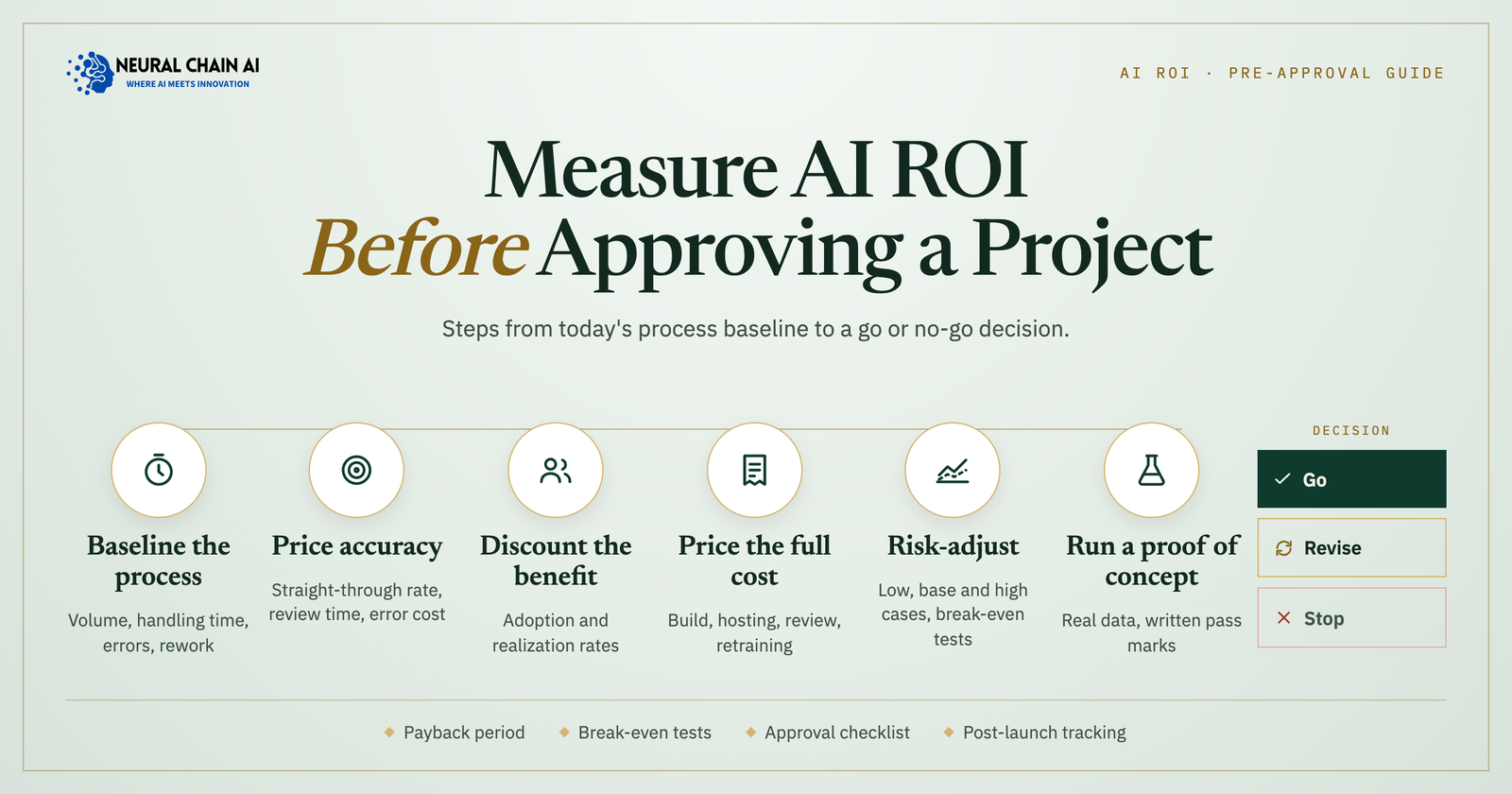
AI ROI is the net financial return an AI project delivers against its full cost, and you can measure it before approval with six inputs: a process baseline, a cost per error, an adoption rate, a realization rate, a full cost of ownership, and a probability of success. This guide turns those inputs into a payback period and a go or no-go decision for any AI agent, machine learning model, or private LLM deployment, and it includes a worked example you can rebuild in a spreadsheet.
What AI ROI Means and Why to Measure It Before Approval?
AI ROI compares what an AI system returns with what it costs to build, run, and maintain. Returns come from labor hours saved, errors avoided, faster cycle times, and revenue gained. Costs include the build, the infrastructure, the people who review the model’s output, and the work of keeping accuracy steady over time.
Approval is the cheapest moment to test those numbers. IBM’s 2025 CEO study, a survey of 2,000 chief executives, found that 25% of AI initiatives delivered their expected ROI over the previous three years, while 65% of the same executives said they prioritize AI use cases by ROI. A pre-approval model gives every input a number that finance can challenge and a proof of concept can test.
The AI ROI Formula: Six Inputs for an AI Business Case
Every AI business case reduces to three lines. The first estimates the annual benefit after discounting for real-world conditions. The second converts it to a three-year net return. The third expresses that return as a percentage of cost.
Expected annual benefit = (Annual cost of today’s process minus annual cost of the process with AI) × Adoption rate × Realization rate × Probability of reaching target accuracy
Three-year net return = 3 × (expected annual benefit minus annual run cost) minus one-time cost
AI ROI = Three-year net return ÷ Total three-year cost
The probability term sets this method apart from a standard business case. A model that has not yet run on your data carries uncertainty, and the formula prices that uncertainty in dollars. The six steps below show how to source each input.
Step 1: Baseline the Process Your AI Will Change
Measure the current process for two to four weeks before anyone scopes a model. Record monthly volume, median handling time, the loaded hourly cost of the people involved, the error rate, and the rework those errors create. Ticketing, billing, and workflow systems already hold timestamps, so pull the median from the system of record instead of asking staff to estimate. The median resists the distortion that a few outlier cases add to an average.
The baseline also fixes the metric that will judge the AI project. Table 1 lists the baseline metric and the human checkpoint for five common AI use cases.
| AI use case | Manual today | With AI | Baseline metric | What a person still checks |
|---|---|---|---|---|
| Invoice and document processing | Staff key fields from each document | OCR and a language model extract, classify, and post fields | Minutes per document, field error rate | Low-confidence fields and exceptions |
| Customer support | Agents search articles and write replies | An AI agent answers from your knowledge base with citations and routes the rest | Cost per resolved ticket, first-response time | Refunds, escalations, sampled transcripts |
| Demand and maintenance forecasting | Planners revise spreadsheets by hand | A machine learning model predicts demand or equipment breakdowns | Forecast error, stockouts, unplanned downtime hours | Overrides on high-value items |
| Contract and policy review | Reviewers read every clause | Retrieval finds clauses, flags deviations from a playbook, and drafts summaries | Hours per matter, issues caught | Every flagged clause and the final sign-off |
| Visual inspection | Inspectors check units by eye | A computer vision model flags defects on camera feeds | Escape rate, scrap, inspector hours | Borderline images and periodic audits |
Step 2: Convert AI Accuracy Into Dollars
Executives approve dollars, and model accuracy arrives as percentages. Translate between them with three numbers: the straight-through rate (the share of items the AI completes with no human touch), the review time per item for the rest, and the cost of each error that survives review.
In the worked example in Step 5, a 70% straight-through rate leaves 30% of items for human review at 4 minutes each. Each additional point of straight-through rate saves about $1,920 a year in review labor before discounting. Residual errors carry their own price: if review leaves 2% of 72,000 annual documents with an error and each correction costs $60, the error line reaches $86,400 a year. Subtract that line unless today’s process already carries the same cost.
This translation also sets the AI accuracy target. Work backward from the review minutes and error cost the business can afford, then write the required straight-through rate and residual error rate into the proof of concept as pass marks.
Step 3: Estimate Benefits With Adoption and Realization Rates
Two discounts turn a gross saving into a defensible benefit. The adoption rate is the share of eligible work that staff route through the AI system. Usage logs measure it, and it rises when the tool saves people time on work they already do.
The realization rate is the share of freed hours that become cash. Hours become cash through avoided hires, reduced overtime or contractor spend, or redeployment to work that earns revenue. A support team that frees 400 hours a month and keeps the same payroll has gained capacity, and capacity has value when a backlog or growth plan can absorb it. Name the route for your project and agree the rate with the finance owner of the process.
Revenue benefits, such as conversion lifts from a recommendation model or retention gains from churn prediction, enter the case when a holdout group or A/B test supports them.
Step 4: Price the Full Cost of an AI Project
AI cost spans more than the build. Table 2 lists the seven lines that a complete AI business case carries.
| Cost line | What it covers | Timing |
|---|---|---|
| Build and integration | Model selection, prompt or training work, connections to existing systems | One-time |
| Data preparation | Cleaning, access controls, and an evaluation set of real examples | One-time |
| Hosting and inference | GPUs or API usage, storage, networking | Recurring |
| Human review | Staff time on low-confidence outputs and exceptions | Recurring, scales with volume |
| Monitoring and retraining | Accuracy tracking, drift checks, model updates | Recurring |
| Change management | Training, workflow redesign, rollout support | One-time |
| Governance and security | Access control, audit logs, compliance review | One-time plus recurring |
Model hosting two ways when your data allows a choice. A private, self-hosted deployment swaps usage-based API fees for a fixed infrastructure cost, which favors high-volume workloads, while API access favors low or uncertain volume. Price both at your own volume before you commit. Add the human-review line even when a vendor quote omits it, because review time is a cost the business pays every month.
Step 5: Risk-Adjust AI ROI With Scenarios and Break-Even Tests
Take an accounts payable team that processes 6,000 invoices a month at 8 minutes each, with a loaded labor rate of $40 an hour. These figures are illustrative, so replace each one with your own baseline. The manual process costs $384,000 a year. An AI extraction pipeline finishes 70% of invoices without a human touch, and staff review the other 30% at 4 minutes each, which costs $57,600 a year. The gross saving is $326,400.
Apply a 90% adoption rate, a 60% realization rate, and an 80% probability of reaching target accuracy, and the expected annual benefit falls to about $141,000. One-time costs total $132,000 ($120,000 for build and integration, $12,000 for change management). Run costs total $42,000 a year ($24,000 for hosting, inference, and monitoring, $18,000 for maintenance and retraining). The example assumes review keeps residual errors at today’s level, so the error cost nets out. Table 3 shows all three scenarios.
| Metric | Low case | Base case | High case |
|---|---|---|---|
| Adoption rate | 75% | 90% | 95% |
| Realization rate | 45% | 60% | 75% |
| Probability of reaching target accuracy | 65% | 80% | 90% |
| Expected annual benefit | $71,600 | $141,000 | $209,300 |
| Annual run cost | $42,000 | $42,000 | $42,000 |
| One-time cost | $132,000 | $132,000 | $132,000 |
| Three-year net return | -$43,200 | $165,000 | $369,900 |
| Three-year AI ROI | -17% | 64% | 143% |
| Payback period | About 54 months | About 16 months | About 9.5 months |
Run two break-even tests on the base case. The three-year net return reaches zero when 37% of freed hours convert to cash, against 60% assumed, or when the probability of reaching target accuracy is 49%, against 80% assumed. Margins of that size tell an approver the case absorbs a miss on any single assumption. A project whose break-even sits above its base case needs a narrower scope or a cheaper design before approval.
Show the low case to the approver as plainly as the base case. A project that returns 64% in the base case and loses 17% in the low case is a sound bet when a proof of concept can narrow the range, and Step 6 shows how.
Step 6: Approve an AI Proof of Concept With Go and No-Go Gates
Approve a proof of concept before the full build. An AI proof of concept of four to eight weeks, run on your own data, converts the riskiest input in the model, the probability of reaching target accuracy, into a measured result. Before kickoff, write down three pass marks: the straight-through rate, the residual error rate, and the review minutes per item. Test against a held-out sample of real items, several hundred at minimum, that the model has never seen.
Attach a decision to each outcome. Results at or above the base case trigger a go and a production budget. Results between the low and base cases trigger a scope revision, such as a narrower document type or a higher review threshold, followed by a re-run. Results below the low case end the project, and the cost stays limited to the proof of concept.
How to Track AI ROI After Launch?
Instrument the system on day one so the approval model becomes the live dashboard. Log every output, human edit, override, and timestamp. Report weekly on straight-through rate, review minutes per item, residual error rate, adoption rate, and cost per item, each against the baseline and the base case. Set an accuracy threshold that triggers retraining, because data drift lowers accuracy gradually and the review rate climbs with it. Reconcile realized savings with finance every quarter so the realization rate rests on payroll and spend data instead of estimates.
AI ROI Approval Checklist
An approver can run this check in one meeting. Each question needs a written answer before funding is released.
- What is the baselined cost per unit today, and who verified it?
- Which straight-through rate and residual error rate does the base case assume?
- Which route turns freed hours into cash?
- Does the cost table include human review, monitoring, and retraining?
- What are the break-even values for realization rate and probability of success?
- Which proof of concept result triggers a go, a revision, or a stop?
How NeuralChainAI Builds AI With Measurable ROI?
NeuralChainAI starts each engagement with a 30-minute strategy session that maps the highest-ROI opportunity, then validates it in a 90-day sprint against a real workflow. Our AI transformation consultant builds the six-input model with your finance team, and our engineers deploy AI agents and machine learning models on top of your existing tools. When the data is sensitive, we run the stack in your own tenant so regulated information stays inside your environment. Each system ships with the baseline, review, and accuracy instrumentation described above, so you can compare live results with the approval case from the first week.
Bring one process and its current volumes to an AI strategy session. We map the baseline, build the six-input model, and set the proof of concept gates with you.