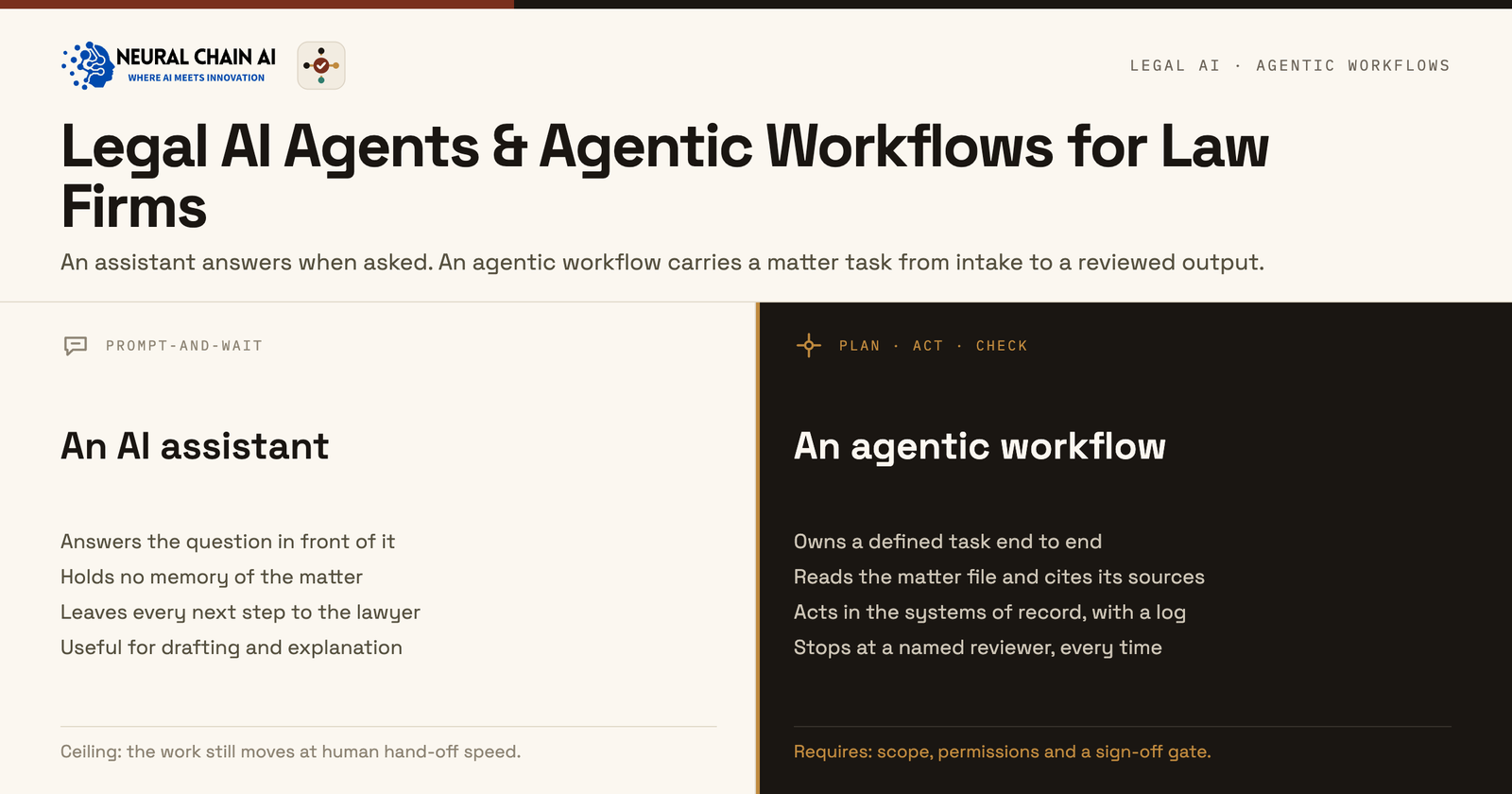
A legal AI agent does more than answer a question. It works a matter end to end, and the real question is where it runs.
A legal AI agent applies artificial intelligence (AI) beyond a chatbot: it pairs a model with tools, planning, and memory to run a multi-step task over the firm’s matter files while a lawyer supervises. The questions that matter are which paralegal workflows it automates, which tools do it, and where the matter data goes. This guide covers all three. Firms exploring the private path can start with our overview of private, self-hosted AI for law firms.
What paralegal workflows can legal AI agents automate?
The strongest fits in 2026 are the document-heavy, repetitive tasks that consume paralegal hours, each run under a lawyer’s supervision.
Discovery review. An agent works through a document set and does first-pass relevance and privilege flagging at a speed no team can match. It hands back a ranked, summarized set; the lawyer makes the privilege calls.
Deposition preparation. It builds outlines and exhibit summaries from the matter file and assembles the raw material for prep, so the lawyer refines rather than compiles.
Contract review. Within a matter, the agent extracts clauses and flags risk against a playbook, the same review workflow folded into a larger task.
Cite-checking and chronology. It cross-references the record and builds timelines that catch gaps and inconsistencies a manual pass can miss.
Intake and matter setup. It organizes incoming documents and metadata into a workable matter and removes the administrative drag at the start of a case.
Where today’s tools fit
The best-known tools map to those workflows. The column that matters most is the last one, where the matter corpus is processed.
| Workflow | Example tools | Data path |
|---|---|---|
| Discovery review | Relativity aiR, Reveal | Vendor cloud |
| Research & drafting | Harvey, CoCounsel | Vendor cloud |
| Contract review | Spellbook, Luminance | Vendor cloud |
| Intake & matter ops | Practice-management AI | Vendor cloud |
Capable tools, but an agent touches the whole matter corpus on the vendor’s cloud.
Where legal AI agents need supervision
An agent that acts is more useful and more exposed than a chatbot, so three controls keep it safe.
Human-in-the-loop. Because an agent takes multi-step actions, a lawyer reviews its work product and any consequential step; autonomy ends where legal judgment begins.
Verification. Agents can chain a wrong intermediate result into a confident final one, so outputs such as privilege calls, chronologies, and citations are checked before they are relied on.
Confidentiality. An agent ranges across the whole matter file, which makes where it runs the central question the next section answers.
The private, self-hosted alternative
The same agents can run on a private, self-hosted stack: an open-source orchestrator over private models and the firm’s document system, inside its tenant, with matter-based access controls and a full audit trail, so the matter corpus never leaves. The agent does the same multi-step work, now inside the firm’s boundary.
It delivers the same reach as the tools above while meeting the confidentiality duty ABA Opinion 512 places on the firm. For the broader set of tools, see our companion guide to the best legal AI tools for lawyers and law firms.
How to run legal AI agents privately
Start with one bounded workflow. Give the agent a well-defined task, discovery first-pass or intake, before handing it broader autonomy.
Keep a human checkpoint. Require lawyer sign-off on outputs and consequential actions, and log every step for review.
Run it on private models. Use an orchestrator over self-hosted models and the firm’s files so the agent never sends matter data to a third party.
Want agents automating paralegal work without the matter file leaving your firm?
Contact us about Agentic Legal AI →The bottom line
Legal AI agents automate the paralegal-hour workflows: discovery, depo prep, contract review, and intake. The deployment choice is the confidentiality choice; for sensitive firms that means a private stack running the same workflows. A short scoping conversation will identify the best first agent.