AI paralegal software automates the document-heavy work that fills a paralegal’s day: client intake, document review, deposition and record summaries, first drafts, data extraction and deadline calendars. This guide shows how to automate paralegal work at your law firm one workflow at a time, which AI methods handle each task, what the paralegal still reviews, and how to run the AI layer privately so client files stay on the firm’s own systems.
Paralegals carry much of the volume work in a law practice. The U.S. Bureau of Labor Statistics counted 404,900 paralegal and legal assistant jobs in 2025 and expects AI tools to make paralegals more efficient at research and document preparation. In Thomson Reuters’ 2025 Future of Professionals survey of 2,275 professionals, respondents predicted that professionals using AI will save 5 hours a week within the next year. For a managing partner, the practical questions are which paralegal workflows to give to AI first, how the models work on the firm’s own documents, and how to deploy them within the firm’s confidentiality duties.
Which Paralegal Work an AI Paralegal Can Automate
The best candidates are high-volume, document-heavy and rule-bound. Each one maps to a specific AI method, which matters when you scope the build.
Client intake and conflict checks
An AI model reads intake forms, emails and attached documents, extracts the parties, related entities, dates and matter type, and fills the intake record. The extracted names then run against the firm’s conflicts database, and the model groups likely matches (spelling variants, subsidiaries, former names) for a paralegal to clear. Intake that used to take a chain of emails becomes a review of a pre-filled record.
Document review and classification
For productions and client document sets, a classification model and an LLM do the first pass: relevance, privilege flags, document type and key issues, each with a short reason and a confidence score. The paralegal works a ranked shortlist plus the low-confidence items. Firms running large reviews can extend this into a self-hosted AI eDiscovery layer on their existing review platform.
Deposition and medical record summaries
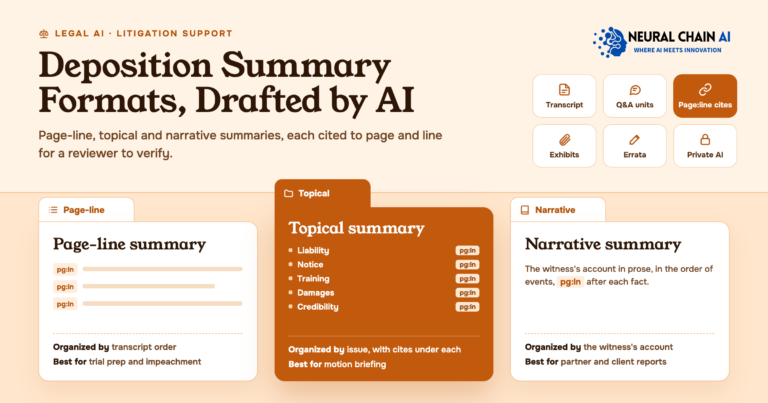
An LLM condenses a transcript or a record set into a summary where every statement carries a page-line or page citation back to the source. The paralegal spot-checks the citations and adds the case context the attorney cares about. Summaries are one of the fastest wins in AI for litigation teams, because they are long, repetitive and easy to verify against the source.
First drafts from firm templates
Using retrieval over the firm’s own templates and past work product, the AI drafts correspondence, discovery responses, routine motions and filing cover documents from the matter record. The paralegal edits a draft that already follows the firm’s house style and cites the documents it drew from.
Data extraction into case management
OCR and extraction models pull dates, parties, amounts, policy numbers and claim details out of scans, PDFs and email attachments, then propose field values for the case management system. A paralegal accepts or corrects each suggestion, and those corrections can be fed back to retrain the extraction model.
Deadline calendaring
An AI model reads scheduling orders, notices and court correspondence, identifies the triggering events and proposes calendar entries with the source sentence and the firm’s rule set attached. The paralegal confirms each entry before it is docketed, so calendaring gets faster while a person keeps ownership of every date.
How AI Paralegal Automation Works on Your Firm’s Documents
Four AI building blocks cover nearly every paralegal workflow, and most builds combine two or three of them.
OCR and document understanding. Scanned exhibits, faxed records and image PDFs go through OCR and a layout model, so tables, signatures and handwritten notes come out as structured text the other AI models can use.
Retrieval with citations. Retrieval-augmented generation (RAG) indexes the matter’s documents and the firm’s precedents, then has the LLM answer or draft from the passages it retrieved, with a citation for each one. Access follows the firm’s matter permissions, so the model retrieves only what that user is allowed to open.
Classification and extraction models. Smaller machine learning models tag documents, route intake and pull fields. They are fast, inexpensive to run and easy to measure against a paralegal’s own labels.
LLM drafting and AI agents. An open-weight LLM drafts summaries, letters and responses. For multi-step work such as intake, an AI agent chains the steps (extract, check conflicts, open the matter, draft the engagement letter) and pauses for a paralegal’s approval at each hand-off.
Paralegal Tasks With and Without AI
The table maps each paralegal task to what the AI does and where the paralegal’s review sits.
| Paralegal task | Manual today | With an AI paralegal | What the paralegal still checks |
|---|---|---|---|
| Client intake and conflicts | Re-keying forms and emails, manual name searches | AI extracts parties and entities, pre-fills intake, groups likely conflict matches | Clears each potential conflict |
| Document review | Reading every document in the set | Classification model and LLM rank relevance and flag privilege, with reasons | Low-confidence items and privilege calls |
| Deposition summaries | Hours per transcript, written from scratch | LLM drafts a page-line summary with citations | Spot-checks citations, adds case context |
| First drafts | Copying an old letter or form and editing it | LLM drafts from firm templates and the matter record | Facts, tone and legal positions |
| Data extraction | Typing dates and parties into case management | OCR and extraction models propose field values | Accepts or corrects each field |
| Deadline calendaring | Reading orders and counting days by hand | AI proposes entries with the source sentence and rule attached | Confirms every date before docketing |
How to Automate Paralegal Work at Your Law Firm in Six Steps
1. Pick one workflow with clear volume. Start where paralegal hours are highest and the AI output is easiest to verify: record summaries, document review or intake. Pull the baseline from the billing system, since time entries in six-minute increments show hours per matter before the AI goes live.
2. Write the AI use policy first. ABA Formal Opinion 512, issued July 29, 2024, expects managerial lawyers to set clear policies on permissible generative AI use and supervising lawyers to make sure nonlawyer staff are trained in its ethical and practical use. A short policy naming the approved AI tools, the matters they cover and the review step gives paralegals a clear, sanctioned way to use AI.
3. Choose where the models run. Decide whether the AI layer runs on the firm’s own servers or in its private cloud tenant, and which systems it connects to: document management, case management, email and the calendar. The deployment choice drives cost, speed and how the firm answers client questions about data handling.
4. Prepare the firm’s data. Gather the templates, model documents and past work product the AI should draft from, plus a few hundred examples of paralegal decisions (relevance calls, extracted fields, approved summaries) to evaluate the models against. Consistent folder structures and matter numbers make retrieval more accurate.
5. Pilot side by side and measure. Run the AI paralegal workflow next to the current process on live matters for a fixed pilot period. Score AI output against the paralegal’s own work on accuracy and time per task. Target: a measurable reduction in hours per matter on the chosen workflow, at an accuracy level the supervising attorney signs off on.
6. Train paralegals as AI reviewers, then add the next workflow. Paralegals learn to read confidence scores, check citations and correct AI suggestions, and their corrections feed model improvements. Once the first workflow holds its accuracy, add the next one on the same private AI platform.
How to Measure AI Paralegal Accuracy
Each AI method gets its own metric, measured on a held-out set of the firm’s documents that paralegals have already handled. Extraction models are scored field by field (did the model pull the right date, party or amount). Summaries are scored on citation accuracy, meaning each cited page and line supports the statement next to it. Document review models are scored on how many relevant documents they surface and how many irrelevant ones they send to the shortlist. Calendaring is scored on whether every proposed deadline matches the paralegal’s own docket entry.
Confidence thresholds turn those scores into routing rules: items above the threshold go to quick review, and items below it go to a paralegal for a full read. Re-run the evaluation set whenever the model, the prompts or the document mix changes, so accuracy is checked on every update.
Where Paralegal Judgment Stays in the AI Workflow
The NALA Code of Ethics and Professional Responsibility frames paralegal work as tasks properly delegated and supervised by an attorney (Canon 3) and requires paralegals to protect client confidences (Canon 7). A well-built AI paralegal workflow supports both: every AI output arrives as a draft with its sources attached, and the person who approves it is recorded.
In practice the paralegal owns the calls the model routes to them: low-confidence classifications, conflict matches, privilege questions, and any extraction where the source is unclear. They bring matter knowledge that lives outside the documents, such as which witness the attorney is focused on or which deadline the client has asked to move. They also handle the client and court communication that turns AI drafts into finished work. An AI that shows its sources and confidence keeps that review fast, so the hours saved on drafting go into higher-value matter work.
Running Your AI Paralegal Privately
Hosted legal AI products such as Thomson Reuters CoCounsel, Harvey and Relativity aiR deliver these workflows as cloud services. NeuralChainAI builds the same AI capabilities as a private layer on the firm’s existing document management and case management systems, so the models run where the client files already live.
A typical private AI paralegal stack runs open-weight LLMs and smaller machine learning models on the firm’s own GPU servers or in its private cloud tenant, behind the firm’s single sign-on. Retrieval respects matter-level permissions, every model call is logged with the user, matter and sources used, and client documents stay inside the firm’s environment. That setup also helps the firm answer the Opinion 512 question of how an AI tool uses client data, because the firm controls the whole path. Our page on private, self-hosted AI for law firms covers the deployment options, and the AI for law firms hub lists the practice-area AI solutions built on the same platform.
Ready to automate paralegal work and keep client files in your firm? NeuralChainAI builds private AI paralegal workflows on your existing systems, from record summaries to intake and calendaring. Book an AI strategy session to choose your first workflow and scope the pilot.