
Artificial intelligence has stopped being an enterprise-only advantage. As of January 2026, 77% of U.S. small and midsize businesses use AI regularly, up from 48% in July 2024, according to the Intuit QuickBooks 2026 AI Impact Report, built on responses from more than 34,000 business owners with economists at the University of Chicago. Yet most owners and operators still wrestle with the same question: where do we actually start, and how do we avoid wasting money? That gap between curiosity and confident action is exactly what AI consulting is built to close.
The difference between a small business that profits from AI and one that merely spends on it is rarely budget or technical skill, it usually comes down to having a clear plan. AI consulting closes that gap: instead of guessing which tools to buy or struggling to connect them, you work with an expert who pinpoints where AI will save the most time or money in your specific operation, implements it safely, and helps you track the return.
For most SMBs, that means seeing measurable results within weeks, not a drawer full of half-finished experiments. So let’s dig into the details.
What Is AI Consulting for Small and Mid-Sized Businesses?
AI consulting for small and mid-sized businesses (SMBs) is a professional service that helps companies, typically those with fewer than 500 employees identify, plan, implement, and scale artificial intelligence solutions matched to their operations, budget, and goals. The consultant’s real value isn’t knowing which AI tools exist; it’s knowing how to apply the right ones to your specific workflows so they produce trackable results.
Think of an AI consultant as the bridge between AI’s raw capability and your day-to-day business reality. They translate a fast-moving, jargon-heavy field into a short list of practical changes automating quotes, drafting customer replies, forecasting inventory that save hours or win revenue within weeks, not years.
In short: AI consulting helps SMBs skip the costly trial-and-error phase. Instead of buying ten tools and hoping, you get a prioritized roadmap, a safe pilot, hands-on implementation, and team training, all sized to a small-business budget.
Why SMBs Need AI Consulting Now?
The numbers tell a clear story about both the opportunity and the gap. Adoption is widespread and the results are real: 78% of US businesses say AI improved their productivity and 43% say it increased revenue, against 2% who report the opposite. Effective adoption is still the rarer thing.
It’s also a moving target: once AI tools are live, they need ongoing monitoring and upkeep to keep performing reliably — the kind of work that MLOps consulting services are built to handle.
1. Confidence is the real bottleneck:
Intuit QuickBooks found the top barriers to adoption cluster around data privacy and security, fear of errors, and uncertainty about what AI can actually do. Cost ranks below all three. Most owners aren’t short on interest, they’re short on a plan.
2. Most adoption stays shallow:
Only around 8% of businesses reach an advanced level of AI maturity. The rest run one or two disconnected tools with no broader strategy, leaving most of the value on the table.
3. Tool sprawl is already here:
The typical AI-using small business now runs a median of five AI tools, often overlapping, rarely integrated. A consultant turns that scattered stack into a coherent system.
4. Early commitments tend to stick:
Of the US businesses Intuit tracked that paid for dedicated AI tools in 2024, 86% were still paying in 2025. Picking the right first commitment is the hard part, and that is what an outside partner is for.
For a small or mid-sized business, the cost of getting AI wrong i.e. wasted subscriptions, abandoned pilots, frustrated staff is proportionally far higher than it is for a large enterprise. Good consulting exists to make sure your first investment is also a productive one.
What an AI Consultant Actually Does?
“AI consulting” can sound abstract, so here is the concrete work involved in a typical SMB engagement:
1. Opportunity assessment:
The consultant audits your workflows to find repetitive, pattern-based tasks, the work AI handles best and ranks them by effort versus payoff.
2. Use-case prioritization:
Rather than chasing every shiny feature, they help you pick one or two high-impact starting points with a clear success metric.
3. Data and workflow preparation:
AI is only as good as the information it works from. Consultants help organize, clean, and connect the data a tool needs to perform reliably.
4. Tool selection and pilot build:
They match the use case to the right tool or custom build, then stand up a small, low-risk pilot you can measure.
5. Integration:
This is where consultants add the most value connecting AI to your existing systems (CRM, email, accounting, e-commerce) so it fits how your team already works.
6. Training and change management:
A tool nobody uses delivers zero ROI. Consultants train your team and build the habits that make adoption stick.
7. Governance and risk:
They set guardrails for data privacy, accuracy checks, and responsible use, an area most SMBs overlook until something goes wrong.
The AI Consulting Process
A well-run SMB engagement usually follows five phases. The whole cycle for a first project typically runs four to eight weeks.
Week 1 – Discovery:
The consultant learns your business, goals, systems, and pain points, then identifies candidate use cases.
Week 1–2 Strategy and roadmap:
You receive a prioritized plan: which use case goes first, the expected ROI, required data, tools, timeline, and budget.
Week 2–5 Pilot implementation:
A single use case is built and launched on a small scale, one team, one workflow, so results can be measured without disrupting operations.
Week 5–6 Measurement and refinement
Results are compared against the success metric set in phase two. The solution is tuned, and outputs are quality-checked.
Week 6+ Scale and enable:
What works is rolled out more widely, your team is trained to run it independently, and the next use case is queued.
Starting with one measurable pilot, rather than a sweeping “AI transformation”, is what separates engagements that pay for themselves from those that quietly stall.
Where AI Delivers the Fastest Wins for SMBs
You don’t need a data-science team to benefit from AI. These are the use cases that most reliably produce quick, visible returns for small and mid-sized businesses:
| Business area | High-impact AI use case | Typical result |
|---|---|---|
| Sales | Lead scoring, proposal and follow-up drafting | Faster response times, higher conversion |
| Customer service | AI chat and email assistant for common questions | 24/7 coverage, lower ticket volume |
| Marketing | Content, ad copy, and SEO drafting at scale | More output at a lower cost per asset |
| Operations | Demand forecasting and smart scheduling | Less waste, fewer stockouts |
| Finance and admin | Invoice processing and expense categorization | Hours saved, fewer manual errors |
| HR and recruiting | Resume screening and job-description drafting | Shorter hiring cycles |
A consultant’s job is to tell you which of these matters most for your business right now based on your margins, your bottlenecks, and the data you already have.
How Much Does AI Consulting Cost for SMBs?
AI consulting for small and medium businesses spans a wide range, depending almost entirely on scope.
At the lower end sit short strategy audits, a few weeks of work to identify use cases, assess feasibility, and produce a roadmap.
The middle tier covers single use case implementations: scoping, building, and deploying one AI capability such as demand forecasting, customer service automation, or document processing over four to eight weeks.
Larger multi-use-case engagements that ship two or three integrated AI capabilities run longer and cost proportionally more.
Ongoing fractional AI advisory where an external expert provides strategy and oversight without the cost of a full-time hire is typically billed monthly.
The variables that drive cost within any of these tiers:
- The quality of your existing data,
- The complexity of integrating with tools you already use, and
- Whether your use case can be solved with off-the-shelf AI APIs or requires a custom-trained model.
Almost universally, well-scoped SMB AI consulting costs a fraction of hiring an in-house data scientist for a year which is precisely why SMBs hire consultants in the first place.
How to Measure ROI on an AI Project?
Every engagement should be tied to a number you agree on before work begins. The simplest ROI framework for an SMB looks like this:
ROI = (Annual value created − Annual cost) ÷ Annual cost
“Value created” usually comes from one of three sources: time saved (hours reclaimed × loaded hourly cost), revenue gained (faster response or higher conversion), or cost avoided (fewer errors, reduced overtime, lower outsourcing spend).
For example, if an AI customer-service assistant saves your team 15 hours a week at a $35 loaded hourly cost, that’s roughly $27,000 a year in recovered capacity. Against a $12,000 project plus $3,000 in annual tool costs, the engagement returns about 80% in its first year and far more thereafter. Insist that your consultant builds this kind of math into the proposal and that they help you track it after launch.
SMB vs. Enterprise AI Consulting: Why the Difference Matters?
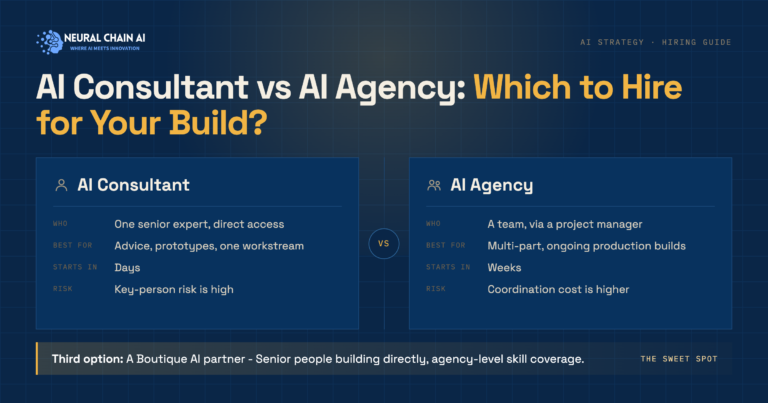
This is where many businesses get burned: hiring an enterprise-style consultant for a small-business problem. The two engagements are not the same.
Speed over scale:
Enterprises can absorb 12-month transformation programs. SMBs need wins in weeks to keep momentum and protect cash flow.
Off-the-shelf over custom:
Enterprise consulting often defaults to bespoke builds. For most SMBs, smart configuration of existing tools delivers 90% of the value at a fraction of the cost.
The owner is the stakeholder:
SMB engagements involve fewer decision-makers and less politics, but also less internal IT support, so the consultant must handle more of the hands-on work.
Budget realism:
A good SMB consultant designs around your constraints instead of recommending a platform that costs more than the problem it solves.
When you evaluate a consultant, ask directly: how many businesses my size have you helped, and what did the first 90 days look like?
How to Choose the Right AI Consultant?
Use this checklist when hiring an AI consultant to separate genuine partners from hype.
1. Business outcomes first:
They talk about your revenue, costs, and bottlenecks before they mention any specific tool.
2. Relevant proof:
They can show results from businesses of a similar size and industry, with real numbers.
3. Tool-agnostic:
They recommend what fits your needs, not whatever they happen to resell.
4. A pilot mindset:
They propose a small, measurable first project and not an all-at-once overhaul.
5. Knowledge transfer:
Training your team is part of the plan, so you’re not dependent on them forever.
6. Clear pricing and scope:
You know the deliverable, the timeline, and the cost before signing.
Hiring an AI Consultant – Red flags to avoid:
Guaranteed results with no discovery work, pressure to sign a large multi-month contract immediately, vague jargon with no plain-English explanation, and no discussion of data privacy or how AI outputs will be checked for accuracy.
Common AI Consulting Mistakes to Avoid
- Starting with the tool, not the problem. “We need AI” is not a goal. “We need to cut quote turnaround from two days to two hours” is.
- Skipping the data step. Messy, scattered data is the number-one reason pilots underperform.
- Boiling the ocean. Trying to automate everything at once guarantees nothing gets done well.
- Ignoring the team. Adoption fails when staff aren’t trained or aren’t brought along early.
- No accuracy guardrails. AI outputs need human review, especially for anything customer-facing or financial.
- Treating it as one-and-done. AI tools and your business both change, so plan for periodic review.
Is Your Business AI-Ready? A Quick Self-Assessment
Before you call a consultant, answer these five questions. The more “yes” answers, the faster you’ll see returns:
- Can you name a specific, repetitive task that eats hours every week?
- Is the data for that task stored somewhere digital and reasonably consistent?
- Do you have a number, cost, or revenue that you want to move?
- Is there a team member who could “own” a new tool day to day?
- Can you commit a modest pilot budget without betting the business?
Two or fewer “yes” answers? Start with a readiness assessment to close the gaps. Three or more? You’re ready for a focused pilot and likely to see results quickly.
Getting Started With AI Consulting
AI is now within reach of every small and mid-sized business — but reach isn’t the same as results. The businesses pulling ahead in 2026 aren’t the ones with the most tools; they’re the ones that picked the right first problem, ran a disciplined pilot, and scaled what worked. That is precisely what good AI consulting delivers.
At NeuralChain AI, we help small and mid-sized businesses move from “we should probably do something with AI” to a working solution with measurable ROI — starting with a no-pressure readiness assessment that maps your single highest-value use case.
Disclaimer: All cost ranges, timelines, and examples on this page are illustrative and provided for general guidance only — not a quote or guarantee. Actual engagement terms are confirmed in writing after a scoping conversation.