
AI for market research works best inside the research firm’s own workflow: coding open-ended responses against a codeframe, turning a tab spec into banners and crosstabs, coding interview transcripts, and drafting charts and report sections. This guide walks through each of those steps, compares the manual approach with AI-assisted work, sets out what stays with the researcher, and explains why studies under NDA or on client data run on private AI.
Adoption is already broad. Qualtrics surveyed more than 3,000 research professionals across 14 countries in the third quarter of 2025 for its 2026 Market Research Trends study, and 53% said they use AI regularly in their work, according to Research Live.
Much of what ranks for this topic is written for marketers who want to size a market, summarize competitor reviews or generate personas. This guide is for research agencies, fieldwork and data processing firms, and in-house insights teams that run surveys and qualitative studies for a living. Their process already exists and already delivers. The useful questions are which steps AI can take on, how a researcher checks its output, and where the data goes while it runs.
Where AI Fits in a Research Firm’s Workflow
A quantitative study moves through questionnaire design, fieldwork, data cleaning, open-end coding, tabulation, charting and reporting. A qualitative study moves from discussion guide to fieldwork, transcripts, coding, synthesis and the report. AI helps most at the steps that involve reading large volumes of text, or turning a written specification into a repeatable output.
Those steps share a pattern. A person defines the rules (the codeframe, the tab spec, the thematic frame or the report outline), the model applies them at volume, and a person checks the result before it reaches the client. Each section below follows that pattern, and the comparison table further down sets the steps side by side.
Data Cleaning and Open-End Quality Checks
Open-ended answers are a quality signal as well as a source of insight. Text pasted from elsewhere, answers unrelated to the question and near-identical verbatims across different respondents all point to bots or fraudulent completes. A model can read every open-end during cleaning and flag the suspicious ones with a reason, alongside the speeder and straight-lining checks your team already runs. The field team reviews the flags and decides which completes to remove, so the sample that reaches coding is one you trust.
Open-End Coding Against Your Codeframe
Open-end coding is often the slowest step between field close and first tables. A coder reads each verbatim, assigns one or more codes from the codeframe and moves to the next. A study with 2,000 completes and three open-ended questions produces 6,000 verbatims, and a tracker repeats that every wave.
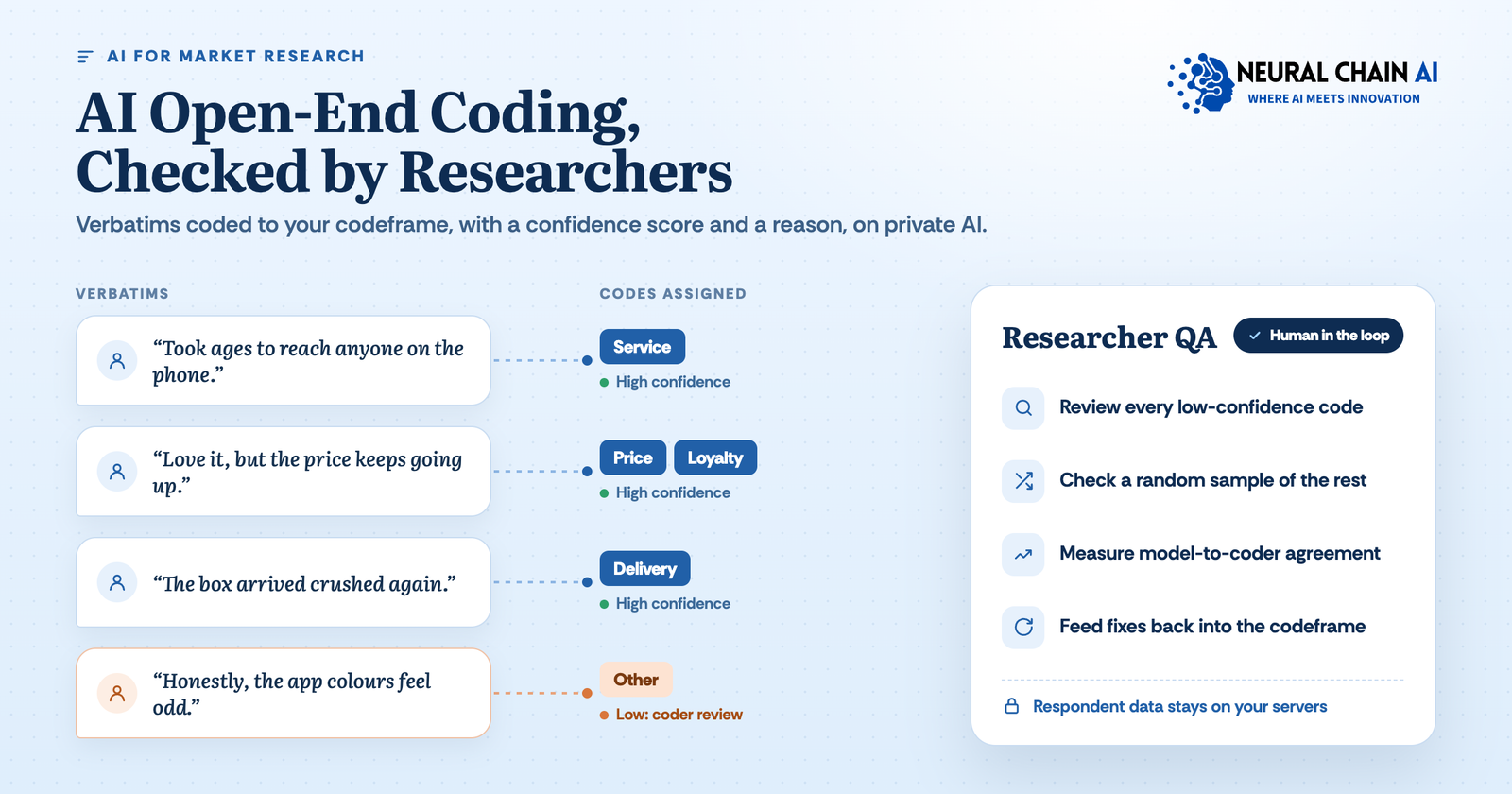
With AI, a language model does the first pass. It receives the codeframe with a definition and examples for each code, reads each verbatim alongside the question text, and returns the codes it assigns, a confidence score and a short reason. Responses that touch several themes get several codes. Responses that fit nothing go to “other” for the coding lead, and those reviews often produce a new code.
The published evidence is encouraging. In a 2024 paper in Research & Politics, Mellon and colleagues compared six language models on “most important issue” answers from the British Election Study Internet Panel, coded into 50 categories. The best model, Claude 1.3, reached 93.9% accuracy against 94.7% for a human coder.
Human QA closes the loop. Coders review every low-confidence assignment plus a random sample of the rest, and the team measures agreement between model and coder for each question, using a statistic such as Cohen’s kappa. Corrections go back into the code definitions, so the next wave starts from a sharper codeframe.
Tab Specs, Banners and Crosstabs
Crosstabs are where survey data becomes a deliverable. A data processing team takes the researcher’s tab spec, builds the banner (the columns, such as age, region or customer segment), defines the base, filters and nets for each table, and runs significance tests at the agreed confidence level. Precision matters here, because every chart and every sentence in the report inherits the table’s base and filters.
AI fits this step as a reader and writer of specifications. A model reads the tab spec and the questionnaire, drafts the table definitions or tabulation syntax, and checks each table against the spec. It confirms that the base matches the questionnaire routing, that each net includes the codes the spec lists, and that banner columns carry enough respondents for a significance test. The tabulation software your team already uses still calculates every number. Keeping the arithmetic in deterministic software and the reading in the model gives you crosstabs you can reproduce exactly on the next wave.
The same approach helps with crosstab analysis once the tables have run. A model can scan a full set of tables, list the significant differences the brief asked about, and draft a one-line description of each, with the table and cell reference attached so the researcher can check it against the source.
Transcript Coding for Qualitative Studies
Qualitative work produces transcripts rather than verbatims: in-depth interviews, focus groups and ethnographic notes, each running to many pages. AI helps in three places. It segments each transcript by speaker and topic, it codes those segments against a thematic frame the researcher defines, and it pulls candidate quotes for each theme with the speaker and timestamp attached.
Retrieval adds a fourth use. With a study’s transcripts indexed, a researcher can ask “what did lapsed customers say about price?” and get an answer that cites the passages behind it. A private RAG deployment does this inside your own environment, so transcripts, embeddings and questions stay on infrastructure you control.
The researcher owns the synthesis. The model organizes the evidence, and the person who moderated the groups decides what it means for the client’s brief.
Charting and Report Drafting
Once tables are signed off, AI can prepare chart-ready data for each key table, apply the house chart style, and draft summary text for each section of the report. Traceability keeps this trustworthy: every number in a draft sentence links to the table and cell it came from, so the reviewer checks evidence instead of recalculating.
Drafting works best from an outline the researcher writes. The model fills each section from the tables and coded open-ends the outline points to, and the researcher rewrites the storyline, the implications and the recommendations. Those parts depend on knowing the client and the market, and they stay with the research team.
AI in Market Research: Manual, AI-Assisted and What Stays Human
The table sets out each workflow step, how teams handle it by hand, what the AI-assisted version looks like, and the decisions that stay with people.
| Workflow step | Manual approach | AI-assisted | What stays human |
|---|---|---|---|
| Data cleaning | Analyst scans open-ends and runs speeder and straight-lining checks | Model reads every open-end and flags likely bots or fraud with a reason | Deciding which completes to remove |
| Codeframe building | Coding lead reads a sample of verbatims and drafts codes | Model proposes draft codes, definitions and examples from a random sample | Approving codes, merging overlaps and setting nets |
| Open-end coding | Coders assign codes to every verbatim | Model codes every verbatim with a confidence score and a reason | Reviewing low-confidence cases and a random sample, measuring agreement |
| Tab spec and banners | DP team writes table definitions from the spec | Model drafts table definitions and checks bases, filters and nets against the spec | Signing off the spec and the checked tables |
| Crosstab review | Researcher reads every table for significant differences | Model lists significant differences with table and cell references | Deciding which differences matter for the brief |
| Transcript coding | Researcher codes transcripts and pulls quotes by hand | Model segments transcripts, codes them to a thematic frame and suggests quotes | Synthesis, interpretation and final quote selection |
| Charting | Analyst builds each chart from the tables | Model prepares chart-ready data in the house style | Choosing the charts that tell the story |
| Report drafting | Researcher writes every section | Model drafts sections from an outline, with each figure traced to its table | Storyline, implications and recommendations |
Why NDA and Client-Data Studies Run on Private AI
Research firms work under contracts that set out how respondent data and client information may be handled. Client NDAs, data processing agreements and panel terms often limit where data can be processed and who can see it. Verbatims and transcripts carry the most sensitive content in a study, because respondents name brands, products, employers and sometimes themselves.
Research buyers ask about this directly. ESOMAR’s 20 Questions to Help Buyers of AI-Based Services devotes a full section to data governance, with questions on privacy, security, data ownership and sovereignty, and a separate question on human oversight. A firm that runs AI on its own infrastructure can answer those questions with a short, documented data path.
A private deployment puts the models, the data and the logs on your servers or in your own cloud tenant. Self-hosted open-weight models such as Llama, Mistral or Qwen handle confidential studies, and access follows your SSO groups per client or per study. Our private AI deployments work this way, with every model call logged so you can show a client what touched their data.
How AI Market Research Tools and a Private Pipeline Fit Together
AI market research tools fall into two broad groups. Survey and insights platforms add AI features, such as text analytics, automatic summaries and dashboards, to the platform where the data already lives. General-purpose assistants help with desk research, questionnaire drafts and document summaries. Both are built for a broad customer base, with processing in the vendor’s cloud, and both suit a wide range of studies.
A private pipeline is built around one firm’s workflow. It applies your codeframes and tab conventions, writes output in the formats your data processing team already uses, such as labelled SPSS .sav or CSV files for Q, Displayr, SPSS or WinCross, and runs where your client contracts need it to run. Many firms use both: AI tools for market research on open or low-sensitivity work, and the private pipeline for client data under NDA.
Building that pipeline draws on the same skills as any applied ML project: data engineering, model selection, and evaluation against a labelled set from your own past studies. Our machine learning consulting team scopes the work with your data processing and research leads.
Getting Started With a Pilot on One Tracker
A tracker makes the best pilot, because past waves are already coded and tabbed. Take one completed wave, run the AI pipeline on the raw data in shadow mode, and compare its codes and tables with the versions you delivered. Review every disagreement with the coder or analyst who did the original work, and set the agreement level you need for each question before the pipeline handles a live wave. Once the shadow results meet that bar, add the next open-end, the next tracker or the qualitative stream.
Coding, tabbing and reporting for clients under NDA? NeuralChainAI builds survey data analysis with private AI on your own infrastructure, with open-end coding, crosstabs and report drafts that feed the tools your team already uses. Bring a past wave and we’ll scope a shadow-mode pilot.