The AI tools that help law firms automate legal workflows in 2026 — what each one does across discovery, contracts, research and intake, and how to run the same workflows on a private, self-hosted stack so privileged data never leaves the firm.
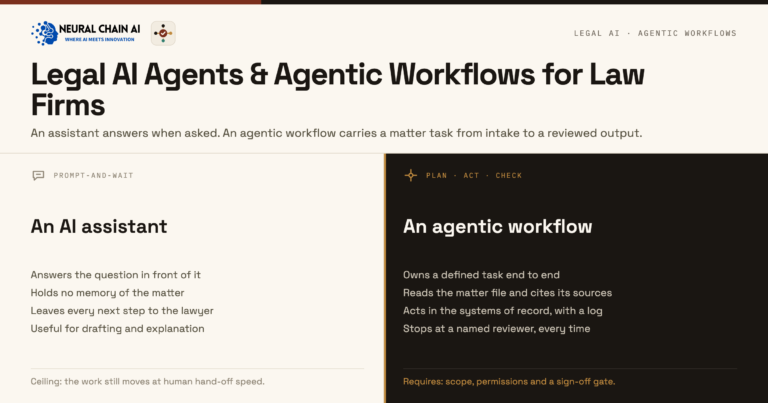
Agentic AI for law firms means artificial intelligence (AI) that doesn’t just answer a question but carries out multi-step work like planning a task, pulling from the firm’s matter files, acting through permitted tools, and checking back with a lawyer. The useful question isn’t whether it’s hype; it’s which workflows it can run today, which tools help, and where the firm’s confidential data ends up. This guide walks through all three. Firms that want to run these workflows in-house can start with our overview of private, self-hosted AI for law firms.
What workflows can Agentic AI run for a Law Firm?
Agentic AI earns its keep where work is multi-step, document-heavy, and repeatable. The workflows that are realistic today:
- Discovery review — first-pass relevance and privilege flagging across large productions.
- Deposition preparation — assembling outlines, witness kits, and exhibit summaries from the matter file.
- Contract review — extracting clauses and flagging risk against the firm’s playbook.
- Legal research & drafting — retrieving authority and drafting cited memos for a lawyer to verify.
- Client intake & matter setup — capturing client information and organizing incoming documents.
- Cite-checking & chronology building — cross-referencing the record and assembling case timelines.
Agentic AI for Law Firms: Where today’s tools fit?
A growing set of commercial platforms targets these workflows. Roughly where the best-known ones land:
| Workflow | Example commercial tools | Data path |
|---|---|---|
| Discovery review | Relativity aiR, Reveal, DISCO Cecilia | Vendor cloud |
| Contract review | Spellbook, Luminance, LinkSquares | Vendor cloud |
| Legal research & drafting | CoCounsel, Lexis+ with Protégé, Westlaw Precision | Vendor cloud |
| Multi-step matter work | Harvey, CoCounsel, Lexis+ with Protégé | Vendor cloud |
| Intake & practice ops | Clio Work, Clio Duo | Vendor cloud |
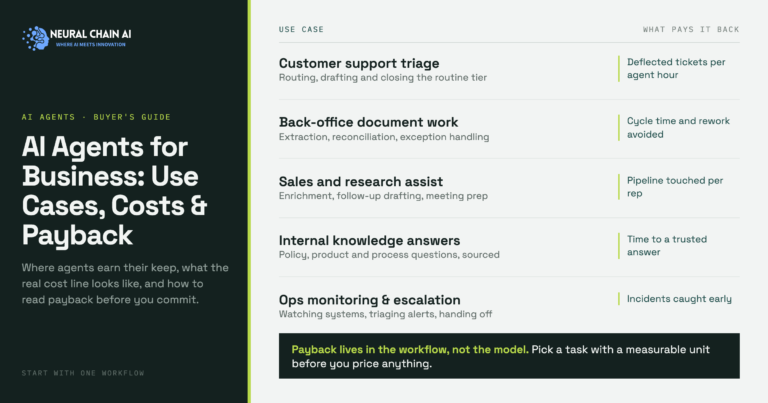
Ranking these comes down to matter volume, whether a lawyer can reverse the output in minutes, and whether a correct result is defined tightly enough to score against past matters. Discovery review and contract review usually win on all three, which is the same reason AI agents pay back first in document-heavy work outside legal.
Clio added multi-step agents to Clio Work in April 2026 and LexisNexis shipped Protégé Work with agentic drafting agents in May, but every platform above still processes the firm’s privileged work on the vendor’s cloud.
The Private, Self-hosted Alternative
Every workflow above can run on a private, self-hosted stack instead — open-weight or licensed models plus an agent orchestrator over the firm’s own document system, deployed inside the firm’s tenant. The agent plans, retrieves from the matter corpus, acts through permitted tools, and checks back with a lawyer, with matter-based access controls and a full audit trail and privileged data never leaves the firm. That preserves the productivity of the tools above while meeting the confidentiality duty ABA Opinion 512 places on the firm, not the vendor. In August 2025 the California Supreme Court directed the State Bar to write AI duties into the Rules of Professional Conduct and to address agentic tools that run tasks without human prompting, and COPRAC put amendments to six rules out for public comment on March 13, 2026.
NeuralChain builds exactly this; for the build-versus-buy decision, see our companion guide on AI consulting vs building an in-house team.
Want these agentic workflows running privately inside your firm?
The bottom line
Agentic AI for law firms is best understood by workflow — discovery, contracts, research, intake — not by hype. Commercial tools cover these on the vendor’s cloud; a private, self-hosted stack runs the same workflows while keeping privileged data inside the firm. A short scoping conversation will map your highest-value first workflow.