
Most teams treat ‘build versus buy AI’ as a budget question. Pick the cheaper line item, defend it in the next planning review, move on. That framing quietly produced the wreckage we are now living through: MIT’s Project NANDA tracked enterprise generative AI in 2025 and found that roughly 95% of pilots delivered no measurable impact on profit and loss, while only about 5% captured real value. The companies in that 95% rarely chose the wrong vendor or the wrong model. They chose a sourcing strategy that never fit the capability they were trying to stand up.
Build, buy, and partner are not three prices for the same thing. They are three different bets, with three different failure modes, and the right one changes from one capability to the next inside the same company. A customer-service summarizer and a proprietary underwriting model do not belong in the same lane, even if they share a budget.
This guide gives you a way to decide that holds up under scrutiny: a two-axis matrix to place any AI capability, a set of tie-breakers for the close calls, the total-cost-of-ownership math that the vendor quote leaves out, and a decision tree you can run in a planning meeting. It is written for the people who own the outcome: the executives signing the budget, the teams who inherit the system, and the hiring managers who staff it.
Bottom line up front. Buy when the capability is common, the vendors are mature, and your edge comes from using it well rather than owning it. Build when the capability is your competitive advantage or rides on data only you hold. Partner when the capability is strategic but you lack the team to build it alone, and structure the deal so the asset ends up yours. The expensive mistake is not picking ‘wrong.’ It is picking by price instead of by where the capability sits on the map below.
Build vs. Buy AI or Partner – Risk Profiles
Start by separating two questions that get tangled constantly.
- The first question is who does the work: your own employees or an outside firm. That is a staffing decision, and we cover it in depth in our breakdown of AI consulting services vs. In-house AI team.
- The second question, the one this guide answers, is how you acquire the capability itself. Those are different axes. You can build with employees or build with a partner. You can buy a product and still need a team to run it.
Holding the sourcing question on its own, three paths exist:
1. Build:
You develop the capability as a custom asset, your data, your models or your orchestration over foundation models, your codebase. You own the IP and the roadmap. You also own every line of the maintenance bill.
2. Buy:
You license a finished product or call a vendor API. Someone else carries the research, the model updates, and the uptime. You trade control and differentiation for speed and a predictable contract.
3. Partner:
A third party builds an asset that you will own, often transferring it to your team over time. This is not the same as hiring a consultant for staff augmentation. The defining trait is a deliverable that becomes your property: co-development, a build-operate-transfer arrangement, or a managed build with a handover clause.
Each path fails in a signature way. Build fails on data readiness and quiet attrition. Buy fails on lock-in and the slow realization that you bought the same edge your competitor did. Partner fails on a botched handoff, where the asset technically transfers but the knowledge to run it never does. Naming the failure mode up front is how you design against it.
Why ‘Buy for Speed, Build for Control’ Stopped Working?
For a decade the shortcut was clean: buy when you want it fast and cheap, build when you need control. That rule is now misleading, for two reasons.
First, the cost relationship inverted. Open-weight models have closed most of the capability gap with frontier systems and run far cheaper to operate, on the order of 10 to 12 times less per token than premium hosted models at comparable capability tiers, and wider still at the budget end. ‘Build’ no longer reads automatically as ‘expensive.’ For a high-volume workload, owning the inference stack can undercut a per-seat or per-token vendor bill within a year.
Second, the base layer became a commodity while the value moved up the stack. Anyone can call the same foundation model you can. A chatbot built on a public API is not a moat; it is table stakes your competitor ships the same quarter. Whatever advantage exists now lives in the layer above the model: your proprietary data, your retrieval and evaluation, your workflow integration, and the judgment encoded in how the system is wired into your business.
So the decision stopped being about cost and control as a pair. It now turns on a single hard question: does this capability differentiate you, or does it just need to work? Everything downstream follows from the answer.
The Moat × Maturity Matrix
Plot any AI capability on two axes and the right path usually reveals itself.
Strategic Moat (vertical): How much does this capability differentiate you, and how dependent is it on data, workflows, or expertise that competitors cannot easily copy? A pricing engine trained on a decade of your transactions sits high. An email-drafting assistant sits low.
Market Maturity (horizontal): How proven, complete, and fit-for-purpose are the products you could buy today? Document summarization and meeting transcription are mature. An autonomous agent that reconciles your specific financial close is not.
Those two axes produce four zones:
| Low market maturity (weak off-the-shelf options) | High market maturity (strong off-the-shelf options) | |
|---|---|---|
| High strategic moat (core differentiator) | BUILD — no one sells your edge, so own it | PARTNER — buy the proven base, build the differentiator on top |
| Low strategic moat (commodity capability) | DEFER / pilot — unproven and not worth owning yet | BUY — license it and move on |
Build (high moat, low maturity). The capability is central to how you win, and nothing on the market does it well. This is the only quadrant where a from-scratch build is clearly justified, because you are creating something that does not exist for sale and that you would not want a competitor to buy either.
Buy (low moat, high maturity). The capability has to work, but owning it wins you nothing, and mature vendors already solve it. Building here is a vanity project that diverts your scarce engineers from the work that differentiates you.
Partner (high moat, high maturity). Strong products exist, but a generic deployment leaves your advantage on the table. You want the vendor’s proven core plus a proprietary layer: fine-tuning on your data, custom retrieval, deep workflow integration. If you lack the team to build that layer fast, a partner builds it with you and hands it over. This quadrant is where most enterprise value is being created in 2026, and where the ‘buy the core, own the edge’ pattern lives.
Defer or pilot (low moat, low maturity). The capability is not differentiating and nothing buyable works yet. Pouring capital into a custom build here is how budgets evaporate. Run a small, time-boxed pilot to track the market, and revisit when the maturity axis moves.
The matrix does most of the work. The next two sections handle the cases where a capability lands near a border.
Reading the Matrix With Real Capabilities
Abstractions are easy to nod along to and hard to apply, so here is where common capabilities land.
An internal knowledge assistant that answers HR and IT questions is Buy: low moat, mature market, dozens of credible products. A customer-facing support agent for a typical business is also Buy, with one caveat: if support quality is your brand promise, it edges toward Partner.
A demand-forecasting or dynamic-pricing model trained on your proprietary transaction history is Build, because the data is the moat and no vendor has it. A computer-vision system for a manufacturing defect unique to your process is Build for the same reason; see how this plays out in our custom manufacturing AI work.
A domain copilot, say a clinical or legal assistant built on a strong foundation model but tuned to your documents, your taxonomy, and your compliance posture, is Partner. The base exists and is excellent; the differentiation is the layer you put on it, and that layer benefits from specialists who have shipped it before. Our generative AI and agentic AI engagements cluster here.
A speculative autonomous agent for a workflow no vendor has cracked, in an area that is not core to you, is Defer: pilot cheaply, watch the market, commit later.
Build vs Buy vs Partner – The Tie-Breakers for Close Calls
Plenty of capabilities land near the center of the matrix. When that happens, weigh the forces below. Each one pulls toward a path; tally the direction of the pull rather than a numeric score, and the cluster tells you where to go.
| Force | Pulls toward Build | Pulls toward Buy | Pulls toward Partner |
|---|---|---|---|
| Proprietary data dependence | High (model lives on your data) | Low (generic data suffices) | Medium (your data tunes a bought base) |
| Regulatory / data sensitivity | Strict residency or privilege; external access is a non-starter | Low sensitivity; vendor compliance covers it | Strict, but you need outside skill under your controls |
| Time-to-value pressure | You can wait a quarter or more | You need it live in weeks | You need it fast and differentiated |
| Internal AI talent depth | Strong, retained, and free to take this on | Thin or fully committed elsewhere | Thin now, but you intend to own it later |
| Expected scale / volume | High and sustained (build amortizes) | Low or spiky (pay-as-you-go wins) | Growing toward a build-worthy threshold |
| Rate of capability change | Stable problem you can productionize | Fast-moving; let the vendor chase the frontier | Fast-moving but core; co-evolve with a specialist |
| Switching-cost tolerance | Low (you refuse lock-in) | High (acceptable for speed) | Low (you want the asset transferred to you) |
A capability that pulls Build on data, scale, and sensitivity but Buy on talent and time-to-value is the textbook Partner case: too strategic to rent, too urgent to wait for a hire. That pattern of strategic capability, thin internal bench, and a real deadline is the most common reason mature companies choose a transfer-of-ownership partner over either extreme.
Build vs. Buy vs. Partner for AI – The Cost Curve Crosses Twice
The vendor quote and the build estimate are both fiction until you load the full total cost of ownership. Here is what each path costs over a two- to three-year horizon, with every line included.
What Buy really costs?
The license or API fee is the visible part. Add integration into your systems, identity and security review, ongoing per-seat or per-token charges that scale with success, and the price increases that arrive once you depend on the product. Buy starts cheap and stays cheap at low volume. Its cost climbs with usage, and you do not control the slope.
A current snapshot of hosted model pricing, per million tokens (input / output), shows how wide the band is:
| Tier | Example model | Input | Output |
|---|---|---|---|
| Budget | Gemini Flash-Lite class | ~$0.10 | ~$0.40 |
| Open-weight (hosted) | Llama / DeepSeek class | ~$0.14–$0.20 | ~$0.28–$0.60 |
| Mainstream production | Claude Sonnet 4.6 / GPT-5.4 class | ~$2.50–$3.00 | ~$15.00 |
| Premium reasoning | Opus / GPT Pro class | ~$5.00–$30.00 | ~$25.00–$180.00 |
Prompt caching (often 10% of base input price for cache hits) and batch discounts can cut these sharply, which matters most for high-volume workloads, and is exactly where an owned stack starts to compete.
What Build really costs?
The model is the cheap part. The bill is the stack around it. Budget realistically for the following, because the proof-of-concept number is not the production number:
- Talent, typically the largest line. Senior ML and data engineers command $200K–$500K+ all-in, with retention and turnover adding 20–30% on top. Plan on talent absorbing 40–60% of total spend.
- Data preparation, which consumes 50–70% of project time and 15–35% of cost, and which no vendor quote includes because it is your problem, not theirs.
- Infrastructure, where production workloads commonly run $10K–$50K+ per month and where a large share of GPU spend evaporates into idle capacity if unmanaged.
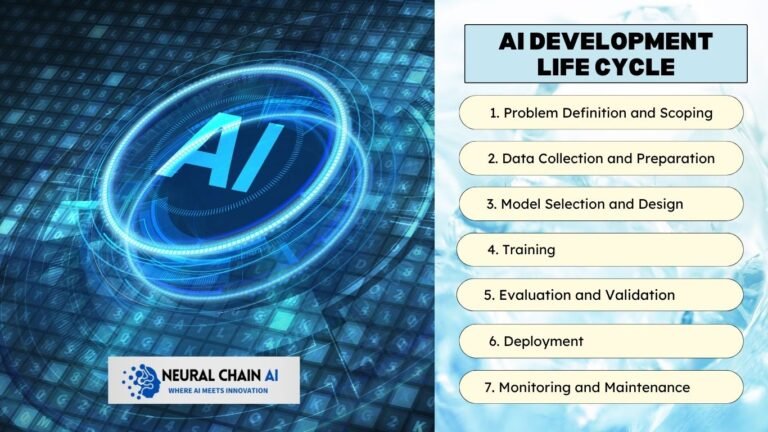
- MLOps and maintenance, a recurring 15–30% of build cost every year for monitoring, drift detection, retraining, and security. None of it is optional, and it never ends. That recurring maintenance line is not an afterthought; it is a permanent stage of the AI development life cycle, and leaving it out of a build estimate is how the real cost stays hidden until after launch.
The gap between expectation and reality is not small. Roughly 85% of organizations misestimate AI project costs by more than 10%, and a common pattern is a six-figure quote becoming a seven-figure year one. One widely cited retail example turned a $300K forecast into a $1.8M first-year reality once data scientists and integration were counted. A safe planning rule: budget three to five times your proof-of-concept cost to reach production.
What Partner really costs?
A partner build sits between the two: a project fee higher than a subscription but lower than standing up a full team from zero, plus a transition cost as ownership moves to you. Priced correctly, it buys down the build’s biggest risks, the failed first attempt and the eighteen-month hiring slog, while still leaving you with an owned asset.
The Two Crossovers:
At low volume, Buy is cheapest and the curve is flat. As usage grows, Buy’s metered cost rises until it crosses the flatter cost of an owned, optimized stack. That is the first crossover, the point where high-scale workloads justify a build. Partner sits in the middle precisely to carry you across that gap: ship fast on a bought or co-built base now, then transition to owned economics as volume earns it.
Build vs Buy vs Partner, Side by Side
| Dimension | Build | Buy | Partner |
|---|---|---|---|
| Time to first value | Months to quarters | Days to weeks | Weeks |
| Cost shape | High fixed, lower marginal | Low fixed, rising marginal | Moderate fixed + transition |
| IP and control | Full | Minimal | Full, after transfer |
| Differentiation | Highest | Lowest | High |
| Lock-in risk | Low | High (multi-layer) | Medium until handoff |
| Talent burden | Heavy and permanent | Light | Heavy early, yours later |
| Who maintains it | You | Vendor | You, post-transfer |
| Best when | Capability is the product | Capability must just work | Capability is core but you cannot build it alone in time |
The Decision Tree
When the matrix and tie-breakers still leave room, run the sequence in order and stop at the first decisive answer.
- Is this capability a source of competitive advantage? If no, Buy the most mature option and invest your effort in adopting it well. If yes, continue.
- Does it depend on proprietary data, workflows, or domain expertise a vendor cannot replicate? If no, Buy, and differentiate through how you deploy it. If yes, continue.
- Do mature, fit-for-purpose products already exist for the core of it? If no, Build (or Defer if it is not yet urgent and the market is moving fast). If yes, continue.
- Do you have the in-house team to build and maintain the differentiating layer on schedule? If yes, Build on top of the bought base. If no, Partner, with a transfer-of-ownership clause.
- Will volume grow enough to justify owned economics? If yes, structure the Partner engagement to transition you to a Build posture over time. If no, stay on the bought base and revisit annually.
A short sequence, one verdict, defensible in a planning review.
When to Build AI?
Build when the capability is the product, not a feature of it: when your advantage depends on proprietary models, novel architecture, or a data flywheel that compounds over years. Regulated environments where external data access is genuinely prohibited also push you here, since the compliance overhead of any alternative erases its speed advantage.
The Failure That Eats Builders
The failure mode is rarely the model. It is data readiness and people. Across the research, the projects that collapse do so because the data was not ready, the workflow integration was an afterthought, or no one defined the outcome before the build began.
Gartner has gone as far as predicting that a large share of AI projects lacking AI-ready data will be abandoned. The second killer is quiet: senior ML engineers turn over fast, and a builder who ships nothing for nine months while wrestling legacy data pipelines tends to leave with no win to show for it, resetting you to zero.
If you build, fund the data work first, define the outcome before writing code, and staff for retention. We lay out those economics in our guide to hiring AI automation talent and what it really costs.
When to Buy AI?
Buy when the capability is mature, non-differentiating, and needed soon. For the broad category of horizontal productivity tools like transcription, summarization, code assistance, and generic chat, building your own is almost never defensible.
Adopt the best product and put your energy into rollout, training, and measurement — that’s where the enterprise productivity gains from generative AI are actually won.
What Off-the-Shelf Cannot Sell You?
What you cannot buy is differentiation, and that is the trap. The same product is available to every competitor, so a bought capability raises the floor without lifting your ceiling. The other cost is lock-in, which accumulates in layers: the model, the orchestration, your data inside their format, the governance evidence you have generated, and the institutional knowledge your team builds around the tool.
Each new use case on the same platform raises the switching cost across all of them at once. You can blunt this. Route through a model gateway so you are not hard-wired to one provider, favor vendors that support open interoperability standards, keep your data exportable, and negotiate exit terms before you sign rather than after you depend on them.
When to Partner for AI?
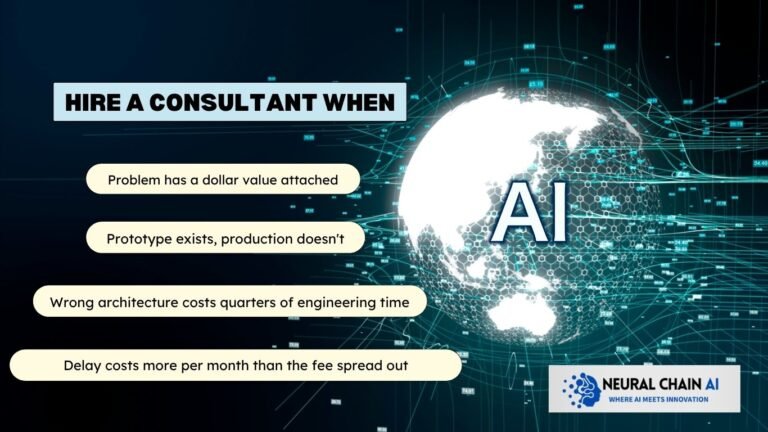
Partner when a capability is strategic enough that you want to own it, mature enough that buying the base makes sense, but blocked by a team you do not have today and a deadline you cannot move. This is the most common real-world answer for mid-market and enterprise companies, because it resolves the contradiction at the center of most AI programs: too important to rent, too urgent to wait on a hire.
The structures that work share one trait: a deliverable that becomes yours. Co-development pairs your people with specialists so knowledge transfers as the asset is built. A build-operate-transfer arrangement has the partner stand up and run the capability, then hand it to your team on a defined schedule; the current wave of these deals is explicitly oriented around transferring a working team and system back to the client.
How to Keep It From Becoming Lock-In?
A managed build delivers a production system plus the documentation, evaluations, and runbooks needed to operate it. The discipline that separates a partnership from soft lock-in is writing the handoff into the contract: name the transfer milestones, require the documentation and evaluation harness as deliverables, and define who owns the weights, the code, and the data from day one.
Build or Buy or Partner – A 90-Day Sequence for Getting This Right
You do not have to decide everything at once, and you should not.
In the first month, inventory the AI capabilities on your roadmap and plot each one on the Moat × Maturity matrix. Most will sort themselves into Buy or Defer immediately, which clears the noise and lets you focus on the two or three that carry real strategic weight.
In the second month, run a full total-cost-of-ownership estimate on those few, comparing build, buy, and partner side by side with the hidden lines included. This is also where you pressure-test data readiness, because a capability that looks like Build collapses into Partner or Defer the moment you discover the data is not there.
In the third month, commit to a path for each and ship one. A bought capability can be live. A partnered build can have its first milestone. A pure build should have a defined outcome, a funded data plan, and a named owner before a line of model code exists. The companies that come out ahead are not the ones that picked a single doctrine and applied it everywhere. They are the ones that made each capability earn its path.
Build, Buy, or Partner for AI : The Decision That Compounds
The right Build vs Buy vs Partner call isn’t fixed — it shifts as your AI maturity, internal capability, and use case complexity change. The companies that get this right don’t pick one path forever; they pick the right path for each use case, in each phase.
The strongest sequence for most enterprises is layered: Buy for commodity capabilities like LLM APIs and productivity tools, Partner for the first strategic use cases where speed-to-production matters, and Build the internal team and platform once your AI footprint outgrows the cost of renting capability.
Companies that apply this framework consistently end up with materially less rework, lower total cost of AI ownership, and faster compounding from each use case to the next.
Which call is your team weighing right now — should you build, buy, or partner for your next AI initiative?