Scarce talent. Steep salaries. A compliance rulebook rewritten almost overnight. In 2026, hiring AI automation experts in Canada has never demanded sharper decisions or punished slow ones faster.
This exclusive guide cuts through it: the roles that actually move the needle, real 2026 salary and contractor rates, and how to choose between a full-time hire, staff augmentation, or an AI consulting partner based on where you are today.
The point is to reach a result you can actually measure without a six-month search or a six-figure hiring mistake.
Key Takeaways
- You need fewer people than you think. A first pilot needs 3–4 roles — a strategist, an engineer, a part-time governance specialist, and a delivery lead not a data-science team.
- 2026 cost reality: full-time AI/automation engineers average ~CAD $120K–$150K base (Toronto/Vancouver higher); fully loaded cost is 1.3–1.5× base. Vetted contractors run ~CAD $90–$160/hr.
- The compliance picture changed. AIDA is not law, it died with Bill C-27 in January 2025. Compliance now runs through PIPEDA, Quebec Law 25, Ontario Bill 194, OSFI E-23, and the Treasury Board ADM Directive.
- Speed is the real lever. A scoped pilot with an augmented team can produce a measured result in ~30 days versus 4–6 months to recruit the same skills full-time.
- ROI is measurable. Start with a high-volume rules-heavy workflow and capture a baseline first; SMEs commonly recover 30–80 staff hours/month per workflow.
Almost every mid-market and enterprise team in Canada has the same automation conversation in 2026: leadership wants AI-driven efficiency, the board wants proof of return, and the people tasked with delivering it cannot find or cannot afford, the right talent fast enough. Recruiting a strong AI automation hire through a traditional process still takes roughly four to six months, and a single full-time mistake costs well into six figures once benefits, ramp-up, and lost momentum are counted.
This guide is written to remove the guesswork. It explains exactly which roles move the needle, what they cost in 2026 (with current Canadian salary and contractor data), how to choose an engagement model, what the compliance picture actually looks like now that the Artificial Intelligence and Data Act has fallen away, and a 30-day playbook to launch a pilot that produces a measured result. Where most articles on this topic still cite “upcoming AIDA,” this one reflects the real 2026 legal landscape which matters, because hiring someone who designs to a law that no longer exists is its own kind of risk.
1. Why hiring AI automation talent in Canada is genuinely hard?
Canada has world-class AI depth, Mila in Montreal, the Vector Institute in Toronto, Amii in Edmonton, yet most companies still struggle to staff practical automation work. Three structural forces explain the gap.
The talent is concentrated and contested
Large platforms, research labs, and global consultancies absorb a disproportionate share of senior AI talent, often at total-compensation levels that mid-market employers cannot match. Toronto and Vancouver in particular have AI engineering compensation that runs 15–20% above general software roles, with senior total comp at marquee employers reaching well above CAD $250K. For an SME that needs one or two strong builders, competing head-on for the same people is rarely the fastest path.
Time-to-hire works against you
A specialist AI/automation hire in Canada typically takes 4-6 months from open requisition to productive output, factoring sourcing, interviewing, offer cycles, notice periods, and onboarding ramp. For a workflow problem that is costing real money every month, that delay is itself a cost.
The “looks qualified, can’t deliver” problem
Automation ROI does not come from model theory; it comes from someone who can map a messy real-world process, integrate with the systems you already run (your CRM, ERP, ticketing, finance stack), build a reliable workflow, and instrument it so the savings are provable. Many candidates with strong machine-learning credentials have never shipped a production automation that a finance team would trust. Screening for delivery, not vocabulary, is the single highest-leverage thing a hiring manager can do.
For US enterprises where building a Canadian hiring pipeline isn’t worth the long-term overhead, nearshore AI consulting covers the same time-zone and legal advantages without the headcount commitment.
2. Roles you actually need (and the ones you don’t)
AI Automation: Core roles
Automation Strategist / Solutions Architect: the one who picks the right problem. Audits workflows, scores them by volume, cost, error rate, and risk, and designs a phased roadmap. The single biggest source of wasted automation spend is building the wrong thing well; this role prevents that.
AI Automation Engineer: the one who ships. Builds the workflow using the appropriate mix of LLM orchestration, APIs, RPA, and integration tooling, and connects it to your existing systems. Optimizes for reliability and observability, not novelty. This is the role most teams under-resource and over-theorize.
Data & Governance Specialist: the one who keeps you out of trouble. Embeds consent, retention limits, audit logging, and human-in-the-loop checkpoints; runs a privacy impact assessment where personal data is involved. In regulated workflows this role is not optional, but it is often part-time on a pilot.
Delivery Lead: the one who makes it land. Owns scope, timeline, stakeholder alignment, and the before/after measurement. Without this role, pilots drift and “ROI” stays anecdotal.
Situational roles: only when the use case demands it
- Data Scientist: needed when the workflow depends on a custom predictive or scoring model, not when you are orchestrating existing models and rules.
- UX/Conversation Designer: needed for customer-facing assistants or intake interfaces, rarely for internal back-office automation.
- ML/Platform Engineer: needed at scale-up when many automations must be deployed, monitored, and retrained, not for a first pilot.
3. Skills & Tools matrix: How to tell a real practitioner from a generalist?
Use this to brief recruiters and to sanity-check candidates and vendors. The “evidence to ask for” column is the part most hiring processes skip and the part that actually predicts delivery.
| Role | Must-have skills | Representative tools | Evidence to ask for |
|---|---|---|---|
| Automation Strategist | Process mapping, ROI/feasibility scoring, sequencing, change management | Process-mining tooling, value-stream mapping, lightweight prototyping | A prioritized backlog they produced and the workflow they recommended not automating, and why |
| AI Automation Engineer | LLM orchestration, prompt & tool design, API integration, error handling, observability | Python, orchestration frameworks, RPA platforms, vector stores, your CRM/ERP APIs | A production automation shipped in the last 12 months and its failure-handling design |
| Data & Governance Specialist | Privacy impact assessments, consent & retention design, audit logging, bias review | PIA templates, logging/lineage tooling, access controls | A PIA they authored and how they handled an automated-decision disclosure |
| Delivery Lead | Scoping, baseline measurement, stakeholder alignment, executive reporting | Project tracking, dashboards, KPI instrumentation | A before/after ROI report with the measurement method, not just the headline number |
4. Cost Bands and Total Cost of Ownership 2026
This is also why many Canadian buyers eventually run into the Big 4 vs Boutique Consulting question before they even finish a hiring search. The same annual cost that funds one senior in-house AI hire can buy a multi-month engagement at a boutique firm or a single quarter at a Big 4, and the answer to which is the better trade rarely matches the loudest name in the room.
Market Benchmarks (2026)
Public Canadian salary data clusters tightly for these roles in 2026. National averages for AI engineers sit around the high CAD $120Ks, with Toronto market data showing averages near CAD $149K and senior bands well above that; automation-engineer roles average roughly CAD $111K–$121K nationally with Toronto and Vancouver premiums of 10–15%. Ranges are wide because seniority and specialization swing pay by 30%+.
| Role | Full-time base / year | Staff augmentation / hr | Independent contractor / hr |
|---|---|---|---|
| Automation Strategist / Solutions Architect | $135,000–$185,000 | $95–$150 | $120–$180 |
| AI Automation Engineer (mid–senior) | $115,000–$155,000 | $80–$130 | $100–$160 |
| RPA / Process Automation Engineer | $120,000–$160,000 | $75–$120 | $95–$150 |
| Data & Governance Specialist | $95,000–$135,000 | $70–$110 | $85–$140 |
| Delivery Lead (automation) | $105,000–$145,000 | $70–$115 | $90–$140 |
Total Cost of Ownership:
Base salary is the smallest honest part of a full-time hire. The true annual cost includes several layers that rarely appear in a budget line until they hurt:
- Statutory + benefits: typically +20–30% on base.
- Recruiting: agency fees (often 15–25% of first-year salary) or the loaded cost of internal sourcing.
- Ramp-up: 1–3 months at reduced productivity before meaningful delivery.
- Management overhead: the senior time spent directing, reviewing, and unblocking.
- Tooling & licenses: orchestration, RPA seats, model usage, observability.
- Attrition risk: in a hot market, an early departure resets much of the above.
A defensible planning multiple is 1.3–1.5× base for fully loaded annual cost, before tooling. That is why a 30-day augmented pilot which produces a result and a decision is so often the cheaper first move than a hire.
| Resource | Approx. hours | Blended rate | Cost |
|---|---|---|---|
| Automation Strategist | ~18 hrs | $130/hr | $2,340 |
| AI Automation Engineer | ~85 hrs | $110/hr | $9,350 |
| Data & Governance Specialist | ~14 hrs | $100/hr | $1,400 |
| Delivery Lead | ~22 hrs | $105/hr | $2,310 |
| Total | ≈ $15,400 |
Figures are planning estimates; actuals vary with workflow complexity, integration depth, and compliance requirements.
5. Engagement Models: Full-time vs. Staff Augmentation vs. Agency vs. Offshore
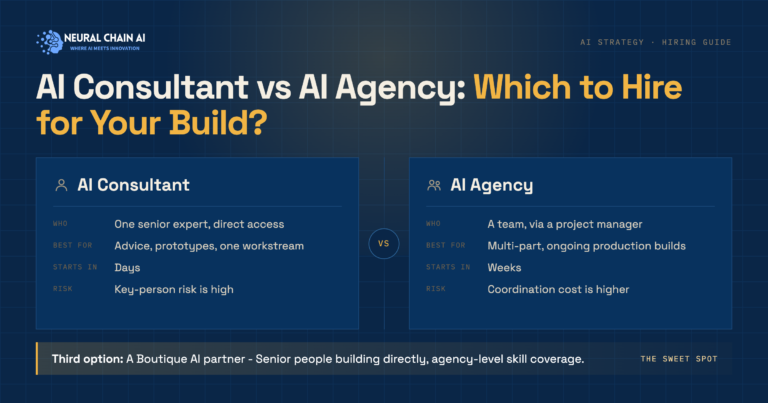
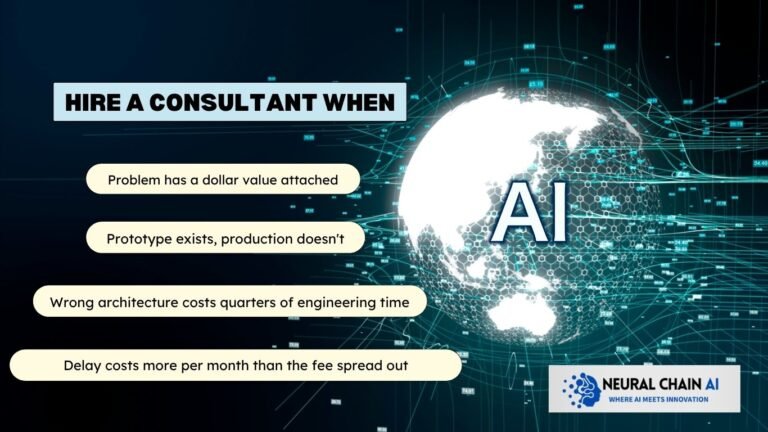
For most Canadian businesses making their first serious move into automation, outsourcing to an established AI consulting company is the highest-leverage option on this list. It collapses the 4-6 months hiring delay into days, replaces single-person key-person risk with a team that has shipped the same pattern many times, and ties spend to a defined outcome rather than a permanent salary line, so you validate ROI and compliance before you ever commit headcount.
The right partner also leaves your team with documented, owned systems, which means you capture the speed of outsourcing without inheriting long-term dependency. The framework below shows where each model fits, but for teams optimizing for speed, proof, and reduced risk, an AI consulting partner is usually the strongest starting point.
There is no universally correct model, there is a correct model for your stage. Use the decision logic below.
| Model | Best when | Speed | Compliance fit | Watch-outs |
|---|---|---|---|---|
| Full-time hire | Automation is a permanent, expanding capability with a stable roadmap and budget | Slow (4–6 mo) | High (in-house control) | Highest TCO; mis-hire risk; key-person risk |
| Staff augmentation | You need vetted specialists fast for pilots or surge capacity | Fast (1–2 wk) | High if partner knows Canadian privacy law | Define IP ownership and knowledge transfer up front |
| Delivery partner / agency | You want an outcome owned end-to-end, not bodies to manage | Fast | High with the right partner | Confirm in-house build vs. subcontracting; avoid lock-in |
| Offshore freelancers | Low-sensitivity, non-regulated, exploratory tasks only | Fast | Low for regulated/personal data | Rarely carry Canadian compliance context; data-residency risk |
Practical rule: Prove the workflow with augmentation, then convert the proven roadmap into full-time roles. Hiring before you have a validated use case is how teams end up with an expensive generalist and no shipped automation.
This is a staffing choice for one pilot, but it sits inside a bigger decision: whether your AI capability should be built in-house or delivered through a partner and in what sequence. Getting that order wrong is expensive, paid in lost quarters and sunk salaries rather than hourly rates.
If you are thinking about automation hiring as part of a broader AI roadmap, our companion guide works through that build-versus-partner decision in depth, with a scoring framework and real-world examples: AI Consulting Services vs. Building an In-House AI Team: What Works Best?
6. The 2026 Compliance Landscape (post-AIDA)
This is the most important update for anyone hiring in this space, and it is where this guide deliberately departs from older articles still ranking on this topic. Designing automation and screening talent against a law that does not exist is a real risk. Here is the actual 2026 picture:
- AIDA not in force. It was Part 3 of Bill C-27; the bill died on the order paper when Parliament was prorogued in January 2025. Its concepts (risk-based classification, human oversight, accountability) still influence best practice, but there is no AIDA obligation to comply with.
- PIPEDA still the federal baseline. The Consumer Privacy Protection Act that would have replaced it also died with C-27, so PIPEDA continues to govern private-sector personal data: limit collection, secure it, define retention, honour access.
- Quebec’s Law 25 in force, and the strictest piece. It requires transparency around automated decision-making and, on request, the ability to explain decisions and offer human review. If you touch Quebec residents’ data, this binds you today.
- Ontario’s Bill 194: in force for the public sector. It mandates AI accountability frameworks, risk management, and human oversight for public-sector entities (with technical standards following by regulation). Relevant if you sell into Ontario government, hospitals, school boards, or agencies.
- Sector regulators: increasingly specific, and now dated. OSFI published the final version of Guideline E-23 on Model Risk Management on 11 September 2025, and it takes effect for every federally regulated financial institution on 1 May 2027. The 2027 text adds explicit AI/ML expectations: explainability proportionate to the model’s autonomy and customer impact, documented data lineage and provenance, controls on synthetic and proxy data, and monitoring for model drift and autonomous re-parametrization. Securities, health, and other sectors have their own AI guidance evolving through 2026.
- Federal public-sector rule: the Treasury Board Directive on Automated Decision-Making requires algorithmic impact assessments and transparency for federal automated decisions, a strong template even for private-sector governance.
- Voluntary code: ISED’s voluntary code of conduct for advanced generative AI is the current federal soft-law signal of expected practice.
Prime Minister Mark Carney launched Canada’s National Artificial Intelligence Strategy, AI for All, on 4 June 2026. The strategy creates no new obligations by itself, but its first pillar commits Ottawa to modernizing privacy and online safety laws and building national AI safety capabilities, which is the clearest signal so far of where federal rules go next. Its third pillar targets AI adoption among small and medium-sized enterprises, and its fourth funds sovereign compute and talent. For a Canadian buyer scoping a pilot now, the practical read is that privacy reform is back on the agenda, so build consent, retention, and audit logging to a standard that survives a stricter statute rather than to the PIPEDA floor.
Compliance-by-design checklist (use it in the pilot, not after)
- Run a privacy impact assessment before any workflow touching personal data.
- Map data residency; keep regulated Canadian data in appropriate jurisdictions.
- Log inputs, outputs, model/version, and human overrides for every automated decision.
- Build a human-in-the-loop checkpoint anywhere a decision affects a person materially (credit, hiring, eligibility, pricing).
- Prepare an automated-decision disclosure and explanation path (Law 25 posture even outside Quebec is good hygiene).
- Put IP ownership, data-handling, and sub-processing terms in the contract before work starts.
7. The 30-day Launch Playbook
Hiring is only useful if it produces a result. This is the framework to go from decision to a measured outcome in about a month with an augmented team.
Week 1: Discovery & use-case selection
- Interview stakeholders; map candidate workflows across finance, support, ops, HR.
- Score each by volume, unit cost, error rate, integration difficulty, and compliance sensitivity.
- Capture the baseline (current hours, cost, error rate) — without it, ROI is unprovable.
- Deliverable: a ranked backlog and one selected pilot with a defined success metric.
Week 2: Team match & setup
- Assign the strategist, engineer, governance specialist, delivery lead.
- Sign NDAs and IP terms; confirm data handling and residency.
- Stand up environments, access, and a KPI dashboard tied to the baseline.
- Deliverable: resourced plan, signed terms, working dashboard.
Week 3: Build & test with humans in the loop
- Build the workflow; integrate with the live systems it must touch.
- Run QA with human-in-the-loop checks; document the PIA and decision logging.
- Deliverable: a working pilot and its compliance documentation.
Week 4: Launch & measure against baseline
- Run in the live environment under monitoring.
- Measure hours saved, cost reduced, error-rate change vs. the Week 1 baseline.
- Deliverable: an ROI report with method, plus a scale-or-stop recommendation.
Still confused, you may go through our Build vs Buy vs Partner for AI: The Enterprise Decision Framework
8. How to actually calculate ROI?
“30–60 hours saved” is meaningless without a method. Here is the calculation to require from any hire or partner.
Monthly gross saving = (baseline hours − post-automation hours) × fully loaded hourly labour cost, plus the value of error reduction (rework cost × error-rate delta) plus cycle-time value where speed has revenue impact.
Net ROI = (annualized gross saving − run cost − amortized build cost) ÷ total cost.
Worked example: a workflow consuming 90 hours/month at a CAD $45 loaded rate, reduced to 20 hours, saves 70 hours = CAD $3,150/month in labour alone (≈ $37,800/year), before error and cycle-time gains. Against a ~$15K pilot plus modest run cost, payback typically lands inside 90 days for high-volume, rules-heavy workflows. Low-volume or judgment-heavy workflows pay back slower, which is exactly why use-case selection in Week 1 matters more than tooling.
9. Hiring Scorecard & Interview Questions
Score candidates and vendors on five dimensions, and listen for the difference between a real answer and a rehearsed one.
| Question | Strong answer sounds like | Weak answer sounds like |
|---|---|---|
| Show a Canadian automation you shipped in the last 12 months. | Specific workflow, systems integrated, failure handling, measured result | Demos, courses, or model accuracy with no production or measurement |
| How do you handle Canadian privacy obligations? | Law 25 automated-decision duties, PIPEDA limits, PIA process; treats AIDA as not-in-force | “We’ll be AIDA-compliant” with no mention of what is actually in force |
| What did you choose not to automate, and why? | A judgment call about ROI, risk, or change cost | “We can automate anything” |
| How do you measure and report ROI? | Baseline-first method, named metrics, executive-readable reporting | Vague hours-saved claims with no baseline |
| What happens after the pilot? | Knowledge transfer, documentation, your repos, scale plan | Dependency by design; code in personal accounts |
10. Vendor Due Diligence: Red Flags to Screen Out
- Compliance pitch built around AIDA “coming into force” — outdated by over a year.
- No named, recent, production reference for a Canadian workflow.
- Reluctance to put IP ownership and data-handling terms in writing before work starts.
- Code or credentials kept in personal accounts rather than your repositories.
- ROI claims with no baseline methodology.
- Offshore delivery on regulated personal data without a data-residency answer.
- Scope that grows the engagement instead of transferring capability to your team.
Here is why an AI consulting partner is usually the stronger first move for Canadian teams: you pay for an outcome, not headcount, so you skip the 4-to-6 month recruiting cycle and the 6 figure mis-hire risk entirely.
As a Canada-based AI/ML consultancy that ships across many deployments a year, NeuralChainAI brings cross-engagement pattern recognition — what actually works, what fails, and which workflows are worth automating — that a single internal hire cannot accumulate from one context.
Every engagement is structured around transfer of ownership: we deliver working, documented automation and then enable your team to run and extend it, so you get speed and specialist depth without vendor lock-in or a permanent twelve-person AI org. And because the work is scoped to a measurable pilot, your board sees proof before you commit to scale.
Not ready for a sales conversation?
Book a free 45 minute strategy session: one question, a written one-page action plan you can take to your exec team. No pitch, no slides.
Book a free strategy session →
Frequently Asked Questions
A list of common questions we get about hiring AI automation experts in Canada.
Disclaimer
This article is for general information only. It is not legal, financial, or professional advice. Salary, cost, timeline, and ROI figures are estimates, not guarantees. Laws and market data change and vary by province and sector. Verify the current rules for your situation and seek qualified advice before acting.