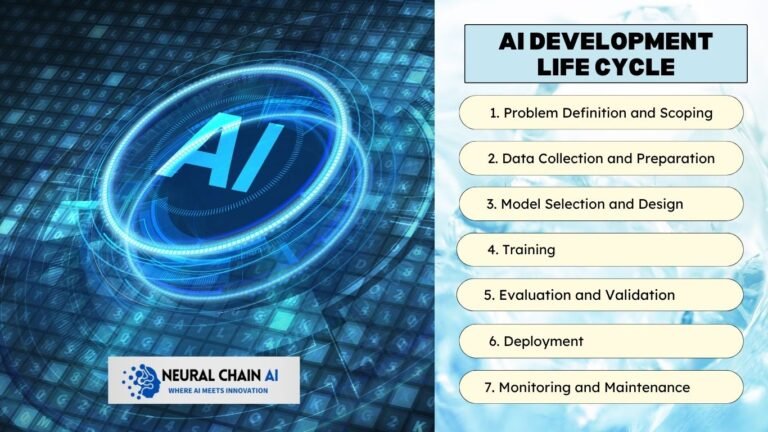

What is MLOps? MLOps is the set of engineering practices and tools that take machine learning models from notebook to production and keep them accurate once they are live, from data versioning and CI/CD to deployment, monitoring and retraining. This guide explains each stage of the MLOps lifecycle, compares open-source and managed MLOps tools stage by stage, covers the benefits teams get and shows when MLOps consulting pays off.
McKinsey’s State of AI survey, published in August 2026, found that 44% of organizations report AI scaling across their enterprise, up from 38% a year earlier. Scaling moves the work from building one model to running many of them. In the 2015 NeurIPS paper Hidden Technical Debt in Machine Learning Systems, Google researchers noted that only a small fraction of a real-world ML system is the ML code itself. The data pipelines, serving infrastructure and monitoring around the model make up the rest, and MLOps is the discipline that builds and runs that surrounding system.
What Is MLOps? How It Extends DevOps to Machine Learning
Google Cloud’s MLOps architecture guide defines MLOps as “an ML engineering culture and practice that aims at unifying ML system development (Dev) and ML system operation (Ops).” The same guide grades teams on three levels of maturity. At level 0 every step is manual, from data preparation to training and validation. Level 1 automates the ML pipeline so models retrain continuously, and level 2 adds automated CI/CD for the pipelines themselves.
DevOps ships code. An ML system ships three things that change on different schedules: the code, the data and the trained model. A model can pass every unit test and still lose accuracy when the data it sees in production drifts away from its training data. MLOps adds versioned datasets, tracked experiments and tests on data and models. It also adds continuous training, which Google’s guide describes as “concerned with automatically retraining and serving the models.”
The same discipline now covers LLM applications and AI agents, often called LLMOps. Prompts, model versions, retrieval indexes and evaluation sets all need versions, and every agent run needs a trace. MLflow’s project page now describes it as an open source AI engineering platform for agents, LLMs and ML models.
The MLOps Lifecycle: Six Stages From Data to Retraining
Each stage below covers what ML engineers automate, which tools do the work and what a person still signs off.
1. Data and Features
Every model is a function of its training data, so MLOps starts by versioning that data. DVC versions datasets and models in your cloud storage and keeps their version information in the Git repository, so a model can be rebuilt from the exact files it was trained on. Great Expectations runs data quality tests, which it calls Expectations, before data reaches training. A feature store such as Feast keeps features consistent between training and serving, with an offline store for historical training data and an online store for real-time prediction. A data owner still approves schema changes and checks label quality.
2. Training and Experiment Tracking
Training produces many candidate models, and tracking records how each one was made. MLflow tracks models, parameters, metrics and evaluation results across experiments, and its Model Registry manages each model’s versions through its lifecycle. Ray scales training and hyperparameter tuning across a cluster through its Train and Tune libraries. The team agrees in advance on the metric that defines a better model, such as recall on fraud cases or forecast error on a held-out period, and a reviewer approves each candidate before it enters the registry.
3. CI/CD for Machine Learning
CI/CD for ML tests three things on every change: the code, the data and the model. A pipeline retrains the candidate, scores it on a fixed evaluation set and promotes it only when it beats the production model on the agreed metric. Kubeflow Pipelines runs these workflows as reusable steps on Kubernetes, and Apache Airflow authors, schedules and monitors them as code. CML, an open-source CLI from the team behind DVC, trains and evaluates models and posts a report with results and metrics on every pull request.
4. Deployment and Serving
Deployment turns a registered model into an endpoint or a batch job. KServe serves predictive and generative AI models on Kubernetes, BentoML turns an inference script into a REST API in a container and vLLM serves large language models. A shadow deployment scores live traffic without returning its answers, and a canary sends a small share of traffic to the new model. Amazon SageMaker AI also offers blue/green deployments with automatic rollback. For LLMs that must stay inside your network, a self-hosted vLLM deployment runs open-weight models on your own GPUs.
5. Monitoring
Monitoring watches live inputs, predictions and outcomes. Data drift means production inputs no longer look like the training data, and concept drift means the link between inputs and the outcome a model predicts has changed. Evidently ships more than 100 built-in metrics, from data drift detection to LLM judges, and SageMaker Model Monitor detects data and model drift on endpoints and sends alerts. For LLM apps and agents, Langfuse traces and evaluates each run and tracks usage and cost. Your team sets the alert thresholds and reviews flagged predictions, including bias reviews for models that affect customers.
6. Retraining
Retraining closes the loop. A pipeline retrains on a schedule, when a drift alert fires or when enough new labeled data arrives, then runs the same CI/CD tests as any other change. Azure Machine Learning publishes events such as data drift detection to Azure Event Grid, which can notify people and trigger that automation. The registry keeps every version, so a rollback is one promotion away, and a reviewer approves each retrained model before it replaces the current one.
MLOps Tools by Stage: Open-Source and Managed Options
Licenses below come from each project’s LICENSE file on GitHub and managed components from each vendor’s MLOps documentation, checked November 20, 2026. Google’s entries use Gemini Enterprise Agent Platform, which Google describes as the evolution of Vertex AI.
| Stage | Open-source tools (license) | Managed options | What your team still reviews |
|---|---|---|---|
| Data and features | DVC, data and model versioning (Apache 2.0); Great Expectations, data quality tests (Apache 2.0); Feast, feature store (Apache 2.0) | SageMaker Feature Store; Agent Platform Feature Store; Databricks Feature Store | Schema changes, label quality and personal data in training sets |
| Training and tracking | MLflow, experiment tracking and model registry (Apache 2.0); Ray, distributed training and tuning (Apache 2.0) | SageMaker AI with managed MLflow and Model Registry; Azure Machine Learning model registry; Databricks MLflow with Models in Unity Catalog | The metric that defines a better model and approval to register a candidate |
| Pipelines and CI/CD | Kubeflow Pipelines, ML workflows on Kubernetes (Apache 2.0); Apache Airflow, workflow orchestration (Apache 2.0); CML, CI/CD reports on pull requests (Apache 2.0) | SageMaker Pipelines and SageMaker Projects CI/CD templates; Agent Platform Pipelines; Azure Machine Learning pipelines; Databricks workflows | Test thresholds and the promotion rule |
| Deployment and serving | KServe, model inference on Kubernetes (Apache 2.0); BentoML, inference APIs (Apache 2.0); vLLM, LLM inference and serving (Apache 2.0) | SageMaker AI endpoints with blue/green deployment; Agent Platform endpoints; Azure Machine Learning managed online and batch endpoints; Databricks Model Serving | Release sign-off and the rollback plan |
| Monitoring | Evidently, drift metrics and evals (Apache 2.0); Langfuse, LLM and agent tracing (MIT core) | SageMaker Model Monitor with Clarify; Agent Platform model monitoring; Azure Machine Learning monitoring; Databricks data profiling of inference tables | Alert thresholds, flagged predictions and bias reviews |
| Retraining | Airflow or Kubeflow Pipelines on a schedule or drift trigger, with versions kept in the MLflow registry | SageMaker Pipelines; Azure Machine Learning events through Azure Event Grid; a Databricks workflow with training as its first task | Approval of each retrained version before it goes live |
Benefits of MLOps for Teams Running AI Models
- Reproducible models. Every production model traces back to its code, data and parameters. SageMaker AI’s ML Lineage Tracking, for example, keeps that audit trail so a model can be recreated for debugging.
- Safer releases. Automated tests and promotion rules decide when a model ships.
- Models that stay accurate. Drift monitoring and scheduled retraining keep predictions close to current data.
- An audit trail for regulated work. The registry records who approved which version and when.
- Less effort per model. The next model reuses the first pipeline, so data scientists spend their time on modeling.
Open-Source or Managed: How Teams Choose an MLOps Stack
Managed platforms suit teams that already run on one cloud. SageMaker AI, Agent Platform, Azure Machine Learning and Databricks each bundle a registry, pipelines, endpoints and monitoring behind one console, so a small team gets a working stack with little infrastructure to run.
Open-source tools suit teams that need portability or private infrastructure. MLflow, Kubeflow Pipelines, KServe, Evidently and vLLM can all be self-hosted in a cloud account you control or on premises, so training data, models and predictions stay inside your network. That suits healthcare, financial services and legal teams with strict data terms and companies serving open-weight LLMs on their own GPUs. Your team then owns patching and scaling the stack. Many stacks combine both, such as managed MLflow on Databricks with KServe on a private cluster.
When MLOps Consulting Pays Off
Outside help pays off when running models by hand takes more of the team’s time than building them. These signals mark that point:
- Several models in production, each deployed by its own script, which matches Google’s level 0, where every step is manual.
- Retraining happens only after someone notices that accuracy has dropped.
- An auditor, regulator or enterprise customer asks which model version made a decision, and the answer means a search through notebooks.
- A move from one cloud to another, or from cloud to self-hosted infrastructure, while models keep serving.
- The first LLM app or agent heading to production, which needs tracing, evaluation sets and cost tracking alongside the classic models.
A team with one model and stable data can often run MLOps in house on a managed platform’s defaults. Consulting earns its place when the gap to an automated, monitored pipeline spans several systems at once.
A useful engagement starts with an assessment of your setup against the six stages and one reference pipeline built end to end on a real model. It then sets promotion rules and monitoring your team agrees with, writes runbooks and hands the pipeline over. Scope depends on how many models you run, how many environments they span, the condition of your data and your compliance requirements, so any estimate should follow an assessment. Our MLOps consulting page describes how NeuralChainAI runs this work.
How NeuralChainAI Builds MLOps on Your Existing Stack
NeuralChainAI builds MLOps around the tools and cloud you already run, whether that is SageMaker AI, Databricks, Azure Machine Learning or a self-hosted stack of MLflow, Airflow and KServe on your own Kubernetes cluster. For private AI work, models, training data and agent traces stay in your cloud account or data center, with open-weight LLMs served by vLLM. Accuracy is measured on a held-out evaluation set before release and through live monitoring after it, and your reviewers keep the approval step for every production model.
Ready to move your models from notebook to production? NeuralChainAI’s MLOps consulting services put CI/CD, monitoring and retraining around the models you already run, on your existing stack or fully self-hosted. Book an AI strategy session to map your setup against the six stages.