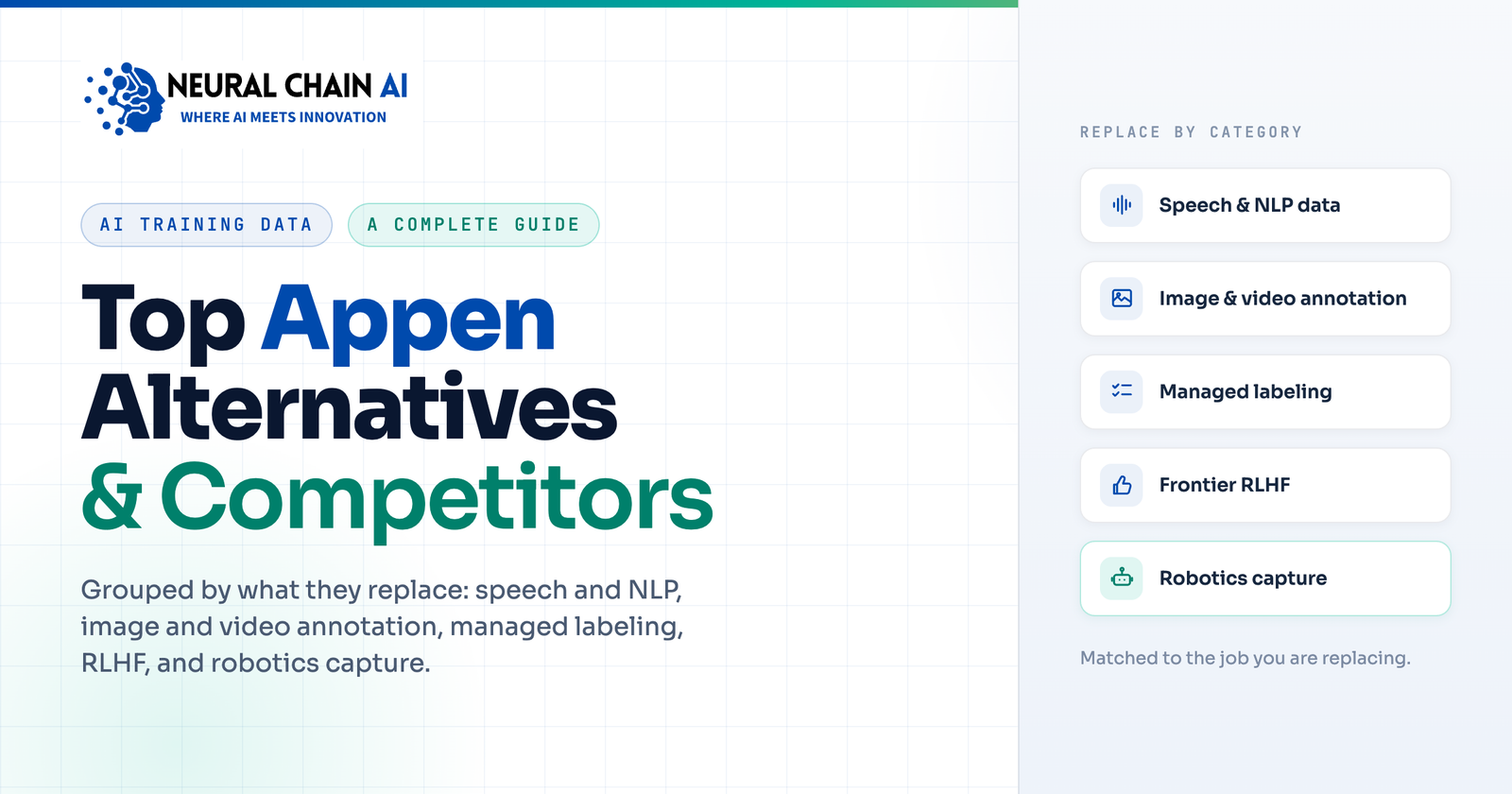
Appen competitors and alternatives are what buyers reach for now that the one-vendor training data era is over, and this guide groups the top options for 2026 by what they replace: speech and NLP data, image and video annotation, managed labeling, RLHF, and robotics capture. Appen was never one product, it was five businesses wearing one logo, so the strongest replacement is usually a specialist that owns the exact job you hired Appen to do, rather than another generalist.
For more than a decade, Appen (ASX: APX) was the default answer for large-scale training data. It combined speech and language collection, image and video annotation, search and ad relevance rating, and a managed global crowd into one procurement contract. That breadth was the whole pitch: one supplier, many data types. The model came under pressure when Google terminated its contract in early 2024. Appen’s FY25 results, reported on 25 February 2026, show where the rebuild landed. Group revenue was 230.8 million US dollars, up 4.5 percent on FY24 once the Google impact is excluded, with underlying EBITDA of 12.2 million US dollars at a 5.3 percent margin and gross margin of 40.3 percent. The split inside that number matters for buyers: Appen China grew 74.8 percent to 102.9 million US dollars while Appen Global fell 21.1 percent to 127.9 million US dollars, and generative AI work reached 44.1 percent of fourth-quarter revenue, up from 34.8 percent a year earlier. Management guides FY26 to 270 million to 300 million US dollars of revenue at a 5 to 10 percent EBITDA margin, so this is a leaner, refocused company rather than a defunct one.
Even so, buyers who once bought everything from Appen are now unbundling. The market has split into specialists, each doing one slice better than a generalist could. The practical way to shortlist Appen competitors is to ask what Appen did for you, then match that job to the category leader. Below we group the strongest alternatives by the specific thing they replace: speech and language data, image and video annotation, managed annotation services, frontier RLHF and expert data, and physical AI and robotics data capture.
| Provider | Best for | Model | Where it stands |
|---|---|---|---|
| TELUS Digital | Speech, NLP, and multilingual collection at scale | Global crowd plus platform | Closest like-for-like replacement for Appen’s core services |
| Defined.ai | Off-the-shelf speech and language datasets | Licensed data marketplace | Strong in low-resource languages and dialects |
| Labelbox | In-house image and video annotation teams | Self-serve platform | General-purpose labeling tooling |
| Encord | Multimodal and medical imaging annotation | Platform | Specialist in complex visual and clinical data |
| Sama | Fully managed, ethically sourced annotation | Managed workforce | Image, video, 3D point cloud, and sensor data |
| iMerit | Managed geospatial and public-sector pipelines | Managed workforce | Part of EXL since August 2026 |
| Surge AI | Frontier RLHF and expert human feedback | Expert network plus platform | Roughly 1.4 billion US dollars 2025 revenue, bootstrapped |
| Mercor | On-demand domain experts for model training | Expert marketplace | About 2 billion US dollars ARR, 10 billion valuation |
| Scale AI | Large-scale frontier data operations | Platform plus managed workforce | Meta took a 49 percent stake for 14.3 billion in 2025 |
| NeuralChain AI | Physical AI and robotics data capture | Specialist multimodal capture | Consented at source, LeRobot-ready (disclosure: that is us) |
Speech, language, and NLP data alternatives
This is the heart of what Appen was known for: recorded speech, transcription, pronunciation lexicons, intent and entity labeling, and multilingual text across dozens of locales. If you are replacing that work, you want a provider with a large, verified global contributor base and mature audio and NLP tooling.
TELUS Digital
TELUS Digital (formerly TELUS International AI, the group behind Lionbridge AI) is the closest like-for-like replacement for Appen’s core service business. It offers speech recognition, speaker identification, diarization, transcription, and a full range of NLP tasks such as named entity recognition, intent classification, and sentiment analysis, all sourced through a mobile-first global community across more than 20 verified expert domains. Everest Group named it a Leader in its 2024 Data Annotation and Labeling PEAK Matrix assessment. One ownership change is worth knowing before you procure. TELUS completed the privatization of TELUS Digital on 31 October 2025, buying the shares it did not already own at 4.50 US dollars each for about 539 million US dollars, so the unit now sits wholly inside TELUS instead of trading on the NYSE and TSX. For teams that want the one-vendor breadth Appen used to offer, TELUS Digital is usually the first name on the shortlist.
Defined.ai
If you would rather buy data than commission a project, Defined.ai runs a licensed marketplace of ready-made speech and language datasets. Founded in 2015 and based in Seattle, it is particularly strong in low-resource languages and dialect diversity, which matters for anyone building genuinely global voice interfaces. The company reported 65 percent year-over-year revenue growth in 2025 and a sharp increase in third-party partner datasets, a sign the licensed-data model is maturing. It is a good fit when your gap is coverage and speed rather than a bespoke collection protocol.
Image and video annotation platforms
Appen also handled large volumes of computer-vision labeling. If that is the slice you are replacing and you want to keep annotation in-house or under tight quality control, a self-serve platform is often a better fit than a managed crowd.
Labelbox
Labelbox is a general-purpose annotation platform for image, video, and text. It gives internal teams the tooling to label, review, and manage datasets themselves, with model-assisted labeling to speed throughput. It suits organizations that have annotation staff or want to build that capability rather than outsource it wholesale.
SuperAnnotate
SuperAnnotate is a hybrid: a capable annotation platform paired with access to a managed workforce when you need extra hands. That flexibility lets you start self-serve and scale into managed labeling on the same tooling, which reduces switching cost as projects grow.
Encord
Encord specializes in multimodal and medical imaging annotation, including complex visual formats and clinical data. If your computer-vision work involves DICOM, surgical video, or other regulated imagery, Encord’s domain focus is a meaningful advantage over a general tool.
Managed annotation services
Some buyers valued Appen precisely because it ran the whole pipeline: recruiting, training, quality assurance, and delivery, with no platform to operate. Two providers stand out for fully managed work.
Sama
Founded in 2008, Sama delivers fully managed annotation across image, video, 3D point cloud, and sensor data, with a long-standing emphasis on an ethical, transparent sourcing pipeline. It is a strong choice for autonomous driving and robotics-adjacent perception work where sensor fusion labeling and auditable labor practices both matter.
iMerit
iMerit provides managed annotation with deep benches in geospatial, government, and other regulated domains. When the work needs domain experts and defensible process rather than raw crowd volume, iMerit’s managed model fits the same procurement shape teams liked about Appen. EXL completed its 310 million US dollar acquisition of iMerit on 3 August 2026, so that managed service now sits inside a listed data and AI services group.
Frontier RLHF and expert data
The fastest-growing slice of the market barely existed when Appen was at its peak: reinforcement learning from human feedback and expert-authored data for frontier models. Appen never really owned this segment, and a new generation of specialists has taken it.
Surge AI
Surge AI focuses on high-quality RLHF and expert human feedback for leading model developers. It reportedly reached around 1.4 billion US dollars in 2025 revenue while remaining bootstrapped and profitable, drawing on a network of roughly 50,000 vetted experts. If your need is nuanced preference data and rubric-based evaluation rather than commodity labeling, this is the tier to look at.
Mercor
Mercor operates an expert marketplace that matches domain specialists, including PhDs, lawyers, and physicians, to model-training and evaluation work. It reported roughly 2 billion US dollars in ARR in 2026 and raised a 350 million US dollar Series C at a 10 billion valuation in October 2025, with more than 30,000 contractors. It is built for on-demand access to hard-to-find expertise.
Scale AI
Scale AI remains a major force in large-scale frontier data operations, combining platform and managed workforce. In June 2025 Meta took a 49 percent stake valuing the company at 14.3 billion US dollars, a move that reshaped supplier relationships across the sector and pushed some labs toward more neutral providers. It is worth evaluating for very large programs, with that ownership context in mind.
Physical AI and robotics data capture
There is one job none of the above was built for: capturing the real-world, multimodal data that robot foundation models and world models learn from. This is a collection problem, not an annotation problem, and it is where the market is heading fastest. Disclosure: that is us.
NeuralChain AI
NeuralChain is a specialist in physical AI training data collection for robot foundation models. Where Appen and its annotation-first successors label data that already exists, NeuralChain captures new interaction data at the source. Every episode carries synchronized streams: stereo depth, tactile force arrays, a 200Hz IMU, dual wrist cameras, and 21-point hand pose, so a policy learns the forces and proprioception behind an action, not only how it looked on camera.
Because embodied models are only as trustworthy as their provenance, every episode is consented at the source and carries a SHA256 per-episode chain of custody, and datasets ship LeRobot-ready so they drop straight into modern training pipelines. Teams building manipulation policies can pair full-body capture with focused tactile manipulation training data from tactile sensing and force arrays. If your reason for leaving Appen is that your roadmap moved from labeling internet data to teaching robots real skills, this is the specific slice we own. You can see the full scope on our physical AI and robotics consulting and development page.
How to choose among Appen competitors and alternatives
Start by naming the job, not the vendor. Write down which of the five categories above actually describes your need, because the right answer for speech data is almost never the right answer for RLHF or robotics capture. From there, weigh a few practical factors: whether you want a platform you operate or a fully managed pipeline, how much your domain demands verified experts versus general crowd, the languages, modalities, and sensors you need covered, and how important consent and provenance are for your compliance posture. Many teams end up with two or three specialist competitors rather than one generalist, and that is usually cheaper and higher quality than forcing everything through a single supplier.
If your roadmap has moved from labeling internet data to teaching robots real-world skills, that is the one slice a generalist cannot cover. NeuralChain captures consented, multimodal, LeRobot-ready interaction data at the source. If that matches where you are heading, take a look at our physical AI and robotics data capture services and see whether the physical-AI slice fits your plan.