Physical AI companies build the robot foundation models, humanoid bodies, warehouse systems, and vehicles that let artificial intelligence perceive, decide, and act in the real world. This ranked guide to the top physical AI companies in 2026 covers each layer of the stack with sourced valuations, deployment evidence, and listing status as of October 2026.
Money and maturity sit in different places in this market. Humanoid makers and robot-model builders attract the largest valuations, while industrial automation, warehouse systems, and robotaxis carry much of today’s paid deployment. The sections below follow that structure so you can compare companies within the same layer.
What Physical AI Companies Do? Definition and Categories
A physical AI company builds systems that perceive, predict, and act in the physical world. This guide groups them into five categories.
- Robot foundation models and compute for companies that train the models and supply the chips and simulation tools robots run on.
- Humanoid hardware for makers of bipedal robots aimed at factories, warehouses, and homes.
- China’s volume leaders for manufacturers shipping humanoids by the thousand.
- Industrial, warehouse, and vehicle systems for arms, inspection, fulfillment, and autonomous driving already earning revenue.
- Data and infrastructure providers for the teams that capture the real-world demonstrations robot models learn from.
How We Ranked the Top Physical AI Companies?
The order rewards deployment over demonstration. Commercial deployment scale comes first: a company with robots in paid work ranks above one running pilots. Hardware and software maturity comes second, covering reliability, payload, and progress from teleoperation toward autonomous operation. The third factor is the data and manufacturing position, since real-world operating hours build a training-data advantage and dedicated factories show a company can fill orders.
Top Physical AI Companies at a Glance
The table summarizes the field before the profiles. Figures are the latest public reports as of October 2026, and a dash marks a figure that is not publicly reported.
| Company | Category | Flagship | Valuation or funding | Listing status |
|---|---|---|---|---|
| NVIDIA | Models and compute | Isaac GR00T, Cosmos, Jetson | Public company | Nasdaq: NVDA |
| Physical Intelligence | Robot foundation models | π-series models | $5.6B (Nov 2025); $11B+ reported (2026) | Private |
| Skild AI | Robot foundation models | General robot brain | $14B reported (Jan 2026) | Private |
| Figure AI | Humanoid hardware | Figure 03 with Helix | $39B (Sep 2025) | Private |
| Agility Robotics | Humanoid hardware | Digit | $2.5B pre-money (Jun 2026) | Merging with Churchill Capital Corp XI |
| Apptronik | Humanoid hardware | Apollo | $5.5B+ (Feb 2026) | Private |
| Boston Dynamics | Humanoid hardware | Atlas, Spot | Hyundai holds about 80% | Hyundai subsidiary |
| Tesla | Humanoid hardware | Optimus | Public company | Nasdaq: TSLA |
| 1X Technologies | Humanoid hardware (home) | NEO | – | Private |
| Unitree | China volume leader | Humanoids and quadrupeds | About CNY 342B market cap (Aug 19, 2026 close) | STAR Market: 688836 |
| AgiBot | China volume leader | Humanoid, wheeled, and quadruped lines | – | Hong Kong IPO process started (Jul 2026) |
| FANUC | Industrial systems | Industrial robot arms | Public company | Tokyo: 6954 |
| Symbotic | Warehouse systems | AI-driven warehouse automation | Public company | Nasdaq: SYM |
| Waymo | Autonomous vehicles | Waymo Driver | Alphabet unit | Alphabet subsidiary |
Last updated October 19, 2026. Valuations and shipment figures move monthly.
Robot Foundation Model and Compute Builders
These companies supply the intelligence, simulation tools, and chips that many robots depend on. They appear less often in demo videos and shape what every robot body can learn.
NVIDIA
NVIDIA supplies three layers that physical AI builders use: the Isaac GR00T foundation models for humanoid robots, the Cosmos world foundation models that generate physics-aware synthetic training data, and the Jetson edge computers that run models inside robots. Isaac Lab, its GPU-parallel simulation framework, lets teams train robot policies in simulation before they reach hardware. NVIDIA is also an investor in Agility Robotics and Figure AI, which ties its chips and models to the companies that deploy them.
Physical Intelligence
Physical Intelligence trains vision-language-action models, the π series, to control many different robot bodies. Former Google DeepMind researchers and academics founded the company, which raised $600 million at a $5.6 billion valuation in November 2025. Bloomberg reported in March 2026 that it was in talks to raise about $1 billion at a valuation above $11 billion. The company has announced no commercialization timeline, so its standing rests on research results: its models have folded laundry, peeled vegetables, and assembled boxes across several robot platforms, according to Dealroom.
Skild AI
Skild AI follows the same hardware-agnostic approach to a general robot brain. It reportedly closed a $1.4 billion round at a $14 billion valuation in January 2026, according to funding-tracker reports.
Humanoid Hardware Leaders
These companies build the bipedal robots meant for factories, warehouses, and homes. They draw the largest private valuations, and deployment records separate the leaders within the group.
Figure AI
Figure AI holds the highest private valuation in the sector at $39 billion after its September 2025 Series C, on about $1.9 billion raised in total, according to Sacra. Its Figure 03 robot runs Helix, an in-house vision-language-action model, and the BotQ factory in California carries an initial capacity of 12,000 robots a year. CEO Brett Adcock counted roughly 740 deployed Figure robots on June 20, 2026, as reported by Value Add VC.
Agility Robotics
Agility’s Digit is one of the clearest examples of paid humanoid work in the West. Digit moved more than 100,000 totes for GXO Logistics in 2025 under a robots-as-a-service model and customers include Schaeffler, Toyota Motor Manufacturing Canada, and Mercado Libre. In June 2026 Agility agreed to merge with Churchill Capital Corp XI at a $2.5 billion pre-money valuation, a deal expected to bring more than $620 million in gross proceeds and more than $300 million in booked multi-year Digit v5 orders, according to TechCrunch. A shareholder vote is reported for November 2, with the ticker AGLT planned.
Apptronik
Apptronik raised $520 million in February 2026, bringing its Series A to more than $935 million at a valuation above $5.5 billion, according to Bloomberg. Its Apollo robot targets repeatable factory and logistics tasks, with partnerships that include Mercedes-Benz, GXO Logistics, Jabil, and Google DeepMind.
Boston Dynamics
Boston Dynamics unveiled the production version of its electric Atlas at CES on January 5, 2026 and began manufacturing it immediately. Boston Dynamics said all 2026 deployments are committed to Hyundai’s Robotics Metaplant Application Center and Google DeepMind, with additional customers planned for early 2027. Google DeepMind is integrating its Gemini Robotics models into Atlas, and Hyundai Mobis supplies the actuators.
Tesla Optimus
Tesla applies its vehicle manufacturing base to Optimus. On its Q1 2026 call, as reported by Electrek, Elon Musk said Fremont production would begin in late July or August 2026, with initial output “quite slow” and a second Optimus factory at Giga Texas starting around summer 2027. Early skills start with simple factory tasks and build from there.
1X Technologies
1X is the clearest home-robot bet. NEO is priced at $20,000 or $499 a month, with US deliveries beginning in 2026 from its Hayward, California factory. Early units use remote 1X operators for tasks the robot has not yet learned, according to Wall Street Journal testing, and the data from those sessions trains later autonomy.
China’s Volume Leaders: Unitree and AgiBot
Omdia counted 13,318 humanoid robots shipped worldwide in 2025, and Chinese vendors accounted for almost 90% of them, according to Nasdaq Private Market. Figure AI, Agility Robotics, and Tesla sat in a 150 to 500 units range each, alongside several smaller Chinese makers, according to the WAM news agency.
Unitree
Unitree listed on Shanghai’s STAR Market on August 19, 2026, pricing its IPO at 150.80 yuan and raising about 6.1 billion yuan (roughly $904 million), according to China Daily. Shares closed the first day up 460.34% at 845 yuan, a market capitalization of about 342 billion yuan, NoCut News reported. Omdia counted 4,200 Unitree humanoid shipments in 2025, and Unitree’s prospectus reports a higher figure of more than 5,500, as reported by Bloomberg.
AgiBot
Omdia ranked AgiBot first in 2025 humanoid shipments at 5,168 units, roughly 39% of the market. The company reported its 10,000th robot on March 28, 2026 and its 15,000th by June, a count that includes wheeled, semi-humanoid, humanoid, and quadruped models, according to Yicai. AgiBot started its Hong Kong IPO process in July 2026 with CITIC Securities as sponsor, and press reports of its valuation target range from about HK$40–50 billion to US$20 billion, according to Gasgoo and The Standard. UBTECH, listed in Hong Kong, shipped about 1,000 humanoids in 2025 according to Omdia.
Industrial, Warehouse, and Autonomous Vehicle Companies
Much of today’s paid physical AI work happens outside humanoids. These companies earn revenue from systems that run on factory lines, in distribution centers, and on public roads.
FANUC and Overview AI: Manufacturing Systems
FANUC is one of the world’s largest industrial robot makers. Overview AI sits at the applied end of the stack with real-time defect detection on production lines, where physical AI pays back through reduced scrap and rework.
Symbotic: Warehouse Systems
Symbotic builds AI-driven automation for large retailers and distributors, combining robots, software, and storage systems inside the warehouse. It trades on Nasdaq under SYM.
Waymo: Autonomous Vehicles
Waymo, an Alphabet company, operates a driverless ride-hailing service in several US cities. It shows what a full perceive, predict, and act loop looks like on public roads at commercial scale.
Data and Infrastructure Providers for Physical AI
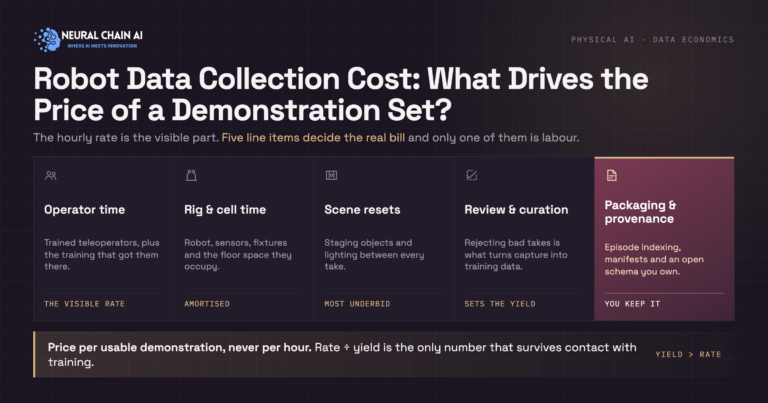
Robot models improve with real-world demonstrations: teleoperated episodes, egocentric video, tactile readings, and consented capture with a clear chain of custody. Humanoid makers collect this data themselves. Apptronik, for example, opened a Robot Park training facility in Austin to gather data for Google DeepMind’s Gemini Robotics models, and 1X learns from its remote-operator sessions.
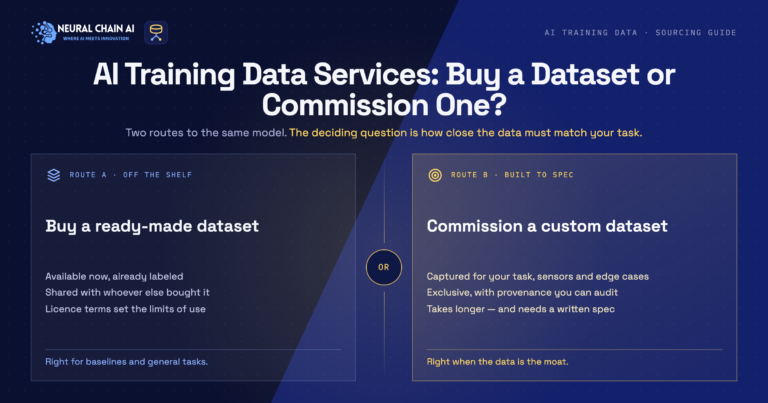
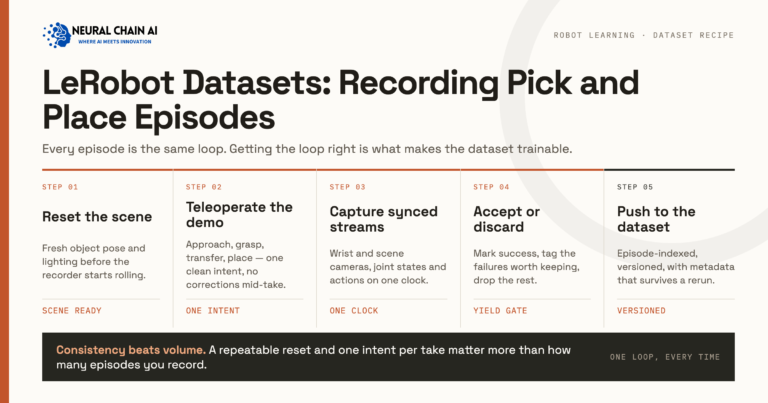
Teams without a robot fleet of their own buy or commission datasets instead. NeuralChain AI is one of these providers, and the disclosure is plain: that is us. We capture physical AI training data with synchronized stereo depth, tactile force arrays, 200 Hz IMU, dual wrist cameras, and 21-point hand pose, consented at the source and delivered in LeRobot-ready format. Our physical AI training data collection page describes the service.
Publicly Traded and IPO-Bound Physical AI Companies
Investors can currently buy shares in NVIDIA, Tesla, Unitree on the STAR Market, UBTECH in Hong Kong, Symbotic, and FANUC. Agility Robotics is in the middle of a SPAC merger, and AgiBot has started its Hong Kong IPO process. This list is informational and does not constitute investment advice. Unitree’s first-day move from a roughly 61 billion yuan IPO valuation to about 342 billion yuan shows how quickly public-market pricing for this category can shift, so check current quotes before relying on any figure here.
What to Ask For? Reliability Evidence
Buyers get the clearest picture from reliability evidence: mean time between failures in production, operating hours at named sites, intervention rates, and uptime. Agility’s tote count at GXO and Figure’s deployed-robot count are the kind of disclosure to request from every vendor, along with the method behind the number.
Capital data adds context. Humanoid companies raised an estimated $3.2 billion to $3.7 billion in 2025 (Dealroom and New Market Pitch figures), and Counterpoint Research put 2025 industry revenue at just over $500 million. With that gap between funding and revenue, deployment records carry more weight than valuation when you compare vendors.
How to Evaluate a Physical AI Partner for Your Business?
Matching a layer of the stack to a problem that pays back matters more than picking the most visible robot. Three questions guide the decision.
1. Is the task structured or unstructured?
Repetitive, well-defined work on a known line suits industrial automation available now. Variable, human-shaped environments are where humanoids are heading, and pilots there give the best read on readiness.
2. Do you need the hardware or the intelligence?
Some buyers need a robot body. Many need the perception and decision layer that makes existing equipment more capable, which is why the robot-model builders attract so much capital.
3. What does deployment evidence look like?
Ask for operating hours, named customers, and failure-mode data in place of demo footage. Paid commercial work with quality metrics is the signal that separates leaders from the field.
An independent integration partner earns its place at this step. At NeuralChain AI, we help Canadian and US organizations map which layer of the physical AI and robotics stack fits a specific operational problem, run grounded proofs of concept, and integrate perception and decision models into existing systems with a vendor-neutral approach. Book a strategy session to scope yours.