What is the AI development life cycle, and why do so many AI projects never make it past the pilot stage?
Most AI projects do not fail in the lab. They fail in the gap between a working model and a system that survives in production. This guide walks the full life cycle, then shows you where that gap opens and how teams close it.
Search “AI development life cycle” and you find the same diagram everywhere. Problem, data, model, deploy, monitor. Neat boxes with arrows. The stages are real. But the diagram hides the part that decides whether your investment returns anything: the handoff from a model that scores well to a system people actually use every day.
We build and deploy these systems for a living. So this guide covers the standard stages every team needs to know. Then it goes further. It marks the exact points where projects stall, what those failures look like in practice, and what separates the pilots that reach production from the ones that quietly get shelved.
What is The AI Development Life Cycle?
The AI development life cycle is the end-to-end process of taking an AI idea from a business problem to a running, maintained system. It spans problem definition, data work, model building, evaluation, deployment, and ongoing monitoring.
It differs from traditional software development in one core way. Ordinary software behaves as written. AI systems behave as they learn. Their output depends on data that shifts over time, so the life cycle is not a straight line. It is a loop. Teams move forward, hit a result that is not good enough, and return to an earlier stage. That looping is not a sign of failure. It is the normal shape of the work.
A clear life cycle gives a team three things. It aligns the project with a business goal instead of a vague ambition. It surfaces risk early, when data or scope problems are cheap to fix. And it sets shared expectations across data scientists, engineers, and the people who will own the result.
AI Life Cycle vs. Software Development Life Cycle
| Dimension | Software development | AI development |
|---|---|---|
| Core driver | Written logic | Patterns learned from data |
| Behaviour | Fixed and predictable | Shifts as data changes |
| Shape of process | Mostly linear | Iterative loop |
| After launch | Maintenance and patches | Ongoing monitoring and retraining |
The Stages of The AI Development Life Cycle
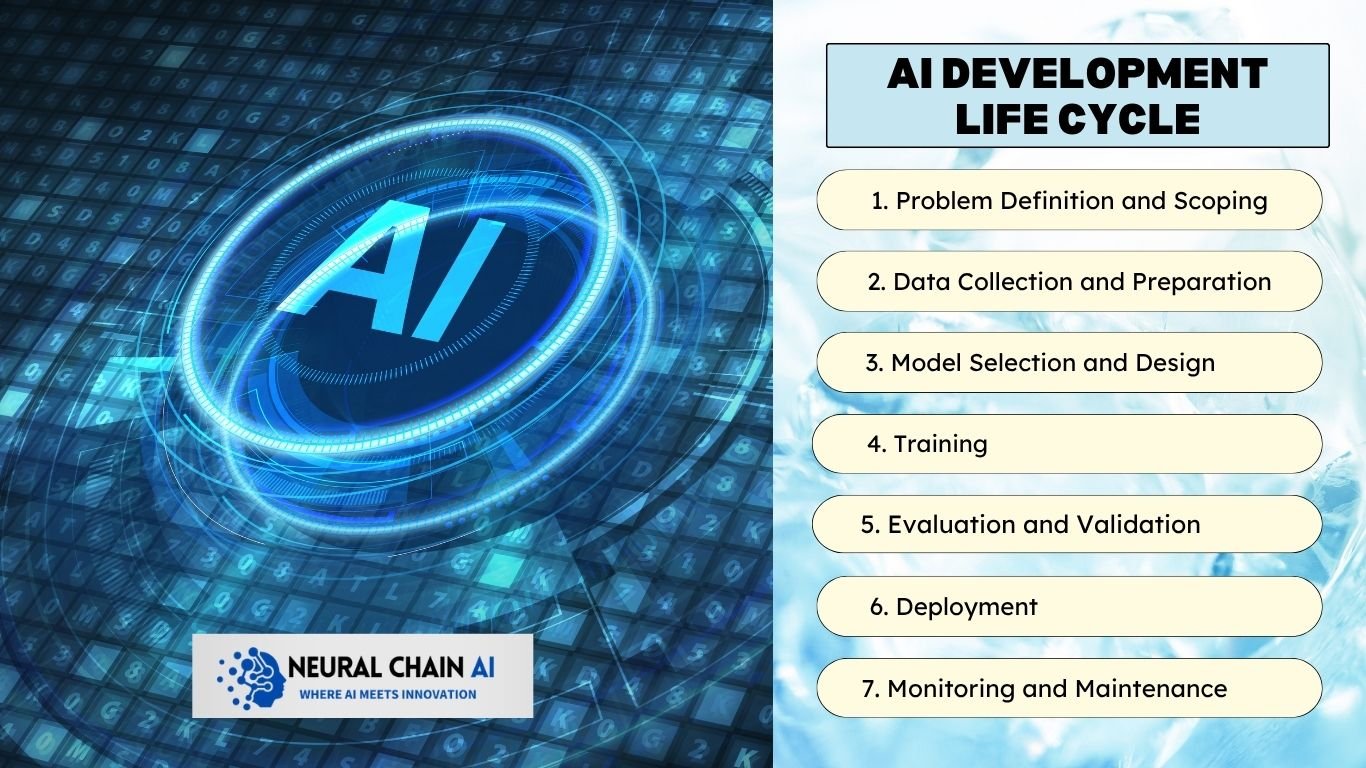
Below are the seven stages that carry a project from idea to steady operation. Read them as a loop, not a ladder. Each stage feeds the next, and any stage can send you back.
1. Problem Definition and Scoping
Everything downstream inherits the quality of this stage. The goal is to name the business problem in plain terms, then decide whether AI is even the right tool for it. Many problems are solved better by a rule, a report, or a fixed workflow. Reaching for a model when a simpler answer exists wastes months.
Good scoping produces three outputs. A specific decision or task the system will support. A measure of success tied to business value, not just model accuracy. And a rough sense of the data and effort required. If you cannot state how you will know the project worked, you are not ready to leave this stage.
2. Data Collection and Preparation
This is where most of the calendar goes. Teams routinely spend the majority of a project gathering, cleaning, and shaping data. The model gets the headlines. The data does the work.
Collection means pulling from the sources that matter: transaction logs, sensor feeds, documents, customer records. Preparation means handling missing values, removing duplicates, fixing labels, and reconciling formats that never agree. Then comes feature engineering, where raw fields become signals a model can learn from. Weak data cannot be rescued by a strong algorithm. Strong data can make an ordinary algorithm look brilliant.
3. Model Selection and Design
Now the team chooses an approach that fits the problem and the data. A prediction task points toward regression. A sorting task points toward classification. Language and image tasks point toward specific model families. The choice is a trade-off between accuracy, speed, cost, and how much the result needs to be explained to a human.
The temptation is to reach for the largest, newest model available. Often the right answer is smaller. A model that is cheaper to run and easier to interpret frequently beats a heavier one that is slow, costly, and opaque once it is in daily use.
4. Training
Training is where the model learns patterns from the prepared data. The team feeds in examples, the model adjusts, and performance improves across repeated passes. This stage demands compute, patience, and careful tuning of the settings that shape how the model learns.
The main risk here is a model that memorizes its training data instead of learning general patterns. It looks excellent on familiar examples and falls apart on new ones. Guarding against this is a core part of the craft, and it is why the next stage exists.
5. Evaluation and Validation
Here the team tests the model on data it has never seen. The question is simple: does it hold up outside the training set? Accuracy alone is a poor guide. A fraud model that flags nothing can still be right ninety-nine percent of the time, because fraud is rare. So teams use measures suited to the task and, critically, check performance against the business goal set in stage one.
This stage is also where fairness and bias get examined. A model can be accurate overall and still fail badly for a particular group. Catching that before deployment is far cheaper than catching it after.
6. Deployment
Deployment moves the model out of the notebook and into the place where real work happens: an app, a workflow, an internal tool. This is the stage the tidy diagrams rush past in a single arrow. In reality it is the hardest crossing in the whole life cycle, and it deserves its own section below.
7. Monitoring and Maintenance
A deployed model is not finished. The world it learned from keeps changing, and its accuracy decays as a result. This decay has a name: drift. Customer behavior shifts, prices move, new products appear, and the patterns the model trusted stop holding.
Monitoring tracks live performance and raises an alarm when quality slips. Maintenance means retraining on fresh data, and sometimes returning all the way to the model design stage. This is the loop closing. A system without monitoring is not maintained. It is slowly failing in silence.
AI Development Stages At A Glance
| Stage | What happens | Main risk |
|---|---|---|
| Problem definition | Name the business problem, decide if AI fits | Building a model when a rule would do |
| Data collection & prep | Gather, clean, and shape data; engineer features | Weak or biased data |
| Model selection & design | Choose an approach that fits problem and data | Over-reaching for the largest model |
| Training | Model learns patterns from prepared data | Memorizing instead of generalizing |
| Evaluation & validation | Test on unseen data against the business goal | Trusting accuracy alone |
| Deployment | Move the model into real operations | Underestimating the production crossing |
| Monitoring & maintenance | Track live performance, retrain on drift | Silent decay from no monitoring |
The Stage Everyone Underestimates: The Pilot-to-Production Gap
Here is the pattern we see again and again. A team builds a promising model. It scores well in evaluation. Everyone is encouraged. Then it needs to become part of daily operations, and it stalls. Industry surveys have long reported that a large share of AI projects never make it from pilot into full production.
The reason is not the model. The model works. The reason is that a model and a production system are different things. Crossing between them requires work that rarely appears in a life cycle diagram:
- Integration. The model must connect to the real systems where data lives and decisions are made. That plumbing is often harder than the model itself.
- Reliability. A demo can crash without cost. A production system cannot. It needs to handle load, recover from errors, and stay available.
- Latency and cost. A model that takes ten seconds and pennies per call in testing may be unusable at production volume. The economics have to work at scale.
- Trust and adoption. If the people meant to use the output do not understand it or believe it, they route around it. A technically perfect system that no one uses returns nothing.
- Ownership. Someone has to own the system after launch: watch it, retrain it, fix it. Without a clear owner, it drifts until it is quietly abandoned.
The same gap decides winners in hardware-heavy AI too. This is the reason, the top physical AI and robotics companies are ranked by deployed operating hours and paid commercial work rather than demo footage.
At NeuralChainAI, we treat the life cycle as production-first, not model-first. The question is never only “can we build a model that scores well.” It is “can we run this in the client’s real environment, day after day, with their team confident enough to depend on it.” Planning for that from stage one, rather than discovering it at stage six, is the single biggest predictor of whether a project delivers.
This crossing is also where most teams first weigh whether hiring an AI consultant is worth it, because experience with this exact gap is what they would be buying.
Roles Across The Life Cycle
No single person carries a project through every stage. AI development is a team sport, and knowing who owns what prevents the handoff failures that stall projects.
- Business or product owner. Defines the problem, sets the measure of success, and keeps the work tied to value.
- Data engineer. Builds the pipelines that deliver clean, reliable data to the rest of the process.
- Data scientist or ML engineer. Designs, trains, and evaluates the model.
- Deployment or platform engineer. Gets the model running reliably in production and keeps it there.
- Domain expert. Supplies the real-world knowledge that keeps the system honest and useful.
The most common failure is not a technical one. It is a handoff dropped between these roles. A model thrown “over the wall” to an ops team that was never involved rarely survives contact with production. The fix is to keep the people who will run the system in the room while it is being built.
Governance, Risk, and Ethics Run Through Every Stage
Responsible AI is not a final checkbox. It is a thread that runs through the whole life cycle. Bias can enter through the data in stage two, hide through training in stage four, and only reveal itself in production in stage seven. Catching it demands attention at each point, not a single review at the end.
The habits that matter across the board.
- Keep a record of what data trained the model and why key choices were made, so results can be explained and audited later.
- Check for fairness across the groups your system affects, not just overall accuracy.
- And confirm that data handling meets the privacy rules that apply in your region.
For teams in regulated sectors, these are not optional extras. They decide whether a system is allowed to ship at all.
How to Apply The Life Cycle Without Stalling?
Knowing the stages is not the same as running them well. A few principles keep projects moving:
- Start with the smallest problem worth solving. A narrow win that reaches production beats an ambitious one that never ships.
- Plan the deployment before you train. Decide where the model will run and who will own it while you still have room to change course.
- Expect to loop. Budget time for going back to earlier stages. Teams that treat iteration as failure freeze; teams that expect it keep moving.
- Measure business value, not just model metrics. A model that improves accuracy but changes no decision has delivered nothing.
- Involve the end users early. The people who will rely on the output should shape it, not receive it at the end.
AI Development Life Cycle – Closing The Gap
The AI development life cycle is not hard to memorize. Problem, data, model, train, evaluate, deploy, monitor. The hard part is the crossing that the diagram draws as a single arrow, from a model that works to a system that lasts. That is where value is won or lost.
Teams that succeed do not treat deployment as the finish line. They design for it from the first stage, keep the people who will run the system involved throughout, and expect the loop to send them back more than once. Get that right, and the life cycle stops being a diagram on a slide and becomes a system doing real work.
This guide reads the way it does because it comes from the production side of AI, not the whiteboard. At NeuralChainAI, we are forward-deployed engineers who embed with a company’s own team and work in their real environment, on their real problems, until the system is live and earning its keep. The pilot-to-production gap is not a concept we read about. It is the gap we get paid to close. No deck. No sales pitch. No follow-up unless you ask for one.