An AI readiness assessment scores how prepared your organization is to adopt AI across five areas: data, technology, people, governance, and use cases. This guide gives you an AI readiness assessment framework built on a 20-question checklist, an online scoring tool, benchmark data from Cisco, Gartner, and the US Census Bureau, and typical assessment costs, written for SMB and mid-market teams.
AI use varies sharply by company size. The Census Bureau’s Business Trends and Outlook Survey found that 32% of firms with 100 to 249 employees and 37% of firms with 250 or more employees used AI in the period ending May 3, 2026, while firms with four or fewer employees stayed below 20%. Mid-market companies sit in the middle of that curve, which makes the choice of a first project worth scoring before it is made.
A readiness score gives that choice a basis. It shows which pillar is ready, which needs attention first, and which workflow to start with. The scoring tool in this guide takes about five minutes and runs in your browser.
What an AI Readiness Assessment Measures?
An AI readiness assessment is a structured review of whether the data, systems, people, and rules around a workflow can support an AI system in production. It returns a score for each area and a short list of first moves.
Two levels of assessment exist.
- An organization-wide score gives leadership a baseline.
- A per-workflow score shows whether one specific use case is ready to build.
Run the organization-wide score first, then repeat the 20 questions for each candidate workflow, because the answers change from one workflow to the next.
Why Organizations Score AI Readiness Before They Build?
Cisco’s 2025 AI Readiness Index groups about 13% of organizations as Pacesetters, its most prepared cohort. Pacesetters are four times more likely to move AI pilots into production and 50% more likely to report measurable value from AI. The index scores organizations across several dimensions, including strategy, data, governance, and talent, which map directly to the five pillars in this guide.
Scoring readiness turns a general question about being ready for AI into five numbers and a first move. That is the part leadership teams can act on in the same week.
AI Readiness vs AI Maturity Assessment
Readiness looks at preconditions at a point in time: does the organization have what the first project needs. An AI maturity assessment, built on a model such as the AI maturity model, rates how far an organization has progressed through stages of AI adoption. Readiness comes first and often feeds the maturity score. Organizations with no AI in production start with readiness, and organizations with several live systems benefit from both.
The 5 Pillars of AI Readiness at a Glance
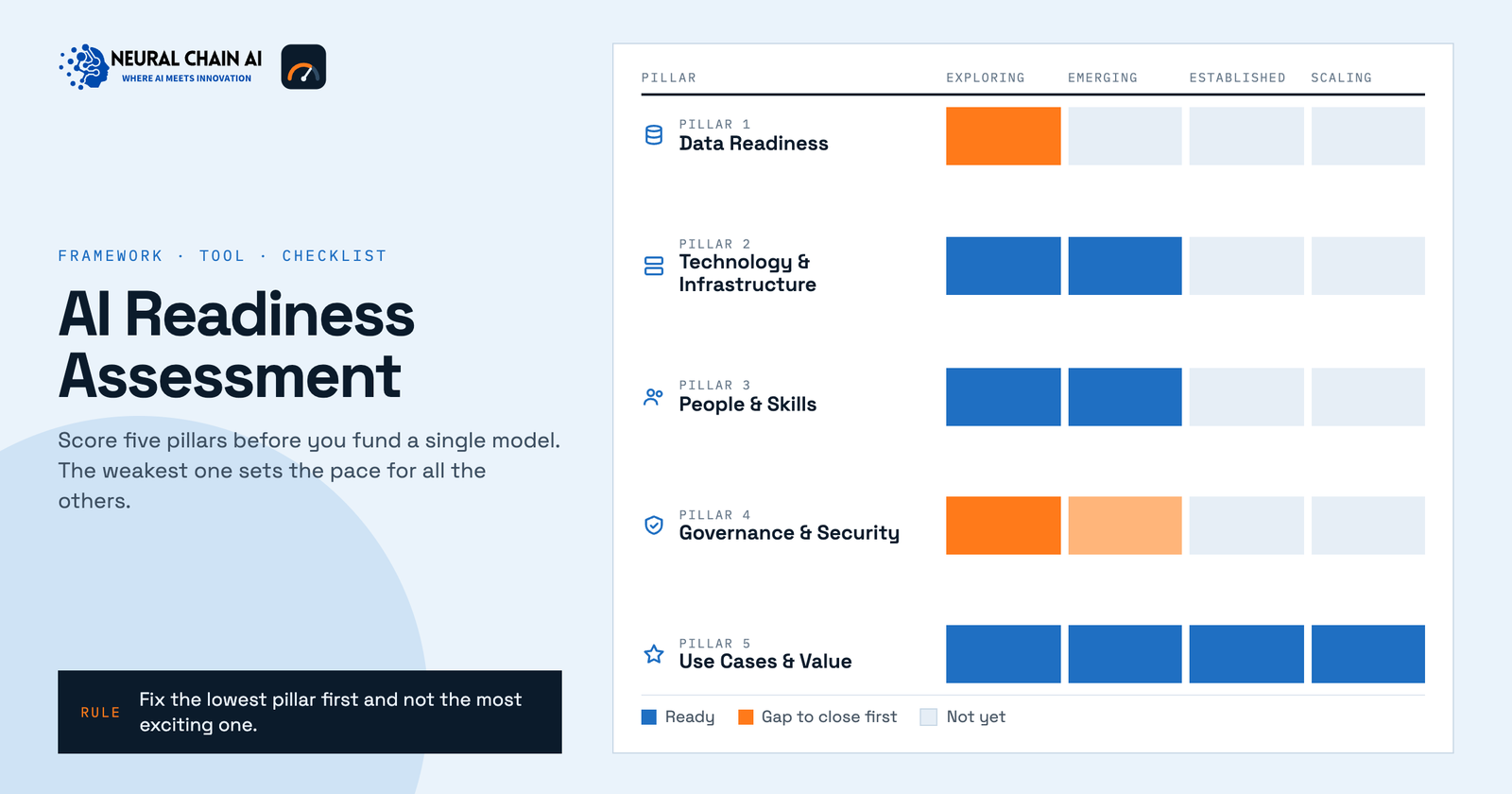
The framework groups the 20 questions into five pillars. Each pillar names the evidence a reviewer would ask to see and the person who usually owns it.
| Pillar | What it covers | Evidence to gather | Usual owner |
|---|---|---|---|
| 1. Data readiness | Where the data lives, who owns quality, how access is controlled | A data map for one workflow, an access policy, a labelled sample of past cases | Head of data or operations |
| 2. Technology and infrastructure | Integration routes, where AI workloads run, identity, logging | A system inventory with API status, a hosting decision, a sample audit log | IT lead or CTO |
| 3. People and skills | Sponsorship, reviewer capacity, team preparation | A named sponsor, a named domain reviewer, a change note to staff | COO or business owner |
| 4. Governance and security | Policy, regulation, review levels, vendor checks | An AI use policy, a review level per action type, a vendor review checklist | Compliance or security lead |
| 5. Use cases and value | Candidate workflows, baselines, metrics, a path to production | A baseline sheet per workflow, an agreed payback threshold, an owner and budget for production | Executive sponsor |
AI Readiness Assessment Framework: 20 Questions Across 5 Pillars
Score each statement from 0 to 3. A 0 means not started, 1 means ad hoc, 2 means defined and written down, and 3 means operating and reviewed. A pillar total runs from 0 to 12 and the overall total runs from 0 to 60. Use this checklist on paper, or enter the same answers in the online tool below.
Pillar 1: Data Readiness
Data readiness covers whether an AI system can reach accurate, permitted data for the workflow. In Gartner’s survey (July 2024) 1,203 data management leaders found that 63% of organizations lacked confidence in their data management practices for AI, and Gartner’s first recommendation is to align data sources to specific AI use cases.
- The data an AI use case needs sits in systems you can query or export, such as your CRM, ERP, or document store.
- Someone owns data quality for those sources, and you can name the last time it was checked.
- Access rules are documented, including who can see customer and employee records.
- A sample of past cases with known-correct outcomes exists for the workflow you would automate first.
Pillar 2: Technology and Infrastructure
Technology readiness covers whether core systems can exchange data with an AI system and where that system will run.
- Core systems have APIs or export routes an AI system can read from and write to.
- You have decided where AI workloads run (vendor cloud, your own tenant, or on-premise) and a named person approved that decision.
- Single sign-on and role-based access cover the systems an AI agent would touch.
- Logging and monitoring can record each action an AI system takes.
Pillar 3: People and Skills
People readiness covers who sponsors the work, who judges output quality, and how the team hears about the change.
- A named executive sponsor owns the AI initiative and its outcome.
- At least one person on staff can judge output quality in the target workflow.
- Staff who will work alongside AI know what changes and what stays with them.
- The pilot team has weekly time allocated to the work.
Pillar 4: Governance and Security
Governance readiness covers the rules that let a team approve AI use with confidence. NIST’s AI Risk Management Framework organizes this work into four functions, Govern, Map, Measure, and Manage, and gives the policy and review questions below a useful structure.
- An AI use policy exists that covers approved tools, data allowed in prompts, and review requirements.
- You know which privacy and sector regulations apply to your data and AI use, and who checks them.
- Each AI action type has a defined review level: approve first, sample afterward, or autonomous.
- A vendor review process covers AI suppliers, including data retention, training on your data, and subprocessors.
Pillar 5: Use Cases and Value
Use-case readiness covers whether the first project has a measured baseline, an agreed metric, and a route to production.
- A short list of candidate workflows exists, each with a measured baseline for volume, handling time, and cost.
- Success metrics and a payback threshold are agreed before the build starts.
- The first use case is bounded to one workflow, one team, and one system of record.
- A path from pilot to production exists, with a budget, an owner, and an integration plan.
What to Do First, by Lowest Pillar?
Data readiness. Map the records one workflow needs, who owns them, and where the access rules live. Gartner recommends aligning data sources to specific AI use cases, and a one-page data map for the first workflow is the practical form of that advice.
Technology and infrastructure. List the systems an AI system would read from or write to, and confirm each has an API or export route. Then decide where workloads run. Teams in legal, financial services, insurance, and healthcare often choose private, self-hosted deployment, where the stack runs inside their own infrastructure so records stay on their network.
People and skills. Name an executive sponsor and one domain reviewer for the first workflow, give each a weekly time allocation, and brief the team on what changes and what stays with them.
Governance and security. Write a one-page AI use policy covering approved tools, data allowed in prompts, and review requirements. Assign a review level to each action type: approve first, sample afterward, or autonomous.
Use cases and value. Baseline three candidate workflows by monthly volume, handling time, and cost. Choose the one with the clearest payback and agree the success metric before building.
What an AI Readiness Assessment Costs?
Price depends mostly on scope. Provider-published ranges for 2026 fall into four bands.
- Entrans lists free platform self-assessments at 1 to 4 hours of internal time, and puts the full range for AI readiness assessments at $0 to $500,000 or more.
- Justin Harris, a Las Vegas AI consultant, lists a standalone small-business readiness audit at $1,500 to $2,500 over 1 to 2 weeks.
- Pearl Technology offers a fixed-price mid-market assessment from $15,000 over 15 days.
- Alice Labs estimates a single-function mid-market assessment at $20,000 to $40,000 over 4 to 6 weeks.
Business-unit count, data complexity, and the depth of evidence checking move the price within each band. These figures come from the providers’ own pages, so treat them as market signals rather than quotes.
AI Readiness Assessment Tool: Score Yourself in 5 Minutes
The scoring tool below applies the same 20 questions. It adds up your answers, shows the score for each pillar, names your lowest pillar, and suggests a first move. Your answers are processed in your browser, and only an anonymous completion count is recorded for site analytics.
AI Readiness Scorecard
20 statements, scored 0 to 3. Takes about five minutes. Your answers are processed in your browser, and only an anonymous completion count is recorded for site analytics.
0 of 20 answered
Your AI readiness score
Take your score into a conversation. In a free 30-minute strategy session, a NeuralChain AI consultant goes through your pillar scores, ranks your first workflows, and recommends where the AI should run.
How to Read Your AI Readiness Score?
- 0 to 19, Foundation. Most of the work ahead is groundwork, and knowing that early saves budget. Pick one workflow, write down its data sources and owner, and name a sponsor. A short readiness sprint on that single workflow is the right first investment.
- 20 to 34, Building. Several pillars are defined and a few are still ad hoc. Raise your lowest pillar to a 2 on every question, then start a pilot on the workflow with the cleanest data.
- 35 to 47, Ready for a first deployment. The basics are in place. Choose one bounded workflow, set the review level for each action type, and agree the payback threshold before the build starts.
- 48 to 60, Ready to scale. Your foundations support more than one workflow. Standardize the scoring, add a reviewer rota, and sequence the next three workflows by payback.
Read the pillar scores alongside the total. A score of 40 with a 3 in governance has a clearer first move than a score of 40 spread evenly across the pillars.
A scored self-assessment such as the tool above is a sound first step because it narrows what a paid review needs to cover. NeuralChain AI starts with a free 30-minute strategy session where we go through your scorecard and rank your first workflows.
Want a second opinion on your score? NeuralChain AI works with SMB and mid-market teams, including regulated industries, to turn readiness results into a first deployment: scoring the workflow, choosing where it runs, and building it inside your own infrastructure. Our AI transformation consultant service begins with a strategy session where you leave with your lowest pillar named and your first workflow ranked.