
A Forward Deployed Engineer (FDE) is a senior engineer who embeds inside a customer’s environment to deploy and stabilize software — typically AI systems — into production. The role was pioneered at Palantir and has become the AI industry’s most-hunted job in 2026, with OpenAI, Anthropic, Google, Salesforce, and Palantir hiring aggressively at $500K+ for senior talent. Here we cover exclusive details on what FDEs do, how they differ from adjacent roles, what they cost, and how to decide if you actually need one.
If you’ve spent time in enterprise AI hiring circles, you’ve noticed every job board filling up with the same role: Forward Deployed Engineer. The title has gone from Palantir-specific jargon to the most-hunted job in enterprise technology in barely two years. The pay is staggering, the supply is thin, and most engineering leaders are still figuring out whether they actually need one.
What is a Forward Deployed Engineer?
A Forward Deployed Engineer is a senior software engineer who works directly inside customer environments — not from a vendor’s headquarters — to deliver working software in production. Where a traditional product engineer ships code into a platform and stops, and a consultant produces analysis and recommendations, an FDE does both: scopes the customer’s problem, designs the architecture, writes the production code, debugs what breaks in the customer’s environment, and stays engaged until the deployment moves a business metric.
The defining characteristics that have emerged across major employers:
1. Customer-embedded:
FDEs work alongside the customer’s team, often on-site for portions of the engagement. Up to 50% travel is common.
2. Full-stack Ownership:
Responsibility for the entire deployment — infrastructure, integration, user-facing behaviour, and the messy parts like legacy systems and compliance.
3. Outcome-bound:
The engagement isn’t done at code merge. It’s done when the customer renews or hits a measurable business goal.
4. Product Feedback loop:
What FDEs learn in the field flows back into the vendor’s product roadmap.
FDE or Forward Deployed Engineer – Where the role came from?
The FDE role was pioneered at Palantir more than 15 years ago. Its customers — intelligence agencies, banks, hospitals — needed engineers on-site who could build custom workflows on top of the platform. The model spread slowly through the 2010s.
AI changed everything. When generative AI moved from demo to production in 2023–2024, every AI company hit the same wall: models worked in sandboxes but broke against customer environments. The consultancies then followed the software vendors. On 28 April 2026 EY launched its own Forward Deployed Engineer roles across the UK and Ireland, placing senior engineers inside client delivery teams on work such as insurance underwriting, claims processing, and bank lending.
What does an FDE actually do?
The day-to-day work has converged on a recognizable pattern in 2026:
1. Discovery and Scoping:
FDEs spend their first weeks on an engagement embedded with the customer’s team, understanding the business problem, the data, the constraints, and the politics. They map use cases to platform capabilities and identify where custom work is required.
2. Architecture and Design:
They design the integration and deployment architecture — how the customer’s data will flow into and out of the AI system, how authentication and authorization will work, what monitoring and evaluation infrastructure is needed.
3. Production Code:
FDEs write the integration code that connects the AI platform to the customer’s specific systems. This includes adapters for legacy databases, SSO integration, data pipelines, custom prompts and agent workflows, retrieval-augmented generation (RAG) implementations, and evaluation harnesses.
4. Production Support:
Once the system is live, FDEs maintain it through the messy realities of production AI: model drift after provider updates, hallucinations triggered by edge-case inputs, latency spikes under real load, and the regression risk that comes with prompt and configuration changes. They build evaluation suites that catch these issues before they reach users.
5. Customer-facing Leadership:
FDEs serve as the technical face of the vendor to the customer’s executives. They run executive briefings, lead steering committee meetings.
6. Product Feedback:
Everything they learn in the field — the patterns that work, the edge cases that break, the customer requests they can’t fulfill — flows back to the vendor’s product organization. This feedback loop is the strategic value of the role, and the reason vendors are willing to pay so much for it.
Who is Hiring Forward Deployed Engineers in 2026?
The list of companies hiring FDE-equivalent roles reads like a roster of the most consequential enterprise technology companies:
| Category | Companies |
|---|---|
| Frontier AI labs | OpenAI, Anthropic, Google DeepMind |
| Hyperscalers | Google Cloud, AWS, Microsoft |
| Established AI platforms | Palantir, Salesforce, Databricks, Snowflake, Scale AI |
| AI infrastructure | Cohere, Decagon, Mistral, Adobe |
| Enterprise platforms | Rippling, Ramp, Intercom |
| Big Four consulting | EY (own FDE roles, April 2026); Deloitte, KPMG and PwC (via Salesforce’s FDE Partner Network) |
Specifics vary. Google Cloud opened 59 FDE roles in early 2026 at $127K–$183K base. OpenAI’s mid-level FDEs in San Francisco earn $220K–$280K base. Salesforce now routes much of its FDE demand through vetted partner firms rather than through direct headcount.
What does a Forward Deployed Engineer earn?
In the US in 2026:
- Mid-level FDE total comp: $300K–$450K
- Senior FDE total comp: $500K+
- Senior at frontier AI labs: Can exceed $700K
- Google Cloud FDE base (2026 listings): $127K–$183K
- Senior FDE base across the market: $215K–$310K
- US average base on Indeed (August 2026): $172,583 across 450 postings, spanning $111,114–$268,058
The premium exists because the talent pool is scarce. You need deep AI/ML fluency, production engineering chops, customer-facing skills, and resilience in messy environments, a combination that stays rare. For most companies outside frontier labs and hyperscalers, competing in this band isn’t realistic, which is why the FDE-as-a-service model has grown alongside in-house hiring.
The Integration Wall: Why FDEs exist?
A phrase emerged in 2026: “the integration wall.” It’s the set of problems that block AI deployments from reaching production — and the core problem FDEs are paid to solve.
The wall has five components:
1. Legacy Data Infrastructure
Customer data lives in legacy SQL databases, stale data warehouses, file shares, and SaaS apps with limited APIs.
2. Authentication and Authorization
OIDC, SAML, custom RBAC, proprietary identity systems. The AI system has to plug in cleanly and audit every action.
3. Compliance Constraints:
HIPAA, SOC 2, GDPR, regional data residency. None of this is solved by a better model.
4. Production Politics:
Getting production credentials from a customer’s security team is a months-long process requiring social skill, not just engineering.
5. Drift and Evaluation:
Once live, model provider updates change behaviour. Without evaluation infrastructure, deployments degrade silently.
No amount of better prompt engineering fixes these. They require engineers who can work inside the customer’s environment and ship integrations that account for all five.
Forward Deployed Engineer vs Other Roles
Adjacent roles overlap with FDE work. Here’s how they actually differ:
| Role | What they ship | Where they work | Outcome ownership |
|---|---|---|---|
| Forward Deployed Engineer | Production code + working deployment | Embedded with customer | Until renewal or business metric hit |
| Solutions Engineer | Demos, POCs, technical sales support | Vendor HQ, pre-sales | Closing the deal |
| Implementation Consultant | Configurations, training | Customer site, time-boxed | Project completion |
| ML Engineer | Models, training pipelines | Vendor HQ | Model performance |
| Customer Success Manager | Relationship, adoption | Remote or on-site | Customer retention |
The clearest distinction: an FDE is the only role accountable for both production code and customer outcome. Solutions Engineers close deals and hand off. Implementation Consultants finish projects and exit. FDEs stay until the customer renews.
FDE or Forward Deployed Engineer: Skills Required
Job descriptions converge on a consistent profile.
1. Technical:
FDE technical skills require 5–10+ years production engineering; LLM application development (RAG, agentic workflows, prompt engineering at scale); eval engineering for automated regression testing; multi-cloud production experience; data engineering fundamentals; integration work across APIs and auth protocols.
2. Customer-facing:
Executive communication, technical empathy, conflict navigation, steering committee facilitation.
3. Operational:
Travel flexibility, ambiguity tolerance, bias to ship — a working v0.5 beats a perfect v2.
The combination is the hard part. Most engineers strong on the technical side aren’t comfortable with executives. Most consultants comfortable with executives can’t ship production code. The FDE is the rare professional who does both.
How AI specifically changed the FDE role?
The pre-AI FDE — the Palantir model — was already a hybrid role, but the integrations were stable. The AI FDE has an extra dimension: the system they ship is non-deterministic and changes underneath them. When OpenAI or Anthropic updates the model, behaviour shifts. When customer data evolves, prompts drift. When users find edge cases, the system fails in ways unit tests don’t catch.
This is why modern FDE job descriptions include evaluation engineering as a non-negotiable. The role isn’t done at deployment; it’s done at renewal. Between those points, the FDE manages a system whose internals are partially opaque and whose outputs degrade silently without active monitoring.
When do you actually need a Forward Deployed Engineer?
Not every AI project needs an FDE. The premium is justified only when specific conditions are present.
You likely need FDE capability if:
- You’re deploying AI into a customer environment you don’t fully control
- Success depends on integration with legacy or complex systems
- Regulatory or compliance constraints shape what’s possible
- The engagement requires sustained ownership through drift and platform updates
- Silent failure is unacceptable due to financial, reputational, or regulatory stakes
You probably don’t need a full FDE if:
- The deployment is internal-only and you control the environment
- Integration is well-bounded and one-time
- Your team already combines senior production engineering with AI/ML fluency
- The risk of silent degradation is low
The most common alternative to building an FDE practice in-house is engaging a nearshore AI consulting partner that supplies the same model — senior, same-time-zone engineers embedded with your team — without the multi-quarter recruiting cycle.
FDE Capability- Paths to Follow
If you need FDE capability, two paths exist.
Path 1: Hire In-house:
Compete with Google, OpenAI, Anthropic, and Salesforce for a small pool of senior engineers. Compensation: $300K–$500K+. Time-to-fill: 4–9 months. Ramp time: 60–120 days.
Path 2: Engage an FDE team through a Consultancy:
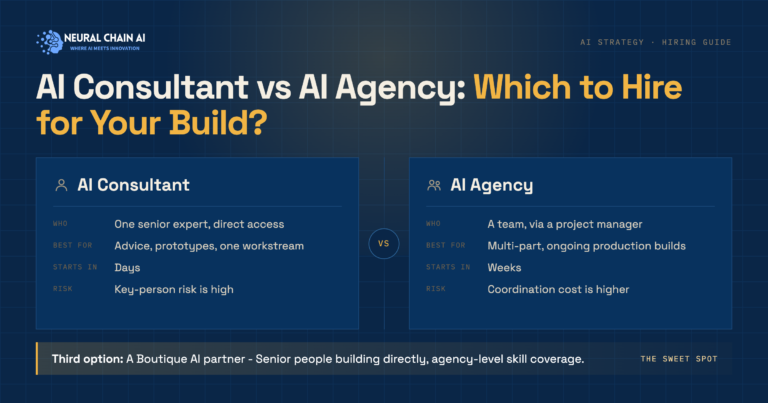
Partner with a firm that already has senior AI engineers with deployment experience. Engagement starts in days. Costs scale with project size. The trade-off: the engineers aren’t yours long-term.
The vendors themselves now push buyers down this path. Salesforce opened its FDE Partner Network on 15 April 2026, extending internal FDE training and direct product-team access to Accenture, Deloitte, IBM Consulting, KPMG, PwC, Slalom, and more than 30 other firms. Salesforce says network members had already driven a third of successful Agentforce implementations, and it ties partner incentives to agents reaching production rather than to hours billed. For a buyer, that means the company that popularised the role expects most production AI work to ship through partners.
The economics increasingly favor Path 2 for companies outside the frontier-lab tier. The talent war has compressed availability and inflated comp; the same skill set is available through specialized consultancies at a fraction of the all-in cost.
Why a Consulting Services Partner often wins this Comparison?
AI Consulting Services vs In-house AI Team: What Works Best? This is an interesting question. For most companies outside the frontier-lab tier, the real decision isn’t about engineers — it’s whether to take on permanent headcount for capability you may only need intermittently.
A consulting services partner converts a fixed-cost talent problem into a variable-cost capability, with the added advantages of multi-engagement pattern reuse, faster ramp, and no recruiting overhead.
For most companies, the question isn’t whether to build the FDE capability — it’s when to Hire FDE Consulting partner instead. The work that ships in months through a seasoned partner can take a year of recruiting and ramp from a cold internal start, by which time the strategic window has usually closed. A consulting firm also absorbs delivery risk the internal hire cannot, with the consequences sitting on the firm’s balance sheet rather than the client’s runway.
Frequently asked questions
Here is a list of FAQs that can guide to learn more details about FDEs or Forward Deployed Engineers.
Forward Deployed Engineers or FDEs: What next?
The Forward Deployed Engineer role isn’t new. It’s a 15-year-old Palantir model that AI deployment has elevated into the most sought-after job in enterprise technology. Every major AI lab, hyperscaler, and now the Big Four are competing for the same scarce talent at $500K+ for senior engineers.
For most companies outside that tier, the practical question isn’t whether to hire an FDE — it’s how to get FDE capability without competing in that market. The answer is usually a consulting partner. NeuralChainAI’s Hire Forward Deployed Engineers service provides senior AI engineers who embed in enterprise environments, ship production AI, and stay through stabilization.
Still deciding between hiring an FDE and engaging a Consulting team?
Three questions usually decide it for our clients:
- Do you have 4–9 months to wait for a hire?
- Can you compete with frontier-lab compensation
- Will this capability be needed continuously, or in bursts?
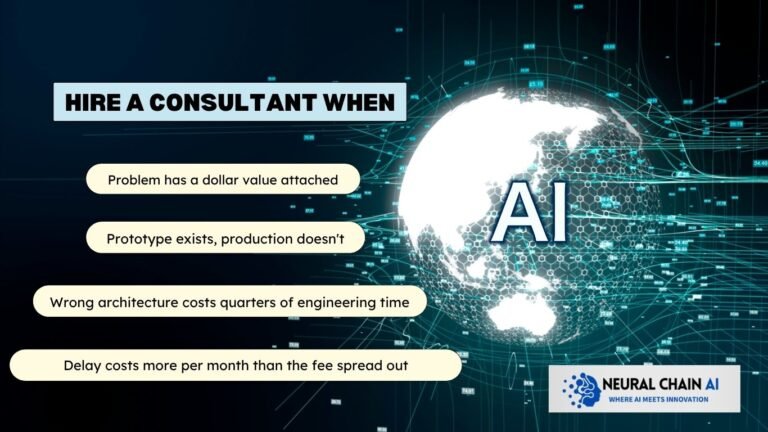
If any of those answers gives you pause, a consulting engagement is usually the better path.
What are you waiting for? Book a 45 minute architecture review to walk through your specific situation.
Disclaimer: This article reflects publicly available information on as is basis. Salary ranges, hiring volumes, and company practices cited may shift as the market evolves. Compensation figures reflect US market conditions and vary by location, seniority, and offer. This guide is for informational purposes only and does not constitute hiring, legal, or financial advice.Verify the current statistics for your situation and seek qualified advice before acting.