Every executive evaluating artificial intelligence eventually hits the same fork in the road: should we hire AI consultants or build an internal AI team? The answer isn’t universal, but the wrong choice can cost a company 12 to 18 months of momentum and millions in sunk salaries. This guide breaks down both paths with the data, trade-offs, and decision frameworks that actually matter in 2026.
AI Consultant vs In-House Team: The Real Cost Comparison
A senior machine learning engineer runs $168,000–$221,000 in base salary nationally, per Motion Recruitment’s 2026 Tech Salary Guide, and $240,000–$380,000 at venture-backed AI companies, per Recruits Lab’s 2026 AI Hiring Report. Neither figure includes equity, benefits, or recruiting fees. A functional in-house AI team typically requires at least four roles (an ML engineer, a data engineer, an MLOps specialist, and a product-aware AI lead), pushing fully loaded annual costs past $1.2 million before a single model ships to production.
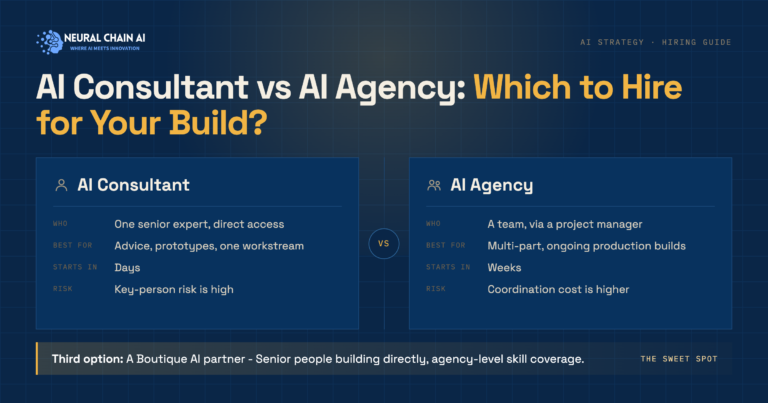
AI consulting engagements, by contrast, generally range from $25,000 for focused proof-of-concept work to $250,000–$500,000 for end-to-end production deployments. The pricing reflects outcomes rather than headcount, and most consulting partners absorb the cost of specialist talent — data scientists, prompt engineers, evaluation leads, and infrastructure architects — that would otherwise require multiple full-time hires.
The harder cost to measure is opportunity cost. A senior AI/ML engineer search runs 8 to 12 weeks with a dedicated recruiter and 14 to 20 weeks without one, per Recruits Lab’s 2026 AI Hiring Report, and a four-role team stacks those searches one after another. Consulting engagements typically deliver a working prototype in 4-8 weeks.
McKinsey’s November 2025 State of AI survey found 88% of organizations regularly using AI in at least one business function, up from 78% a year earlier, yet only 39% attribute any enterprise-level EBIT impact to it and about 6% clear McKinsey’s bar for AI high performers. Six months spent on enterprise generative AI pilots that never reach production costs more than six months of waiting.
So, who actually wins?
In most cases, the right answer to “Which works best – AI consulting or building an in-house team?” is “both, in sequence.” However, the order matters. In fact, getting it wrong is the most expensive mistake mid-market companies make on the path to operational AI.
Below, we break down the real cost of each path, when AI consulting services make sense, when an in-house AI team is the right bet, why most successful companies use a hybrid model, and a four-question framework to decide what fits your business.
TL;DR
- If you need a production AI system in under six months, hire a consultant first. Building an in-house team from scratch will burn $400K+ on salaries and recruiting before anyone agrees on what to ship.
- If you’ve already shipped one production model, hire in-house next. Consulting ROI drops sharply once you have a clear roadmap and a use-case backlog — at that point you’re paying premium rates for work your own team can do.
- The failure mode of consultant-first is vendor lock-in. The failure mode of in-house-first is “we’re still hiring” twelve months later.
- Hybrid wins most often — a consulting partner ships the first model and stands up MLOps for the first 6 months; the in-house team takes ownership as the system scales.
AI Consultant vs In-House Team: Side-by-side Comparison Table
| Criterion | AI Consultant | In-House Team |
|---|---|---|
| Time to first production model | 8–16 weeks | 9–18 months (hire + ramp + first ship) |
| 24-month total cost | $400K–$1M (project-based) | $1.5M–$3M (3 FTEs fully loaded + tooling) |
| Senior IC time on your problem | High (small senior team, no junior staffing pyramid) | 100% — your team, your problem |
| Talent retention risk | Their problem | Yours (ML engineers average 18-month tenure) |
| Build vs buy decision quality | High — cross-client pattern recognition | Medium — single-context view |
| Roadmap independence | Low until handoff (risk of soft lock-in) | High — owned from day one |
| Vendor / tooling relationships | Comes with their existing book | Built from zero |
| Org-change muscle | Limited — they leave eventually | High — they live with the consequences |
When AI Consulting Services Make Sense?
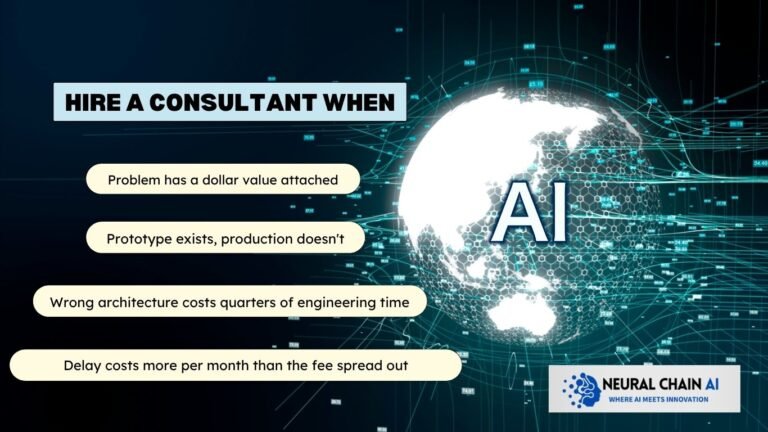
First, picture your situation. You haven’t shipped a single production model yet. Additionally, you’re under 500 employees — somewhere between Series A and a profitable mid-market business. Meanwhile, your exec team has a list of “AI ideas” that nobody has prioritized or pressure-tested. In fact, this is the most common starting position. Moreover, it’s the one where consultant-first pays for itself five times over.
Here’s the trap: hiring before you have a roadmap. To start, the senior ML engineer market is a knife fight. Furthermore, your first hire will cost $210K–$370K all-in once payroll tax, benefits, GPU compute, data tooling, and recruiting fees stack onto base pay.
If you want the full picture before you post a role, we broke down the Canadian numbers in detail — salary bands, contractor rates, total cost of ownership, and the post-AIDA compliance landscape — in our companion guide on How to hire AI automation experts in Canada and what it really costs?
Then, their first three months will be data plumbing, not models. And if your first use case is wrong, they’ll either ship something useless or quit. In that case, you’ll be replacing them inside eighteen months. By contrast, a consultant lets you de-risk the roadmap before you commit a single FTE.
Here’s the signal you’re in this column. Your CEO can articulate the “why” of AI — competitor pressure, investor pressure, margin compression. However, nobody internally can name three use cases ranked by ROI and feasibility. As a result, a 4–6 week workshop or feasibility study answers that question for $35K–$75K. By contrast, the same answer from an unguided in-house build costs a year and a million dollars.
So we can say, Consulting is the right call when speed, specialized expertise, or uncertainty dominate the decision.
Companies that benefit most from this model usually fall into one of three categories.
- The organizations that need a clear AI roadmap before committing capital. A consulting partner can audit existing data infrastructure, identify the highest-ROI use cases, and produce a costed implementation plan in weeks rather than quarters.
- Businesses that need production-grade AI in a specific domain — retrieval-augmented generation, agentic workflows, computer vision, document intelligence — without the time to recruit specialists who have done it before. Standing up open-source enterprise search platforms like Onyx is a typical example: the platform is free, but the connector, ACL, and deployment work is exactly the specialist effort a domain partner absorbs. AI Consulting Services like NeuralChainAI work across dozens of deployments per year, which compresses the learning curve an internal team would have to climb from scratch.
- Companies where AI is a strategic enabler but not the core product. A logistics firm, law practice, or healthcare provider rarely needs a permanent twelve-person AI organization; they need reliable systems that work, are monitored well, and improve continuously.
When Building an In-house AI Team Is the Right Bet?
Now consider a different situation. You already have at least one production model running. For example, it might be a recommender, a churn classifier, or a basic computer vision pipeline. Additionally, you’re 500+ employees with a data engineering function. Your AI use cases also sit in deep domain territory. As a result, a consultant would need four months just to learn your data model. In this case, bringing a consultant on top of a capable in-house team usually creates friction, not leverage.
Similarly, you’re in this column if data sensitivity rules out external access. For instance, this applies to HIPAA-covered patient records, source-of-truth financial data, defense, or legal privilege. In those cases, the procurement and security overhead alone wipes out a consultant’s speed advantage.
Here’s the signal. You can already answer the question “what’s your next AI use case, and why that one?” Moreover, you have a backlog. In other words, your constraint is execution capacity, not direction. Therefore, hire an ML engineer and a data engineer first. Then, bring in a consultant only as a surgical specialist — for example, an MLOps stand-up or one tricky modeling problem — once the team is shipping.
Building internally makes sense when AI is the product, not a feature. If your competitive advantage depends on proprietary models, novel architectures, or data flywheels that compound over years, you need the institutional knowledge that only full-time staff can develop.
In-house teams also win on three structural fronts:
- Deep familiarity with internal systems,
- Faster iteration on long-lived products, and
- Direct ownership of sensitive data pipelines.
For companies in regulated industries — banking, defense, or healthcare research — that ownership is often non-negotiable.
The honest trade-offs are recruiting difficulty, retention costs, and ramp time. The AI talent market remains tight, attrition runs high, and even strong hires need three to six months to deliver meaningful output. Smaller companies often underestimate how much engineering leadership bandwidth an internal AI function consumes.
In-house also requires building or buying the supporting stack: evaluation pipelines, observability, vector stores, prompt management, model gateways, and fine-tuning infrastructure. None of this is glamorous, and all of it is expensive to do well.
Hiring senior AI talent for production deployments? Learn more in our detailed guide: What Is a Forward Deployed Engineer? Role, Salary & Hiring Guide
The Hybrid Model: Why Smart Companies Choose Both?
In practice, most mid-market companies don’t end up with a binary answer. Instead, what works — and what the strongest AI organizations all converged on — is a phased hybrid.
First, months 0–6. A consultant ships the first production model. Initially, a workshop or feasibility study sets the roadmap. Then, a 90-day pilot delivers a working artifact, MLOps backbone, and documentation. By month 6, you have one model in production, one repeatable pipeline, and a clear next-three-quarters plan.
Next, months 6–12. Now you hire the first senior ML engineer. Critically, the model and pipeline are already in hand. As a result, they inherit a working system instead of starting from scratch. Furthermore, onboarding time drops from months to weeks. Meanwhile, the consultant transitions to part-time advisory or specific surgical engagements.
Finally, months 12–24. The in-house team scales. Specifically, you hire two to three more engineers, an ML platform person, and possibly a fractional CAIO for exec-level governance. By this point, the consultant is on retainer or called only when needed.
Here’s why this works. Essentially, it inverts the standard failure modes.
- The consultant-first failure — vendor lock-in — is prevented by the explicit handoff and engineer hire.
- The in-house-first failure (“we’re still hiring”) is prevented because the first hire arrives into a working system.
Additionally, the cost curve is cheaper than either pure option over 24 months. That’s especially true once you account for the cost of waiting.
AI Consulting Services vs. In-House Team: Hybrid Model Wins
The most effective AI adopters in 2026 rarely choose one path exclusively. They use consulting partners to ship the first three to five production systems — accelerating learning, de-risking architecture decisions, and proving ROI to stakeholders — while gradually building an internal core team that takes ownership over 12-18 months.
This model captures the speed and specialist depth of consulting without surrendering long-term control. It also gives internal hires something rare and valuable: a working system to inherit, complete with documentation, evaluations, and operational playbooks, instead of a blank repository and a vague mandate.
NeuralChainAI structures most of its engagements around this transfer-of-ownership principle: deliver working AI, then enable the client’s team to run and extend it.
Companies that follow this pattern typically reach AI maturity in roughly half the time of pure in-house builders, and at 30 to 50 percent lower total cost over a three-year horizon.
AI Consultant or In-House Team: A Simple Decision Framework
First, score each question 1 (strongly no) to 5 (strongly yes). Then, total your score at the end.
- Is AI core to your product, or an enabler of it?
- How urgent is the first production deployment?
- Do you already have the data infrastructure AI requires?
- Will the system need to evolve continuously after launch?
- Have you shipped at least one production ML model in the last 18 months?
- Do you have a data engineering function with stable pipelines?
- Is your first AI use case obvious, validated, and owned by a business stakeholder?
- Can you actually hire a senior ML engineer in 60 days for your comp band and region?
- Will your AI roadmap need 5+ distinct use cases over the next 24 months?
- Is your data so IP- or compliance-sensitive that external access is a non-starter?
- Do you have an exec sponsor who owns AI at the C-suite level (not just IT)?
- Are your data pipelines stable enough that an ML hire won’t spend month one debugging plumbing?
Now interpret the score.
Score 8–18: Consultant-first. You don’t have the substrate to absorb an ML hire yet.
Score 19–29: Hybrid. Use a consultant for the first model and 6 months of MLOps; in-house owns scale.
Score 30–40: In-house first. Bring consultants in as surgical specialists for specific problems.
The companies that struggle most aren’t the ones who picked the “wrong” model. They’re the ones who picked without clarity on these questions and ended up paying twice — once for the failed in-house attempt, and again for the consultants who eventually cleaned it up.
For most mid-market and enterprise companies, the best answer in 2026 is hybrid: ship fast with experienced partners, build the durable team in parallel, and own the outcome long-term.
AI Consulting Services vs. In-House Team: Case Studies (anonymized)
Case 1: Mid-market manufacturer ($200M revenue)
First, they hired a senior ML engineer. Then they spent 9 months building data pipelines on legacy SCADA systems before the first model attempt. At month 11, the engineer left. Crucially, he was burnt out with no shipped wins to put on a CV. As a result, they started over with a boutique consultant. Within 14 weeks, a predictive maintenance model shipped. Now they’re hiring engineer #2 — but this time the engineer inherits a working model, an MLOps pipeline, and a roadmap.
Lesson: in-house-first cost them a year, $400K in burned comp, and one good engineer’s career goodwill.
Case 2: Healthcare SaaS ($50M ARR)
Initially, they had a senior ML engineer who’d shipped a working recommender. Then they hired a consultancy for a clinical NLP use case. However, the in-house engineer felt undermined. As a result, he slowed integration, gatekept the data warehouse, and blocked the consultant’s handoff. Six months in, the consultant project was mothballed. Meanwhile, the engineer is still there shipping.
Lesson: bringing a consultant on top of a capable, sponsored in-house team is friction, not leverage. Instead, it should have been an in-house-led project. A consultant should have been retained for one narrow problem (clinical NER), not the whole engagement.
Bring this decision to a 60-minute strategy session
60 minutes, one question, a written 1-page action plan you can take to your exec team. No sales pitch, no slides. Free for qualified buyers.